

Bagågraven Travel Guide
Free Guide: A former coastal clay pit turned wild hollow, where Jurassic layers, dinosaur history and Baltic waves meet just north of Rønne on Bornholm.


A brief summary of Bagågraven
A former coastal clay pit turned wild hollow, where Jurassic layers, dinosaur history and Baltic waves meet just north of Rønne on Bornholm.
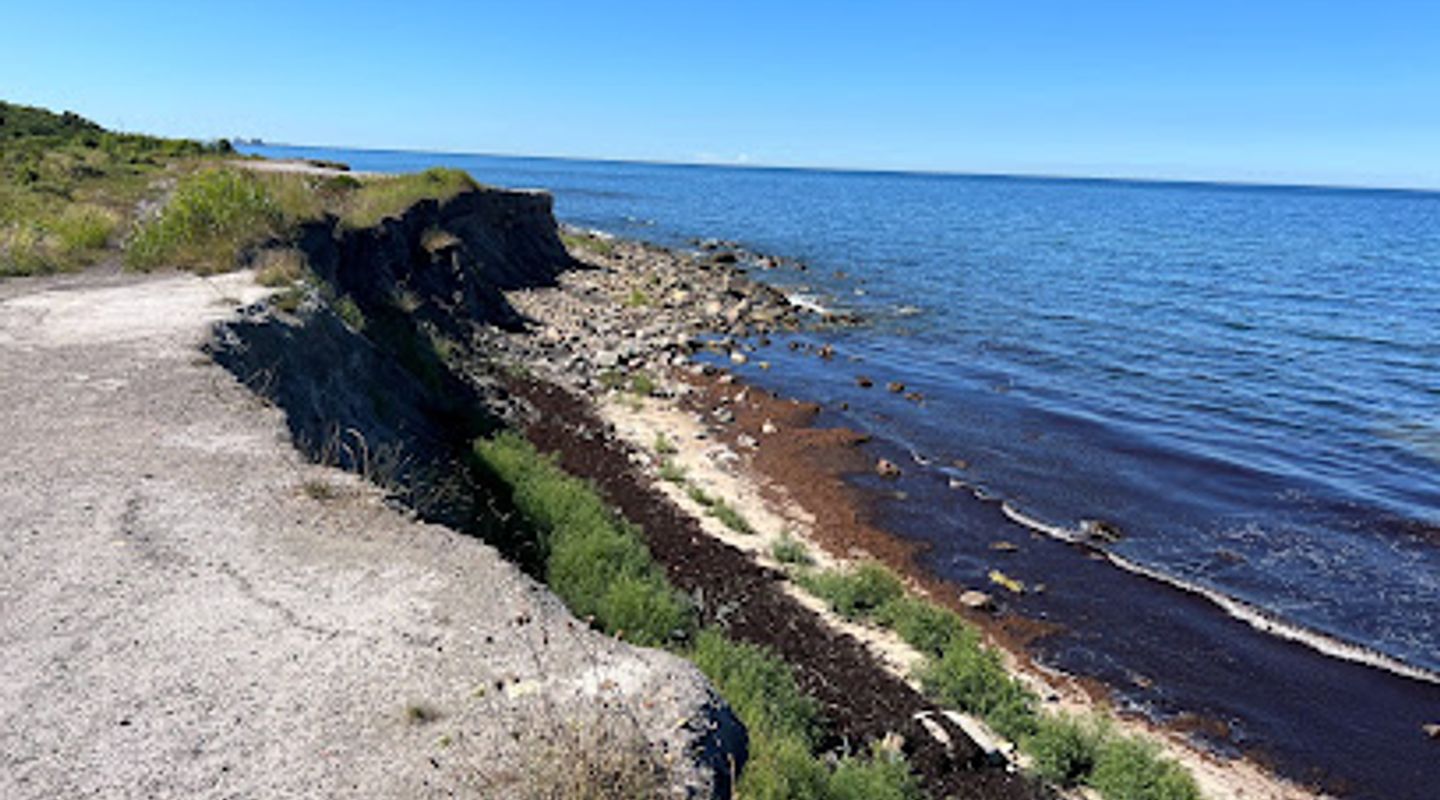
Bagågraven, on Havvej just north of Rønne on Bornholm, is a former coastal clay pit that has transformed into a striking landscape of steep sandy banks, Pyritsøen lake and Baltic shoreline. Once dug for clay used in Hasle’s famous tiles, it now reveals layers from the Middle Jurassic and has yielded dinosaur footprints nearby. Today it is a quiet, wind‑swept spot for short walks, coastal views, geology, birdlife and a taste of Bornholm’s industrial and deep natural history.
On-site amenities
 Trash bins
 Information boards
 Seating areas
Opening hours
- Every dayOpen 24 hours
Opening hours as listed on the venue’s Google Business Profile. Hours can change for services and special events, so check with the venue before you go.
- Address
- Havvej, 3700 Rønne
- Website
Getting there
Local bus from Rønne
Bicycle from Rønne
On foot via coastal trail
Discover more about Bagågraven
From working clay pit to wild coastal hollow
Bagågraven sits tucked between forest, coast and the Hasle–Rønne stretch of shoreline, where the Baltic rolls in against steep man‑made slopes. Around 1900 clay extraction began here, feeding the Hasle tile and refractory works that lined the coast. For decades, machines bit steadily into the shoreline, carving a broad amphitheatre‑like hollow that has since partly filled with water to form Pyritsøen, a sheltered lake just inland from the sea.When extraction stopped in the late 1980s, the site was left as a raw wound in the landscape. Over time, wind, rain and the Baltic have reshaped the exposed clay and sand, softening edges and cutting small ravines. The result is an unusual semi‑wild bowl of slopes, ponds and banks, framed by low woodland and opening westwards to the horizon.
Layers from the Jurassic beneath your feet
Bagågraven exposes deposits known as the Bagå Formation, laid down in the Middle Jurassic around 170 million years ago. In the scarred walls you can see a sequence of dark coal‑bearing clays, pale sandstones and grey muds, once formed in river channels and floodplains on a broad delta. Between the channels, quieter water deposited fine clay while vegetation colonised the low‑lying ground.Nearby, at the coast around Pyritsøen, geologists have found dinosaur footprints preserved in sandstone blocks washed out of these layers. They are some of the key pieces of evidence that large dinosaurs once roamed Bornholm, which remained dry land while most of future Denmark lay under shallow seas. Standing here, it is easy to picture broad‑backed animals trudging across a muddy delta long before the Baltic existed.
A refuge for birds, amphibians and coastal plants
After the diggers left, Bagågraven quickly became a refuge for wildlife. The steep faces and loose material attracted sand martins and other burrowing birds, while shallow pools and the lake margins turned into breeding grounds for frogs and toads. The mixture of bare ground, scrub and wet patches is also good insect habitat, and sharp‑eyed visitors may notice dragonflies skimming low over the water in summer.Closer to the sea, hardy coastal plants push roots into the eroding banks and pebble‑strewn foreshore. Storms periodically bite into the protective ridge between Pyritsøen and the open Baltic, carrying clay and sand away and slowly altering the outline of the coast. It is a landscape in visible motion, where each winter’s waves redraw the fine details of the shoreline.
Short walks, viewpoints and quiet pauses
For visitors, Bagågraven is a compact, low‑key destination rather than a formal park. Unmarked paths and trods loop around the hollow, linking forest, lake edge and seafront. From the upper banks you gain broad views along Bornholm’s west coast towards Rønne and, in clear light, north towards Hasle’s smoking chimneys and cliffs.Down by the water, the atmosphere shifts. The lake surface often lies calmer than the sea beyond, reflecting sky and banks, while the muffled boom of surf reaches you from the far side of the narrow land bridge. It is an easy place to linger on a bench or rock, watching the changing light and the movement of clouds above the Baltic.
A stop on coastal trails and cycle routes
Bagågraven also functions as a natural pause point on longer excursions. The coastal trail that connects Rønne and Hasle passes close by, weaving between forest and sea. Cyclists on the popular Hasle–Rønne route skim the land bridge and can detour a few minutes to look down into the former pit and across Pyritsøen.There are no attractions in the theme‑park sense here: no displays, no playgrounds, simply a raw, evolving landscape shaped first by industry and now by wind and waves. That simplicity is part of its charm. Bagågraven offers a compact encounter with Bornholm’s deep time, its coastal energy and its quieter, everyday nature, all within a short outing.
Evendo Review Centre
 Google
Guest reviews
Best time to go
Quietest: Jan, Feb & Dec · before 6am or from 9pm
Busy times are Evendo estimates for a typical year, to help you plan. Actual crowds vary with events, school holidays and the weather.
Explore Bagågraven on the map
A handpicked selection of must-see spots near Bagågraven, mapped for you.
Get your free copy of our complete guide to Bagågraven, delivered straight to you.
Everything on this page, from opening hours and how to get there to Eve’s tips and the best time to go, in one PDF you can read offline, print or share.
Already have an account? Sign in
Your Bagågraven guide is ready.
We'll send it to · Not you? Sign out

Getting your guide ready…
We are putting together a fresh copy of the Bagågraven guide. This can take up to a minute.
This can take a few moments. If your browser asks, choose Allow so the download can start. You'll find the guide in your Downloads folder.
Nothing happened? Download it again
Sorry, the guide is taking longer than usual. Please try again in a minute, or get it by email instead.
Other nearby places you may find interesting
The closest places of the same kind, if this one is not quite what you had in mind.
-
Hammershus Castle Ruins Bornholm’s great clifftop fortress, where vast medieval ruins, Baltic Sea panoramas and a striking modern visitor centre bring 800 years of history to life.
-
Opal Lake A flooded granite quarry turned emerald lake, Opal Lake on Bornholm blends raw cliffs, deep clear water and coastal views with swimming, cliff jumps and rugged trails.
-
Bornholms Rovfugleshow Immersive birds-of-prey shows and evolution-themed encounters on Bornholm, where owls, falcons, reptiles and farm animals turn science into a full, family-friendly day out.
-
Bornholmertarnet Former top-secret NATO listening post turned Cold War museum, crowned by a 70 m viewing tower with sweeping panoramas over Dueodde and eastern Bornholm.
-
Hammeren Lighthouse Compact granite lighthouse on Bornholm’s highest headland, offering free summer access, sweeping Baltic views and heather-clad coastal walking trails.
Swipe for more places
More to explore near Bagågraven

 Best experiences near Bagågraven
 Best hotels near Bagågraven
 Best landmarks near Bagågraven
 Best attractions near Bagågraven
 Best shops near Bagågraven
 Best restaurants near Bagågraven
 Best bars near Bagågraven
Do you manage this location?
Take control to get all the benefits, like improved information, better appearance, and stronger visibility across AI-powered discovery.
Explore more

Explore more of Bornholm
Explore Bornholm: Denmark's Baltic gem, offering stunning nature, rich history, and vibrant local culture. Perfect for nature lovers, history buffs, and food enthusiasts.
Explore Bornholm
Explore more of Denmark
Discover Denmark: A perfect blend of history, modern design, and the cozy concept of hygge. Explore vibrant cities, serene landscapes, and world-class cuisine.
Explore Denmark
