The Brogård stone Travel Guide
Free Guide: Bornholm’s largest Viking runestone, standing quietly by a country road near Hasle, where clear runes in granite still tell a thousand-year-old story.


A brief summary of The Brogård stone
Bornholm’s largest Viking runestone, standing quietly by a country road near Hasle, where clear runes in granite still tell a thousand-year-old story.
Standing quietly in the countryside south of Hasle on Bornholm, the Brogård Stone is the island’s largest Viking runestone, rising around 2.7 meters beside a rural road where Simblegårdsvej and Svalhøjvej meet. Once reused as a bridge stone and rediscovered in the 19th century, it now stands upright again, its remarkably clear runic inscription offering an intimate, tangible link to the island’s late Viking Age and the people who commemorated their dead in carved granite.
On-site amenities
 Information boards
- Address
- Simblegårdsvej 28, 3790 Hasle
Getting there
Car from Rønne on Bornholm
Local bus to Hasle and walk
Cycling from Hasle
Discover more about The Brogård stone
A quiet giant of the Viking Age
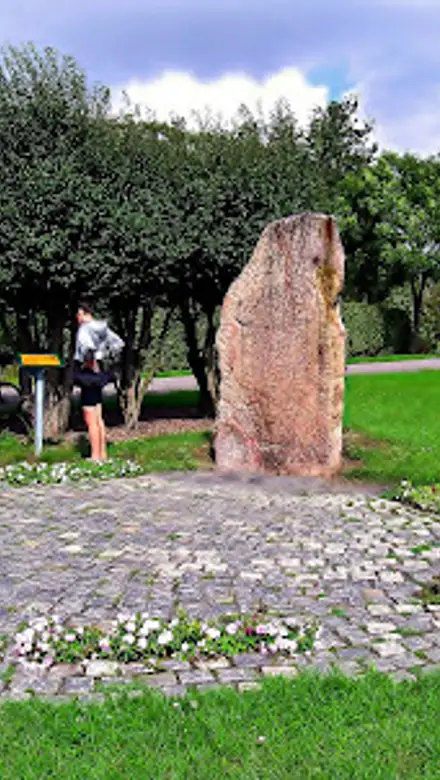
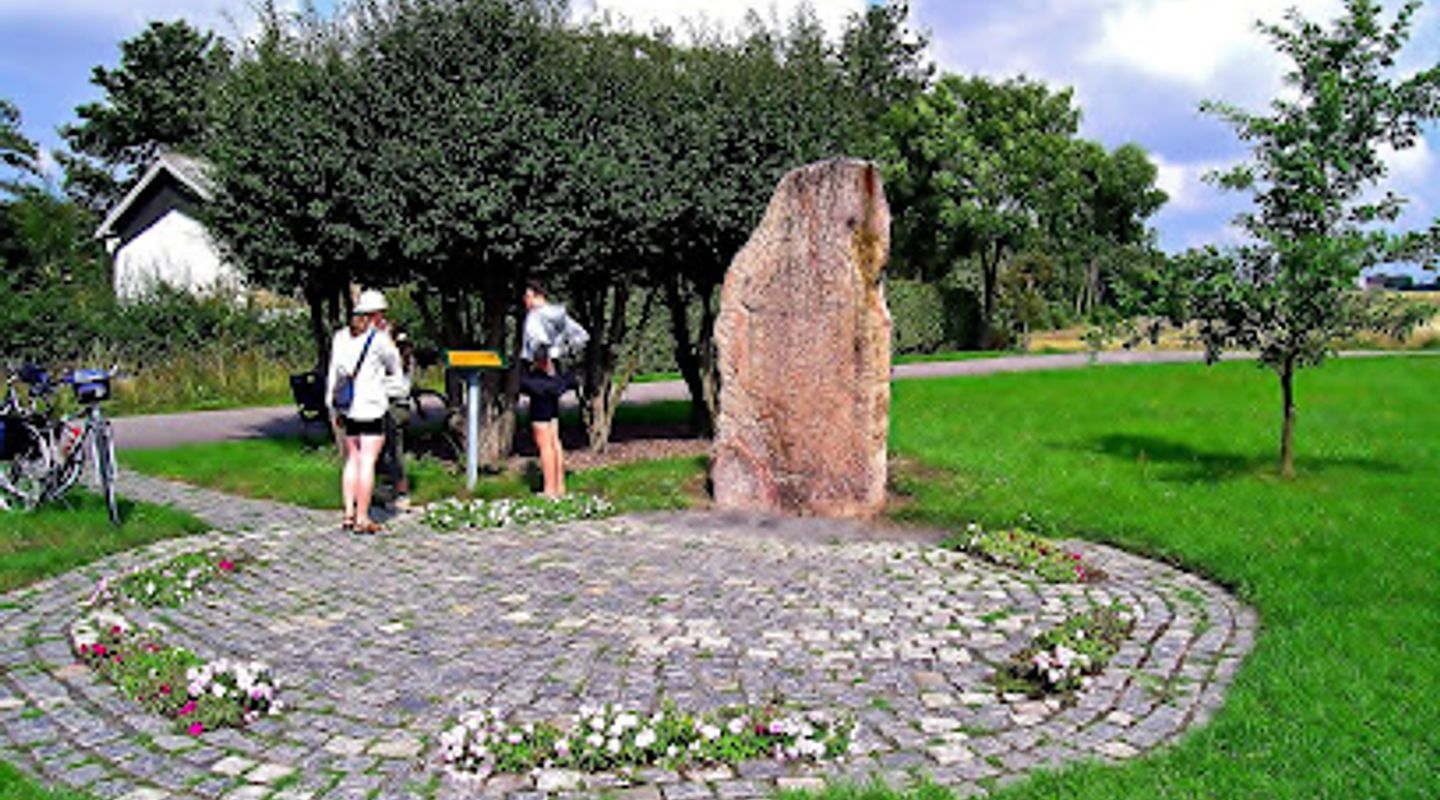
The Brogård Stone stands in a small clearing by fields and farmsteads just south of Hasle, yet it carries the weight of more than a thousand years of history. Rising to about 2.7 meters, it is the largest known runestone on Bornholm, hewn from local granite and set upright in the landscape like a solitary sentinel. Today it looks almost modest beside the narrow country road, but in the late Viking Age this would have been a deliberate, prominent marker in the terrain, visible to anyone passing along the route.Approaching the stone, you notice its tapering shape and weather-softened edges. Lichen dapples the surface, and on a bright day the grain of the granite catches the light. It is easy to imagine how striking it must have seemed when newly raised, its carving crisp and the stone freshly quarried.
Runes that still speak clearly
What makes the Brogård Stone especially compelling is how clearly its runes can still be read. Unlike many weathered stones, the inscription here remains relatively sharp, cut in the younger futhark alphabet used in the Viking Age. The runes follow a band that winds up the face of the stone, forming a memorial text typical of the period: naming the person who commissioned the monument, the person commemorated, and often their kinship or status.Even without mastering runology, you can see how the carver laid out the runes in an even, confident hand. Each character is formed with straight strokes, adapted to the chisel and the hard granite. The inscription turns an otherwise anonymous boulder into a specific story about named individuals, anchoring personal memory in the landscape.
From hilltop monument to hidden bridge stone
Originally, the Brogård Stone stood on a small hill nearby, most likely in a more commanding position. In the early 1700s it was removed and reused as building material, ending up as a horizontal capstone in a bridge across the Bagaa stream. For more than a century its inscription was largely out of sight, serving a purely practical purpose as people crossed the water without realizing they were walking over a Viking memorial.In 1868 the stone was rediscovered and recognized as a runestone. It was then raised again near its present spot by the roadside. This journey—from sacred monument to anonymous construction stone and back to protected heritage—illustrates how even important objects can fade from memory, only to be reclaimed later as part of a shared past.
Bornholm’s rune landscape
The Brogård Stone is part of a broader constellation of runestones spread across Bornholm. The island hosts several dozen such stones, some at churches, others in fields or village settings. Together they chart the spread of Christianity, shifts in power, and networks of families in the late Viking and early medieval periods.Visiting this particular stone offers a compact introduction to that world. Standing here, you can imagine messengers and traders moving between farmsteads, pausing to trace the runes with their fingers or to invoke the name of the person commemorated. The stone belongs both to its immediate farm landscape and to a larger Scandinavian tradition of carved memorials.
Atmosphere of stillness by the roadside
Despite its historical importance, the Brogård Stone’s setting today is simple and unassuming. There is no grand monument, just the stone, the verge, and views across low fields and hedgerows. The soundscape is usually limited to wind in the grass, birdsong, and the occasional car. This understated environment gives you space to linger, read any nearby information, and reflect on the long continuity of human presence on Bornholm.The lack of crowds or elaborate facilities means you experience the stone much as local residents do: as a familiar landmark on a quiet rural road. That everyday quality—an extraordinary artifact in an ordinary setting—is part of its charm and a reminder that the Viking past here is woven into the living landscape rather than confined to museums.
Evendo Review Centre
 Google
Guest reviews
Best time to go
Quietest: Jan, Feb & Dec · before 8am or at 8pm
Busy times are Evendo estimates for a typical year, to help you plan. Actual crowds vary with events, school holidays and the weather.
Explore The Brogård stone on the map
A handpicked selection of must-see spots near The Brogård stone, mapped for you.
Get your free copy of our complete guide to The Brogård stone, delivered straight to you.
Everything on this page, from opening hours and how to get there to Eve’s tips and the best time to go, in one PDF you can read offline, print or share.
Already have an account? Sign in
Your The Brogård stone guide is ready.
We'll send it to · Not you? Sign out

Getting your guide ready…
We are putting together a fresh copy of the The Brogård stone guide. This can take up to a minute.
This can take a few moments. If your browser asks, choose Allow so the download can start. You'll find the guide in your Downloads folder.
Nothing happened? Download it again
Sorry, the guide is taking longer than usual. Please try again in a minute, or get it by email instead.
Other nearby places you may find interesting
The closest places of the same kind, if this one is not quite what you had in mind.
-
-
-
-
-


Swipe for more places
More to explore near The Brogård stone

 Best experiences near The Brogård stone
 Best hotels near The Brogård stone
 Best landmarks near The Brogård stone
 Best attractions near The Brogård stone
 Best shops near The Brogård stone
 Best restaurants near The Brogård stone
 Best bars near The Brogård stone
Do you manage this location?
Take control to get all the benefits, like improved information, better appearance, and stronger visibility across AI-powered discovery.
Explore more

Explore more of Bornholm
Explore Bornholm: Denmark's Baltic gem, offering stunning nature, rich history, and vibrant local culture. Perfect for nature lovers, history buffs, and food enthusiasts.
Explore Bornholm
Explore more of Denmark
Discover Denmark: A perfect blend of history, modern design, and the cozy concept of hygge. Explore vibrant cities, serene landscapes, and world-class cuisine.
Explore Denmark