Lur Blowers, Copenhagen Travel Guide
Twin bronze horn‑blowers high above City Hall Square, fusing Bronze Age echoes, Carlsberg history and Copenhagen’s everyday bustle into one striking landmark.
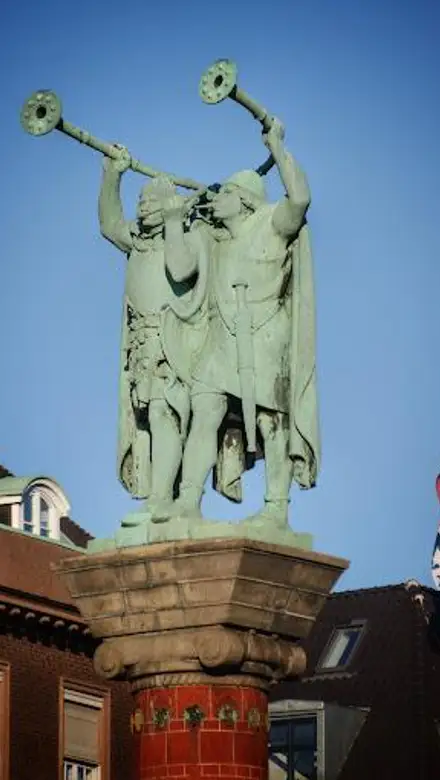
Rising above Copenhagen’s City Hall Square, the Lur Blowers monument is a striking bronze sculpture of two Viking-style figures sounding ancient lurs from atop a 20m terracotta column. Gifted to the city by the Carlsberg foundations in the early 1900s to honor brewery founder J.C. Jacobsen, it has become one of Rådhuspladsen’s most recognisable silhouettes. With its red-brick column, circular bench and views over the bustling square, it’s a quick but characterful stop between Tivoli, Strøget and City Hall.
A brief summary to Lur Blowers
- Rådhuspladsen 57, Copenhagen, Indre By, 1550, DK
- Duration: 0.25 to 0.75 hours
- Free
-
 Outdoor
- Mobile reception: 5 out of 5

Know before you go
Hi, I'm Eve. Here are a few practical things to know before exploring Lur Blowers.
- Look for the inscription halfway up the column noting J.C. Jacobsen and the 1811–1911 dates, which reveal the monument’s Carlsberg connection.
- Visit around golden hour for the most dramatic silhouettes of the bronze figures against the sky and the City Hall clock tower.
- Combine a quick stop here with the nearby Dragon Fountain, Hans Christian Andersen statue and Tivoli Gardens for a compact city-center walk.
- Bring a zoom lens or use your phone’s telephoto mode to capture details of the lurs and helmets, which are hard to see from street level.
Do you manage this location?
Take control to get all the benefits, like improved information, better appearance, and stronger visibility across AI-powered discovery. Learn more about listing your business on Evendo
Activate your presenceOther nearby places you may find interesting
The closest places of the same kind, if this one is not quite what you had in mind.


Explore Lur Blowers on the Map
A handpicked selection of must-see spots near Lur Blowers, mapped for you.
Unlock the Best of Lur Blowers
Buy tickets
-
No tickets available
Book tours with entry


Book tours without entry
-
No tours available
Getting There
-
Metro
Take the M3 or M4 metro line to Rådhuspladsen Station in central Copenhagen; from most inner-city stops the ride takes 3–8 minutes, with trains running every few minutes throughout the day. Standard single tickets within the city zones cost roughly 20–25 DKK. The station has lifts and escalators; once you exit onto City Hall Square, the Lur Blowers are visible a short, step‑free walk across the plaza.
-
City bus
Several city bus routes stop at the Rådhuspladsen hub beside City Hall Square, typically 5–20 minutes from nearby districts such as Vesterbro, Nørrebro or Østerbro depending on traffic. A single bus ticket within the central zones is usually around 20–25 DKK, and buses run frequently from early morning until late night. Most vehicles are low‑floor and wheelchair accessible, and the stop is directly adjacent to the square where the monument stands.
-
On foot from Copenhagen Central Station
From Copenhagen Central Station, reaching City Hall Square on foot takes about 10–15 minutes at a relaxed pace along broad pavements with gentle gradients. The route is generally accessible for wheelchairs and strollers, with crossings at traffic lights and plenty of cafés en route. This walk brings you toward Tivoli’s main entrance and then into the open space of Rådhuspladsen, where the Lur Blowers column rises beside City Hall.
-
Bicycle
Using a regular or shared city bike, you can cycle to City Hall Square from most central neighbourhoods in 5–15 minutes via Copenhagen’s dedicated bike lanes. Expect busy cycle traffic at peak hours and limited formal bike parking immediately on the square, though racks are available on nearby side streets. If you rent a bike, day rates are commonly in the 100–150 DKK range, and helmets are optional but recommended.
For the on-the-go comforts that matter to you
-
 Restrooms
-
 Drink Options
-
 Drinking Water
-
 Food Options
-
 Seating Areas
-
 Trash Bins
-
 Information Boards
-
 Visitor Center
-
 Sheltered Areas
Discover more about Lur Blowers
Bronze horns above the heart of Copenhagen
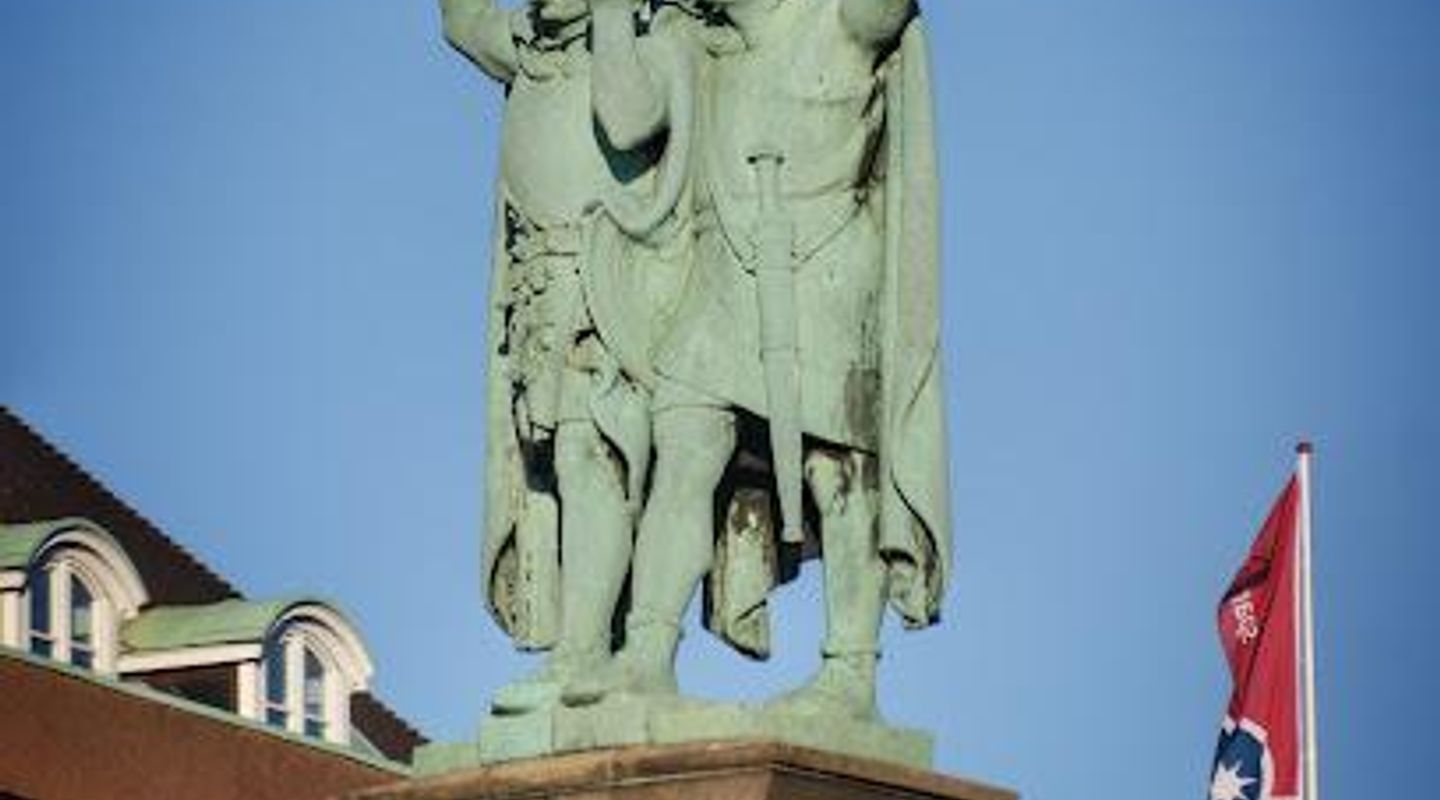
The Lur Blowers monument, or Lurblæserne, stands on a compact plaza beside Copenhagen City Hall, its twin bronze figures visible from across Rådhuspladsen. The two caped, helmeted men stand shoulder to shoulder, each raising a long, curved lur to the sky, as if sounding a call over the city. Perched on a tall column of warm red brick and terracotta, they add a vertical accent to a square otherwise dominated by the broad façade and clock tower of City Hall.From street level, you first notice the column’s sturdy proportions and the integrated circular bench at its base, inviting you to pause and look up. As your gaze climbs, the figures seem to step out against the northern sky, their outlines sharp in low sun and dramatically silhouetted after dark when the square is lit. Despite the rush of buses, bicycles and pedestrians, there is a sense of ceremony about the composition, as if the lurs might sound at any moment.A Carlsberg gift and a brewer’s birthday
The monument owes its existence to Copenhagen’s famous brewing dynasty. It was commissioned as a gift to the city from the Carlsberg Foundation and the New Carlsberg Foundation to mark the centenary of J.C. Jacobsen’s birth in 1811, the founder of the Carlsberg brewery. The red-brick column bears his name and dates in crisp lettering, quietly linking the sculpture to Denmark’s industrial and philanthropic history.Architect Anton Rosen designed the column, while sculptor Siegfried Wagner created the dynamic bronze group at the top. Work took place in the early 1910s, and the monument was inaugurated a few years after Jacobsen’s centenary, in 1914. Its materials and detailing echo the National Romantic style of City Hall itself, allowing the new column to sit comfortably among the surrounding façades while still asserting its own identity.From solo figure to synchronized pair
Early ideas for a monument here revolved around a single heroic figure, continuing a turn‑of‑the‑century fascination with Norse mythology and grand civic symbols. Late in the design process, however, plans shifted from one musician to two. The reason lies in the lurs themselves: these Bronze Age instruments are traditionally tuned and played in pairs. Representing two synchronized players rather than a solitary figure makes the sculpture more faithful to archaeological finds and musical practice.Up close, the compact pose of the two men is striking. Their bodies lean almost into one another, cloaks flowing together, lurs raised in perfect symmetry. The tight grouping was not just an artistic choice but a practical solution, ensuring stability against Copenhagen’s weather and giving the composition strength when viewed from far below. From the ground, you read them as a single, powerful silhouette rather than two separate characters.Echoes of the Bronze Age in modern bronze
The instrument depicted, the lur, is a curved bronze horn dating back to the Late Bronze Age, around 1000 BC. Many of the finest examples have been found in Danish bogs, often carefully deposited in pairs, suggesting a ritual or ceremonial role. Their long, sweeping forms, animal‑like bell ends and polished surfaces have inspired artists and designers for generations, from butter brands to public monuments.Here on City Hall Square, that prehistoric sound world is evoked in modern metal. The lurs in the sculpture mirror the inverted curve seen on archaeological specimens, a deliberate nod to famous finds such as the Brudevælte lurs. While the monument itself is early 20th‑century, it projects your imagination back more than two millennia, bridging Copenhagen’s contemporary civic space with the ritual landscapes of ancient Scandinavia.Part of the choreography of Rådhuspladsen
The Lur Blowers are only one element in the choreography of Rådhuspladsen, but they play an important visual role. From certain angles, they line up with the City Hall clock tower; from others they frame views down Vesterbrogade or toward Tivoli’s entrance. They stand near the Dragon Fountain and the Hans Christian Andersen statue, forming a cluster of sculptural landmarks within a few steps of each other.For visitors, this makes the monument an easy and rewarding stop: you can sit on the circular bench to rest between museums and shops, use the column as a meeting point, or simply photograph the figures contrasted against the copper roofs and brickwork around the square. The monument is always accessible, free to visit at any time of day, and offers a small but memorable slice of Copenhagen’s blend of mythology, history and urban life.












Your all‑in‑one travel companion app
Explore expert travel guides, compare and book tours, experiences, hotels, and more—all from the palm of your hand. Download now for seamless trip planning wherever your wanderlust takes you.


Explore More of Copenhagen
Looking beyond Lur Blowers? Discover Copenhagen for broader travel guides, local hot-spots, and regional highlights.
Explore Copenhagen