Background

Amalienborg Palace

Copenhagen’s living royal residence: four rococo palaces, a ceremonial square and a museum that opens the doors to 150 years of Danish royal life.

4.5

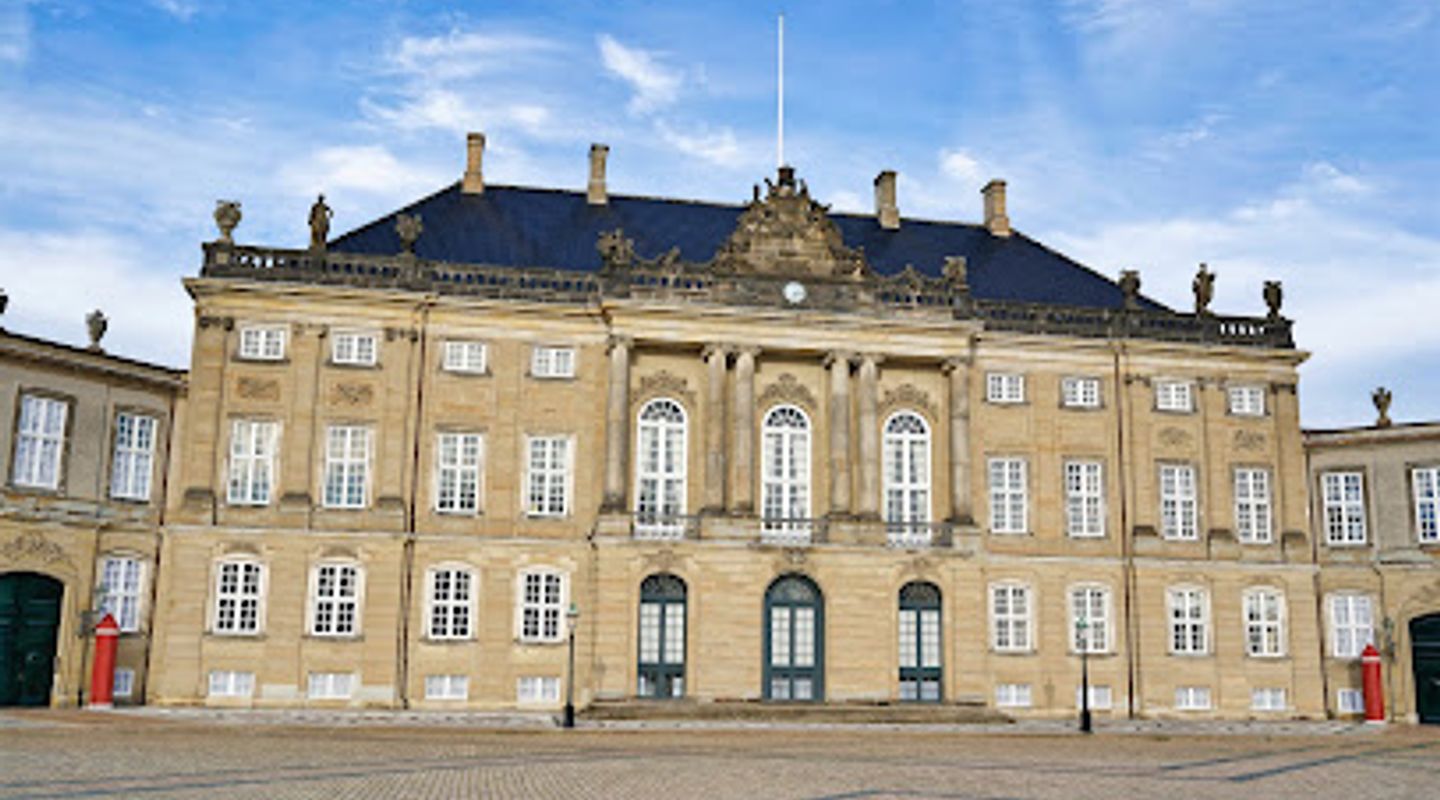
Amalienborg Palace is Copenhagen’s working royal residence and the ceremonial heart of Denmark’s monarchy. Four near-identical rococo palaces frame an elegant octagonal square, guarded by the Royal Life Guards and centred on an equestrian statue of King Frederik V. Visitors can explore the Amalienborg Museum inside Christian VIII’s Palace, with richly furnished royal interiors, glittering state rooms and a Fabergé chamber, and can witness the daily changing of the guard at noon.

A brief summary to Amalienborg Palace

  • Amalienborg Slotsplads, København K, København K, 1257, DK
  • +4533153286
  • Visit website
  • Duration: 1.5 to 3 hours
  • Mid ranged
  • Environment icon Mixed
  • Mobile reception: 5 out of 5

Local tips

  • Arrive before noon to secure a good position in the square for the changing of the guard, especially if a marching band accompanies the ceremony.
  • Combine your museum ticket with nearby Rosenborg Castle to see both royal residences and the crown jewels on a single, good‑value pass.
  • Plan at least an hour inside the museum if you enjoy historic interiors; the Fabergé chamber and state rooms reward slow, detailed viewing.
  • Photography is allowed in many areas but not all; check signage in each room and be mindful of flash restrictions around delicate objects.
  • Visit on a clear day if possible to fully enjoy the axial views between the palace square, the Marble Church and the harbourfront Opera House.
widget icon

Getting There

  • Metro and short walk from central Copenhagen

    From central Copenhagen, take the M3 or M4 metro lines to Marmorkirken Station, a journey of about 5–8 minutes from major hubs like Kongens Nytorv. Standard single tickets within the city zones typically cost around DKK 20–25 and trains run every few minutes most of the day. From Marmorkirken it is an easy 5–10 minute level walk on pavements to Amalienborg Palace, suitable for most visitors including those with strollers; wheelchairs may encounter some cobblestones in the square itself.

  • Bus from inner city districts

    Several city bus routes serve the area around Amalienborg, with typical travel times of 10–20 minutes from central neighbourhoods depending on traffic. A standard bus ticket in Copenhagen is usually the same price as the metro, around DKK 20–25 for a short inner‑city trip, and services run frequently throughout the day. Buses stop on nearby main streets, from which you walk a few minutes along flat sidewalks; this option suits visitors who prefer to minimise time on the metro but still want straightforward access.

  • Bicycle from the city centre

    Copenhagen is highly cycle‑friendly, and many travellers reach Amalienborg by bike from central districts in around 10–15 minutes. Public bike‑share schemes and rental shops typically charge from about DKK 75–150 for a day’s hire, with lower rates for shorter periods. Dedicated cycle lanes lead close to the palace, but bicycles are not allowed to ride through the central square, so you should dismount and walk the last stretch, taking care on cobblestones and following local signage on where to park.

Amalienborg Palace location weather suitability

  • Weather icon Clear Skies
  • Weather icon Mild Temperatures
  • Weather icon Any Weather
  • Weather icon Cold Weather

Unlock the Best of Amalienborg Palace

Buy tickets

    No tickets available

Book tours with entry

    No tours available

Book tours without entry

    No tours available

Discover more about Amalienborg Palace

A royal square at the heart of Copenhagen

Amalienborg Palace forms one of Europe’s most graceful palace squares: four almost identical rococo mansions surrounding an octagonal cobbled plaza, with the equestrian statue of King Frederik V at its centre. The symmetry is striking from every angle, with the façades’ pale sandstone, pilasters and delicate ornamentation set against the often steel-blue Copenhagen sky. The space feels both ceremonial and surprisingly human in scale. The square is also very much alive. The Royal Life Guards, in dark uniforms and bearskin hats, patrol the perimeter and perform the daily changing of the guard at noon, accompanied on some days by a marching band. The steady rhythm of boots on stone, the snap of rifle drill and the occasional trumpet fanfare underscore that this is not just a historic monument but the working front yard of Denmark’s monarchy.

From noble mansions to royal residence

Amalienborg’s story begins in the mid‑18th century, when the Frederiksstaden district was laid out to celebrate the 300th anniversary of the Oldenburg dynasty. Four grand townhouses were commissioned for prominent noble families, designed in refined rococo style with elegant façades and richly decorated interiors. Their arrangement around the square was a deliberate exercise in urban theatre, aligning the complex with the nearby Marble Church and the harbour. That original plan changed dramatically after a devastating fire destroyed Christiansborg Palace in 1794. The royal family quickly purchased the four mansions and converted them into a new principal residence. Over time each palace took the name of a monarch who lived there, and Amalienborg evolved into the central stage for royal life in Copenhagen, hosting receptions, state visits and significant constitutional moments.

Palaces within the palace

Today each of the four palaces has its own role. Christian VII’s Palace is reserved for major ceremonies and official functions, its interiors used for state banquets and formal receptions. Christian IX’s Palace has long been associated with the late Queen Margrethe II, while Frederik VIII’s Palace serves as the private home of King Frederik X, Queen Mary and their children, placing a contemporary royal family life behind those stately façades. Christian VIII’s Palace houses the Amalienborg Museum, where visitors can step into preserved royal apartments and state rooms. Here, panelled salons, heavy curtains and glittering chandeliers reveal changing tastes from the 19th century to the present. Personal objects, portraits and uniforms trace the story of Christian IX and Queen Louise and their descendants, whose marriages linked Denmark to royal houses across Europe.

Inside the Amalienborg Museum

The museum delves into 150 years of royal history, from the era when Christian IX was dubbed the “father‑in‑law of Europe” through to the 21st‑century monarchy. Rooms are arranged as lived‑in spaces rather than abstract displays: writing desks still laid out with papers, dining rooms set for formal meals, and private sitting rooms that hint at quieter family moments behind the ceremonial façade. A particular highlight is the Fabergé chamber, with one of the world’s notable collections of Russian jewellery and objets d’art, reflecting close historic ties between the Danish and Russian courts. In other galleries, uniforms, orders, photographs and film clips explore public duties, royal tours and the evolving symbolism of monarchy in a modern democracy.

An axis of architecture and water

Step back towards the centre of the square and you sense how precisely Amalienborg is placed within Copenhagen’s urban fabric. Look inland and the domed Marble Church rises at the end of a grand processional avenue; turn seaward and the line continues across the harbour to the modern Copenhagen Opera House. This carefully planned axis links baroque, rococo and contemporary architecture in a single vista. The square’s openness also makes it acutely sensitive to light and weather. On bright days the façades glow warmly and the statue’s bronze gleams; in winter, a dusting of snow turns the cobbles and roofs into a monochrome scene punctuated by the guards’ dark uniforms. Twilight often brings a softer mood, when interior lights flicker to life behind tall windows and the palace complex feels simultaneously intimate and imposing.

Experiencing Amalienborg today

A visit typically weaves together indoor and outdoor experiences. Many travellers time their day to be on the square before noon to watch the changing of the guard, then move into Christian VIII’s Palace for the museum. Inside, signage and displays are offered in multiple languages, and staff are on hand to explain protocol, symbolism and anecdotes from royal life. Temporary exhibitions occasionally focus on particular monarchs, fashions or diplomatic themes. Beyond the formal exhibits, simply lingering along the edge of the square rewards close observation: the subtle differences between the four façades, the regimented pace of guards on duty, and the interplay between palace life and the surrounding city streets. Amalienborg remains both a symbol of national continuity and a living neighbourhood landmark, bridging centuries of Danish history in a compact, walkable space.

Busiest months of the year

Busiest hours of the day

Popular Experiences near Amalienborg Palace

Popular Hotels near Amalienborg Palace

Select Currency