Inderhavnsbroen
Copenhagen's iconic curved 'kissing bridge' where innovation meets the Inner Harbour.
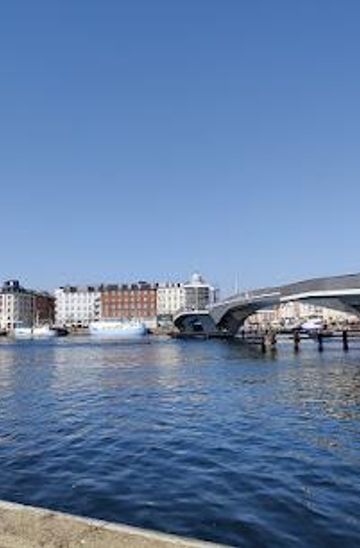
Inderhavnsbroen, Copenhagen's iconic 'kissing bridge,' is a 180-meter pedestrian and bicycle crossing spanning the Inner Harbour between Nyhavn and Christianshavn. Designed by Flint & Neill with Studio Bednarski, this innovative opening bridge features distinctive curved steel spans that meet in the middle, creating a unique silhouette. Opened in July 2016 after a challenging construction period, it has become a vital link in Copenhagen's world-renowned cycling infrastructure and a striking architectural landmark that welcomes visitors entering the harbour from the sea.
A brief summary to Inderhavnsbroen
- Inderhavnsbroen, Copenhagen, Indre By, 1401, DK
- Duration: 0.25 to 1.5 hours
- Free
-
 Outdoor
- Mobile reception: 5 out of 5
- Monday 2 pm-9 am
- Tuesday 2 pm-9 am
- Wednesday 2 pm-9 am
- Thursday 2 pm-9 am
- Friday 2 pm-9 am
- Saturday 2 pm-9 am
- Sunday 2 pm-9 am

Know before you go
Hi, I'm Eve. Here are a few practical things to know before exploring Inderhavnsbroen.
- Approach the central meeting point slowly on a bicycle or foot, as the curve is sharper than it appears and requires a deliberate turn to avoid the glass barriers.
- Visit during off-peak hours (early morning or late evening) to experience the bridge's elegant geometry without heavy pedestrian and cyclist traffic.
- Watch for the opening sequence if you time your visit during sailing season (May–September); the bridge opens up to 30 times monthly, offering a dramatic spectacle.
- Photograph the bridge from the water level or from Nyhavn to capture its distinctive curved steel spans and the interplay of light on the structure.
- Explore both Nyhavn (west) and Christianshavn (east) before or after crossing to fully appreciate the bridge's role in connecting Copenhagen's historic and modern quarters.
Do you manage this location?
Take control to get all the benefits, like improved information, better appearance, and stronger visibility across AI-powered discovery. Learn more
Activate your presenceOther nearby places you may find interesting

Getting There
-
Bicycle or on foot from Nyhavn
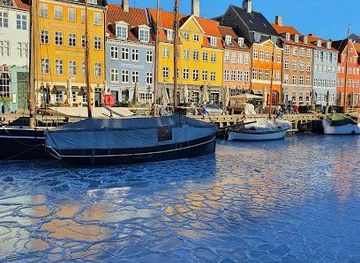
From Nyhavn, the bridge is directly accessible. Simply walk or cycle toward the waterfront on the eastern side of Nyhavn. The bridge entrance is clearly marked and takes approximately 2–3 minutes to reach on foot from the main Nyhavn square. No fees or permits required; access is free and available 24 hours daily.
-
Bicycle or on foot from Christianshavn
From Christianshavn, approach via the waterfront promenade on the eastern bank of the Inner Harbour. The bridge entrance is signposted and accessible from street level. Walking from the Opera House or central Christianshavn takes approximately 5–10 minutes depending on your starting point. Access is free and unrestricted.
-
Public transport to nearby stations
Copenhagen Metro Line M1 or M2 stops at Nyhavn Station (approximately 200 metres west of the bridge) with journey times of 5–15 minutes from central Copenhagen depending on origin. Single journey tickets cost approximately 24 Danish Krone (3–4 EUR). Alternatively, S-train services serve nearby stations; consult Rejseplanen (journey planner) for current schedules and fares.
-
Harbour tour boats
Several harbour tour operators depart from Nyhavn and pass directly under Inderhavnsbroen, offering views of the bridge from the water. Tours typically last 1–1.5 hours and cost approximately 80–120 Danish Krone (11–16 EUR) per person. This provides context for understanding the bridge's role in the harbour landscape.
For the on-the-go comforts that matter to you
-
 Information Boards
-
 Seating Areas
Discover more about Inderhavnsbroen
A Bridge Born from Ambition and Innovation
Inderhavnsbroen, meaning 'The Inner Harbour Bridge,' is Copenhagen's most talked-about pedestrian and bicycle crossing. Spanning 180 metres across the Inner Harbour, this bridge connects the historic Nyhavn district with the rapidly developing Christianshavn neighbourhood, home to the striking Copenhagen Opera House. The bridge was conceived through an international design competition in 2009, which attracted ten competing teams tasked with creating a crossing that would serve as the first architectural impression for anyone entering Copenhagen harbour from the sea. The winning design, led by engineering consultancy Flint & Neill (now part of COWI) in collaboration with Studio Bednarski and Hardesty & Hanover, proposed something radically different from conventional bridge typologies.The Distinctive 'Kissing' Design and Its Engineering Complexity
The bridge's most striking feature is its curved, sinusoidal plan with two steel spans that meet in the middle—a design that earned it the affectionate nickname 'the kissing bridge.' This innovative approach was chosen deliberately to avoid the limitations of traditional opening bridges. Bascule spans would have blocked river views for waiting pedestrians and cyclists, while swing bridges would have compromised navigation in adjacent canals. Instead, the Inderhavnsbroen withdraws its opening sections in a sliding manner, allowing the side spans to function as viewing balconies where users can observe both the bridge's movement and passing vessels. The curved alignment, however, introduced significant engineering challenges. The sinusoidal geometry meant that no two cross-sections of the steel spans were identical, and each of the four winch drums required slightly different diameters to navigate the curves. The varying structural depths in elevation, combined with the horizontal curvature, created a structure of extraordinary geometric complexity.A Troubled Path to Completion
The bridge's construction history proved as dramatic as its design. The original contractor, Pihl and Søn, was appointed in 2011 but encountered multiple critical problems: steelwork failed to meet specifications, cracks and defects appeared in concrete supports, and design errors were discovered showing supports 0.6 metres higher than intended. The contractor collapsed in August 2013, forcing the scrapping of fabricated steelwork and necessitating a complete restart. Storm flooding damaged already-installed electrical motors during the transition period. When a new contractor, Valmont SM, was appointed in 2014, independent engineers identified inadequate reinforcement in several supports, requiring extensive remedial work. As completion approached, the wire rope opening system proved faulty, and the two bridge arms were found to meet improperly in the middle, with locking bolts misaligned—a problem attributed to differential temperature effects across the deck width that design standards had not anticipated. By the time the bridge finally opened to the public on 7 July 2016, it had taken twice as long as originally planned and cost approximately 50 percent more than the initial budget. The project was ultimately funded by the A.P. Møller Foundation to the tune of 241 million Danish Krone, rather than by the City of Copenhagen.Navigating the Curve: Design Intent Versus Practical Reality
The bridge's curved geometry serves a functional purpose—it provides additional length and thus slightly higher navigation clearance in the middle—but it also creates a distinctive visual and experiential challenge. The curve is so pronounced that cyclists and pedestrians often fail to anticipate the sharp turn required at the central meeting point, where the two spans 'kiss.' This has led to collisions with the glass barriers that separate the two directions of travel. The City of Copenhagen has installed prominent warning signs to alert users to the dead-end effect created by the curve, a design feature that has drawn criticism from urban design experts who argue that good design should not require warning signage to function safely. The barrier system itself reflects the bridge's complexity: rather than the simple boom barriers used on other Copenhagen harbour crossings, Inderhavnsbroen employs large, mechanically elaborate barriers that rise dramatically when the bridge opens.Opening Frequency and Operational Demands
To accommodate the sailing community, the City of Copenhagen agreed to allow the bridge to open 30 times per month—significantly more than the six times monthly that other major harbour crossings such as Knippelsbro and Langebro operate. This frequent opening schedule has raised concerns about the bridge's reliability as a consistent transport link during sailing season, potentially disrupting the commute patterns of cyclists and pedestrians who depend on uninterrupted passage. The opening mechanism itself represents a departure from the elegant simplicity that characterizes much of Danish design philosophy.A Landmark in Copenhagen's Cycling Culture
Despite its design controversies, Inderhavnsbroen has become an integral part of Copenhagen's world-famous cycling and pedestrian infrastructure. The bridge carries far more daily users than originally projected, testament to the genuine need for this crossing and the city's commitment to sustainable transport. Its distinctive silhouette, with the curved steel spans meeting in the middle, has made it instantly recognizable and iconic. The bridge represents both the ambitions and the complexities of contemporary urban design—a structure that pushes technical and aesthetic boundaries while simultaneously revealing the challenges of translating innovative concepts into functional, user-friendly infrastructure.Explore the best of what Inderhavnsbroen has to offer













More about North Zealand
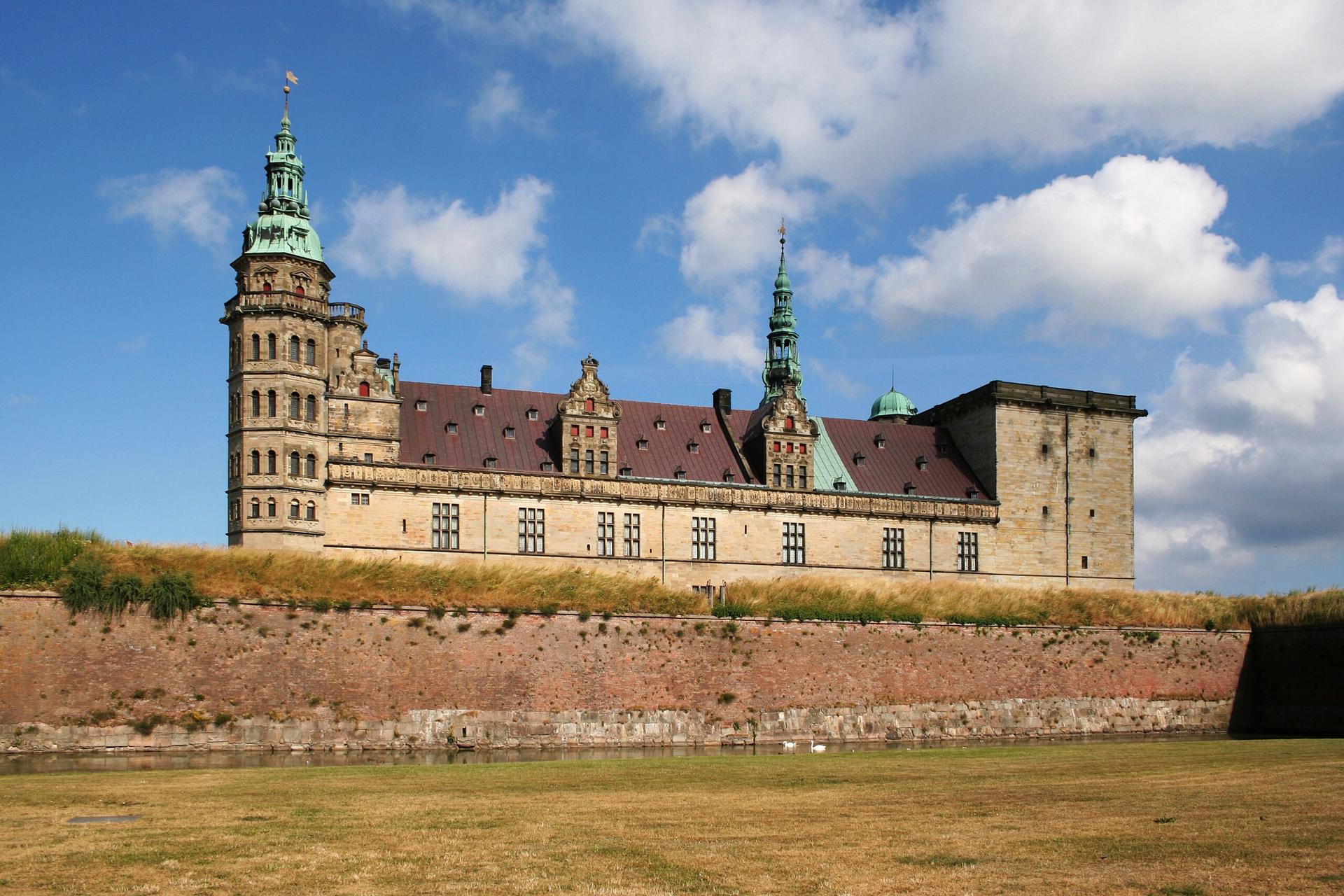
Explore North Zealand, Denmark's enchanting region of castles, beaches, and royal estates, perfect for history buffs, nature enthusiasts, and seaside lovers.
Tell me more about North Zealand