Amalienborg Palace
Working royal residence and museum in Copenhagen’s Frederiksstaden, where four rococo palaces, daily guards, and intimate interiors bring Danish monarchy to life.
A royal heart in the Frederiksstaden district
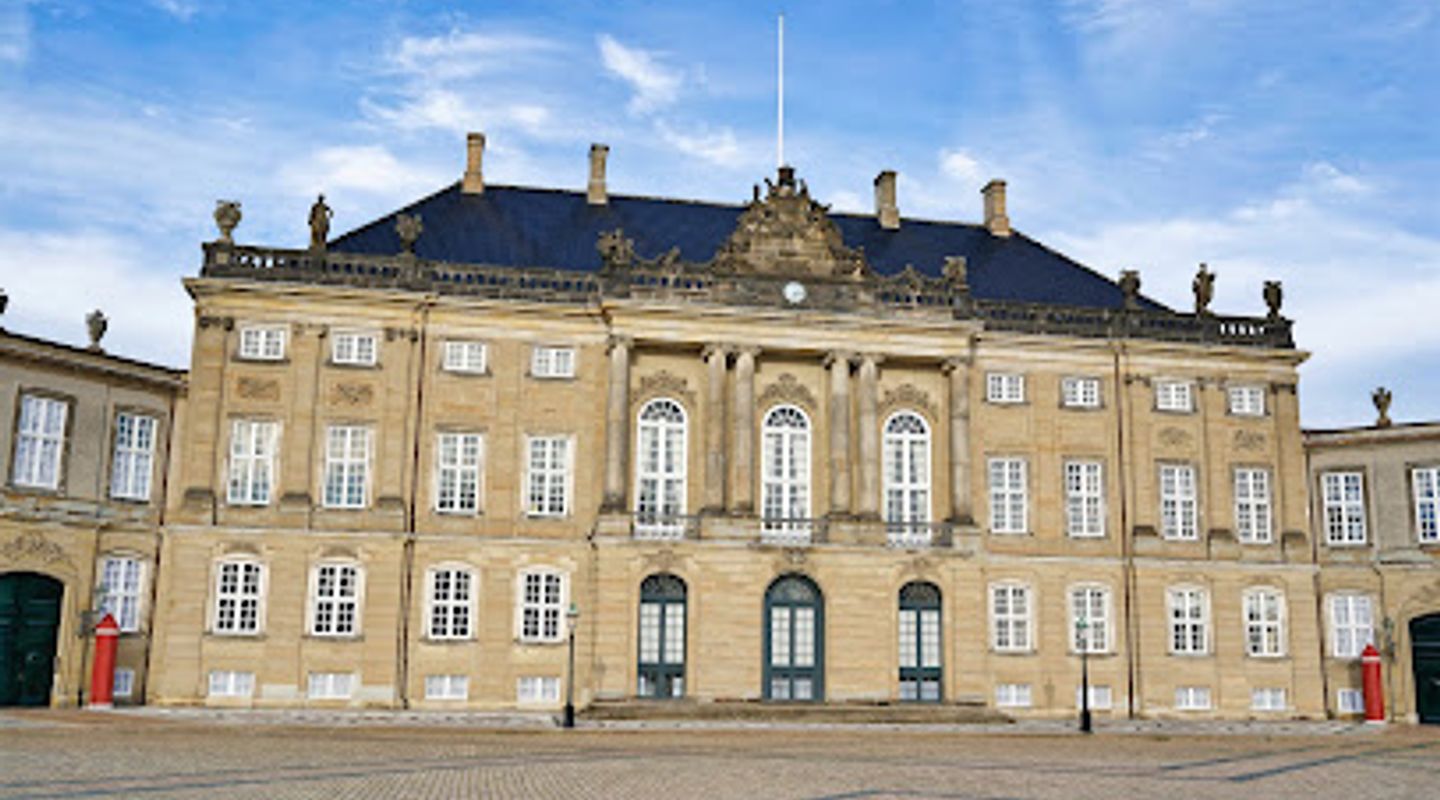
Amalienborg Palace sits at the center of Frederiksstaden, the 18th‑century quarter created to celebrate the Danish royal house. Four almost identical rococo palaces stand around a spacious, cobbled octagonal square, their cream façades and mansard roofs forming a perfectly balanced stage for royal ceremony. In the middle rises the equestrian statue of King Frederik V, the monarch who envisioned this ensemble and turned the district into a showcase of royal power and urban planning. Originally, these were aristocratic mansions for some of Denmark’s wealthiest families. When Christiansborg Palace burned in 1794, the royal family bought the buildings and moved in, transforming Amalienborg into the primary royal residence. Today it remains the home of the Danish monarch and their immediate family, making this one of Europe’s rare palatial complexes where living royal apartments and museum spaces stand side by side.Four palaces, one working monarchy
Each side of the square bears the name of a king. Christian VII’s Palace, the most lavishly decorated, hosts important state functions and ceremonial events. Christian VIII’s Palace houses the Amalienborg Museum and reception rooms used by members of the extended royal family. Christian IX’s Palace has long served as a principal royal residence, while Frederik VIII’s Palace is the private home of the reigning sovereign and their family. Despite the formal uniformity of their exteriors, the interiors differ markedly in style and period detail. Over the centuries, successive monarchs have refitted their apartments in fashions ranging from French‑inspired classicism to late‑Victorian comfort and modern Scandinavian understatement. Together the four palaces illustrate how a working monarchy has adapted to changing times while retaining carefully maintained tradition.Inside the Amalienborg Museum
The Amalienborg Museum, entered through Christian VIII’s Palace, offers an unusually intimate look at royal life. Period rooms are preserved much as their occupants left them, with personal belongings, portraits, uniforms, and everyday objects placed where they were once used. Exhibitions trace the family tree from Christian IX and Queen Louise, known for their far‑reaching dynastic links, through to modern generations. Display cases and galleries highlight ceremonial regalia, orders of chivalry, and glittering gifts exchanged with other courts. Side by side with these treasures, you encounter objects that feel almost domestic: children’s toys, travel mementos, and handwritten notes. The contrast underlines how this is both a symbol of state and a family home. Interpretive panels carefully situate each room within broader Danish history, from constitutional change to world wars and social reforms.Ceremony on the cobblestones
Outside, Amalienborg’s broad square functions as an open‑air stage for royal ritual. The Royal Life Guards, in their dark uniforms and bearskin hats, stand sentry at the palace fronts. Around midday, their changing of the guard brings movement and music to the space, with marching formations and the rhythmic echo of boots on stone. On days when the monarch is in residence, the ceremony grows more elaborate, underscoring the palace’s role as an active seat of power. The setting itself amplifies the sense of occasion. One axis runs directly to the domed Marble Church, whose green copper cupola seems to hover above the palace roofs. The opposite line opens toward the harbor and the modern opera house, dramatically linking the 18th‑century royal project to the contemporary waterfront. At different times of day, light plays across the stone façades, from crisp morning clarity to soft evening glow.Experiencing the palace and its surroundings
Visitors typically split their time between the museum interior and the square. Inside, you move through a sequence of furnished rooms at your own pace, with space to linger over displays or step close to inspect fabric, ornament, and portraits. Audio and written explanations help decode royal symbolism, etiquette, and everyday rhythms. The route is compact but layered, rewarding an unhurried visit. Stepping back outside, the palace square invites you to pause rather than rush through. There are no fences between you and the façades; you stand in the same space used for royal arrivals, state visits, and historic announcements. From here it is easy to appreciate Amalienborg as part of a larger urban composition, aligned with the church dome and the waterfront beyond. Whether you stay briefly for the changing of the guard or explore the museum in depth, the palace offers a clear, tangible introduction to Denmark’s continuing royal story.Local tips
- Time your visit for just before noon to find a good spot in the square for the changing of the Royal Life Guards, then head into the museum once the ceremony ends.
- Allow extra time in Christian VIII’s Palace to read room labels carefully; many small objects and portraits reveal family connections across European royal houses.
- Visit on a clear day to fully appreciate the visual axis from the equestrian statue through the palace façades to the Marble Church dome and the harbor beyond.
A brief summary to Amalienborg Palace
- Amalienborg Slotsplads, København K, København K, 1257, DK
- +4533153286
- Visit website
Getting There
-
Metro
From central Copenhagen, take the M3 or M4 metro line to Marmorkirken Station in the Frederiksstaden district. The ride from the main interchange stations typically takes 5–10 minutes, with frequent departures throughout the day. A single zone 2 ticket costs around 20–25 DKK and is valid across metro, bus, and S‑train within its time limit. From the station, expect a short, level urban walk on paved surfaces to reach the palace square; the route is suitable for wheelchairs and strollers in most weather conditions.
-
City Bus
Several city bus routes serve the area around Amalienborg Palace from other central neighborhoods, with journey times of roughly 10–20 minutes depending on traffic. Standard bus tickets fall within the same 20–25 DKK range as metro fares and use the same zone system. Buses generally run every 5–15 minutes during the day, less frequently in late evenings. Stops are located on nearby main streets; from there you walk a few minutes on flat, paved sidewalks. In peak tourist season, buses may be crowded near the harbourfront.
-
Bicycle
Copenhagen’s extensive cycle lanes make cycling to Amalienborg a straightforward option from most inner‑city districts, usually taking 10–20 minutes depending on your starting point. You can use public bike‑share schemes or hire a standard city bike, with typical rental costs around 100–150 DKK for a full day. Cycle lanes lead close to the palace, but you must dismount and walk your bike within the square itself. Surfaces are mostly smooth, though cobblestones near the palaces can feel uneven under narrow tires.
-
Taxi or Rideshare
A taxi from central Copenhagen areas such as the main station or City Hall Square generally takes 10–15 minutes to reach the streets bordering Amalienborg, depending on traffic and roadworks. Typical fares fall in the 120–180 DKK range for these short city journeys, with surcharges in late evening or at busy times. Vehicles cannot drive into the palace square, so drop‑off is on adjacent streets, followed by a brief walk across level pavements. This is the most convenient choice if you prefer door‑to‑door comfort or are traveling with limited mobility.