

Painted Hills Travel Guide - Free Web & App
Your ultimate guide to Painted Hills. Discover top landmarks, proposed trips, and local tips. Free on the web or via the Evendo companion app.


Painted Hills in Oregon reveals vividly striped fossil-era landscapes, short scenic trails and deep geological history near Mitchell in central Oregon.
Colours Written into the Earth
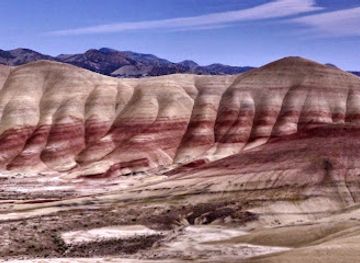
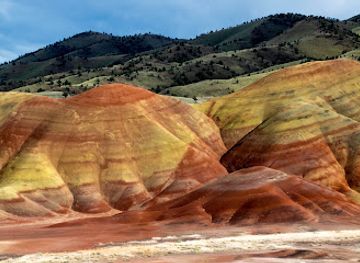
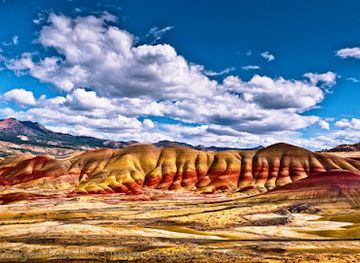
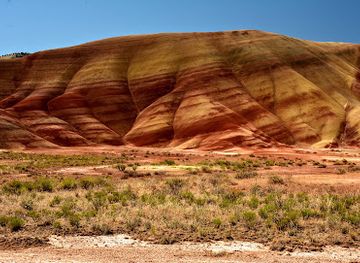
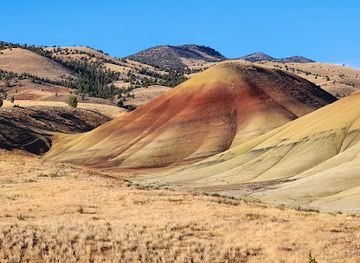
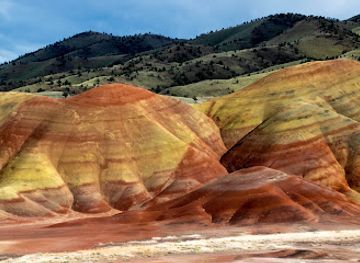
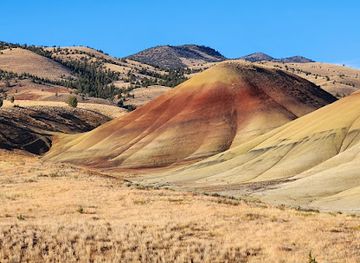
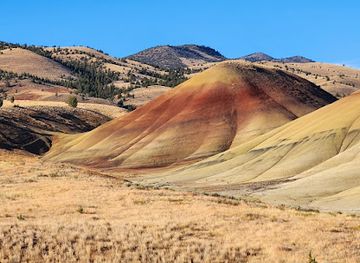
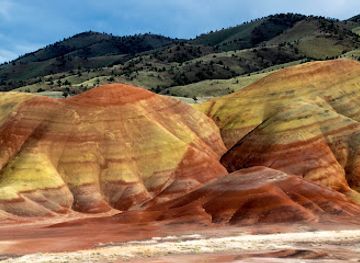
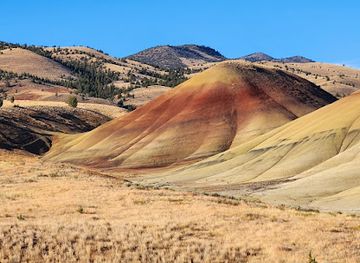
Painted Hills is the most visually distinctive unit of John Day Fossil Beds National Monument, a compact landscape of rolling claystone hills in central Oregon. Located near the small town of Mitchell, the unit is known for bands of red, gold, black and ochre earth that curve across dry slopes like layered brushstrokes. The colours reflect different minerals and ancient soil conditions, while the rounded formations reveal a geological record built up over millions of years.Read more about Painted Hills
A Landscape with Deep Time
Exploring the Unit
When is the best time to visit Painted Hills?
Best: May–June, September · 23–29°C| Month | High (°C) | Rainfall (mm) |
|---|---|---|
| January | 5 | 33 |
| February | 8 | 26 |
| March | 14 | 30 |
| April | 18 | 26 |
| May (best) | 23 | 24 |
| June (best) | 29 | 18 |
| July | 36 | 9 |
| August | 35 | 10 |
| September (best) | 28 | 17 |
| October | 19 | 24 |
| November | 10 | 34 |
| December | 5 | 38 |
Getting to and around Painted Hills
How to get there
Transportation
Best attractions in Painted Hills
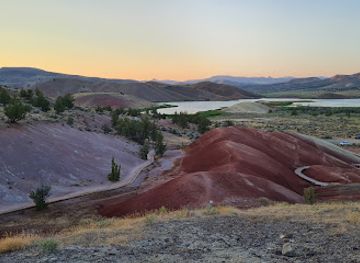
The principal attraction is the Painted Hills’ exposed sequence of rounded, mineral-coloured slopes, best viewed from the established trails and overlooks within the unit. Painted Cove Trail follows a short route through closely folded bands of red, yellow and gold earth, while Carroll Rim Trail provides a higher perspective across the formations and the surrounding John Day Basin. Red Scar Knoll offers another angle on the vivid scarlet and ochre surfaces. Interpretive information helps explain the fossil record and the environmental changes represented by the rocks, although the unit is primarily an outdoor landscape rather than a museum complex. Visitors interested in the wider national monument can continue by road to the Sheep Rock and Clarno units, which contain different geological exposures and fossil landscapes but are not adjacent to Painted Hills. Mitchell, the nearest town, provides a practical stopping point before or after exploring the monument.
-
Tourist attraction
John Day Fossil Beds National Monument
Explore the vibrant landscapes and ancient fossils of John Day Fossil Beds National Monument, a treasure trove of natural history in Oregon.
-
Tourist attraction
Painted Hills Overlook
Explore the stunning Painted Hills Overlook in Oregon, a geological marvel showcasing vibrant colors and breathtaking landscapes perfect for hiking and photography.
-
Tourist attraction
Painted Cove Trail
Explore the breathtaking Painted Cove Trail in Oregon, a stunning showcase of vibrant landscapes and unique geological formations perfect for hiking enthusiasts.
-
National reserve
John Day Fossil Beds National Monument - Painted Hills Unit
Explore the stunning Painted Hills Unit of John Day Fossil Beds National Monument, where vibrant colors and ancient landscapes await your discovery.
Best landmarks in Painted Hills
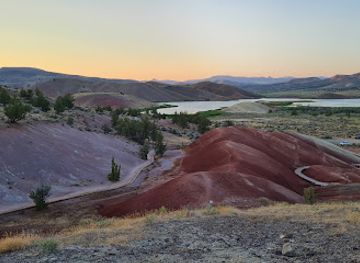
The Painted Hills themselves are the defining natural landmark: a succession of rounded claystone ridges marked by red, yellow, gold, black and pale mineral bands. Their appearance changes with moisture, sunlight and the angle from which they are viewed, while their significance comes from both their geological formation and their place within the fossil-rich John Day Basin. Carroll Rim is an important viewpoint landmark within the unit, looking across the coloured formations rather than representing a separate geological feature. The wider John Day Fossil Beds National Monument also includes the Sheep Rock and Clarno units, but these are separate landscapes many miles away. Nearby Mitchell is the principal historic settlement associated with visits to Painted Hills, serving as a gateway rather than a landmark within the formations themselves.
-
National reserve
John Day Fossil Beds National Monument - Painted Hills Unit
Explore the vibrant landscapes and rich fossil history at John Day Fossil Beds National Monument's Painted Hills Unit in Oregon.
Explore Painted Hills on the map
Plan your trip on one map. See where the top attractions, landmarks, restaurants and hotels are, and book hotels and experiences in a few clicks.
Best hotels in Painted Hills
Best restaurants in Painted Hills
Painted Hills has no developed dining district, so meals are generally arranged in Mitchell or other towns reached during a wider central Oregon journey. Mitchell provides the nearest small-town options, typically centred on modest cafés, diners or locally run eating places rather than a large restaurant market; availability can be limited, making advance planning sensible. The region’s food culture reflects ranching country and the high-desert interior, with straightforward American café fare, beef and other locally sourced agricultural products appearing more often than a specialised cuisine associated specifically with the formations. Travellers staying farther afield may find a broader selection in larger communities such as Prineville or Bend, but these are outside the Painted Hills area. Picnicking can be a practical part of a visit, provided food and water are carried in and all rubbish is removed in accordance with monument guidance.
-
Mountain peak
Painted Hills
Explore Oregon's Painted Hills: A vibrant showcase of nature's artistry and geological history waiting to be discovered.
Best bars in Painted Hills
Evening entertainment around Painted Hills is quiet and small-scale rather than nightlife-led. Mitchell, the nearest community, may offer the sociable atmosphere of a local pub, bar or casual hospitality venue when establishments are open, but visitors should not expect a concentration of nightclubs, live-music rooms or late-night entertainment. The wider John Day Basin is valued for dark skies, rural stillness and early starts on the road, so evenings often centre on accommodation, conversation and outdoor views rather than organised nightlife. More varied bars, breweries and performance venues are found in larger Oregon towns such as Bend, but they are outside the destination and require a substantial drive. Check local opening arrangements before relying on a particular evening venue, especially outside the busiest travel periods.
-
Vista point
Painted Hills Overlook
Experience the breathtaking beauty of Painted Hills Overlook, where vibrant colors and stunning landscapes await every visitor in Oregon.
-
Mountain peak
Painted Hills
Experience the breathtaking colors and geological wonders of the Painted Hills in Oregon, a natural masterpiece that captivates every visitor.
Best nightclubs in Painted Hills
Evening entertainment around Painted Hills is quiet and small-scale rather than nightlife-led. Mitchell, the nearest community, may offer the sociable atmosphere of a local pub, bar or casual hospitality venue when establishments are open, but visitors should not expect a concentration of nightclubs, live-music rooms or late-night entertainment. The wider John Day Basin is valued for dark skies, rural stillness and early starts on the road, so evenings often centre on accommodation, conversation and outdoor views rather than organised nightlife. More varied bars, breweries and performance venues are found in larger Oregon towns such as Bend, but they are outside the destination and require a substantial drive. Check local opening arrangements before relying on a particular evening venue, especially outside the busiest travel periods.
-
Mountain peak
Painted Hills
Explore the Painted Hills of Oregon, a stunning geological wonder featuring vibrant colors and rich history, perfect for nature lovers and adventurers alike.
Best shops in Painted Hills
Shopping at Painted Hills is limited because the unit has no commercial centre or substantial retail facilities. Mitchell is the nearest place to look for basic provisions, locally run services and practical supplies, while larger Oregon communities provide more extensive outdoor equipment and regional retail. The most characteristic purchases associated with the area are likely to be locally produced food, ranch-country goods, books or educational material connected with the John Day Fossil Beds, when available through nearby businesses or official visitor facilities elsewhere in the monument. Visitors should not expect a permanent craft market, designer shopping street or cluster of specialist boutiques at the trailheads. Buy fuel, water, snacks and any hiking essentials before setting out, and treat fossils, rocks and other natural materials as protected features rather than souvenirs.
-
Monument
John Day Fossil Beds National Monument
Discover the ancient secrets of John Day Fossil Beds National Monument, a stunning blend of geology, history, and vibrant landscapes in Oregon.
-
Vista point
Painted Hills Overlook
Explore the vibrant colors and stunning landscapes of Painted Hills Overlook in Oregon, a breathtaking vista point perfect for hiking and photography.
-
Hiking area
Painted Cove Trail
Explore the mesmerizing hues of Painted Cove Trail in Oregon, a unique hiking experience amidst stunning geological formations.
-
Mountain peak
Painted Hills
Discover the breathtaking colors and unique geology of the Painted Hills in Oregon, a stunning natural wonder perfect for photographers and nature lovers.
Get your free copy of our complete guide to Painted Hills, delivered straight to you.
Everything on this page, from attractions and restaurants to essentials and local phrases, in one PDF you can read offline, print or share.
Already have an account? Sign in
Your Painted Hills guide is ready.
We'll send it to · Not you? Sign out

Getting your guide ready…
We are putting together a fresh copy of the Painted Hills guide. This can take up to a minute.
This can take a few moments. If your browser asks, choose Allow so the download can start. You'll find the guide in your Downloads folder.
Nothing happened? Download it again
Sorry, the guide is taking longer than usual. Please try again in a minute, or get it by email instead.
Painted Hills essentials
Currency and Payment
Safety
Emergency Situations
Do's and Don'ts
Local Tips
From Eve
Local phrases worth knowing
You don't need to get them perfect. A few words go a long way, and locals appreciate the effort.
Basics
| English | Local | Say it |
|---|---|---|
| Hello | Howdy | [HOU-dee] |
| Goodbye | See ya later | [SEE ya LAY-ter] |
| Yes | Yup | [YUP] |
| No | Nah | [NAH] |
| Please/You're welcome | Please 'n thank ya | [PLEEZ 'n THANK ya] |
| Thank you | Much obliged | [MUCH uh-BLAHYD] |
| Excuse me/Sorry | Pardon me | [PAR-dun me] |
| How are you? | Howdy | [HOU-dee] |
| Fine. And you? | Jest fine. How 'bout y'all? | [JEST fine. HOW 'bout y'all?] |
| Do you speak English? | Y'all speak English? | [Y'all speak ING-glish?] |
| I don't understand | I reckon I don't git ya | [I REK-un I don't git ya] |
Eating & Drinking
| English | Local | Say it |
|---|---|---|
| I'd like to see the menu, please | Can I see what's cookin'? | [Can I see what's COO-kin'?] |
| I don't eat meat | I ain't no carnivore | [I AIN'T no CAR-nuh-vore] |
| Cheers! | Bottoms up! | [BOTTOMS up!] |
| I would like to pay, please | Check, please | [Check, please] |
Emergencies
| English | Local | Say it |
|---|---|---|
| Help! | SOS! | [SOS!] |
| Go away! | Git! | [Git!] |
| Call the Police! | Ring up the Sheriff! | [Ring up the SHER-iff!] |
| Call a doctor! | Get the doc! | [Get the doc!] |
| I'm lost | I'm turned around | [I'm turned around] |
| I'm ill | I'm feelin' poorly | [I'm feelin' POOR-lee] |
Shopping
| English | Local | Say it |
|---|---|---|
| I'd like to buy... | I'm fixin' to buy... | [I'm FIX-in' to buy...] |
| I'm just looking | Just browsin' | [Just BROW-zin'] |
| How much is it? | What's the damage? | [What's the DAM-ij?] |
| That's too expensive | That ain't worth the price | [That ain't worth the price] |
| Can you lower the price? | Can y'all do better on the price? | [Can y'all do BET-ter on the price?] |
Time & Numbers
| English | Local | Say it |
|---|---|---|
| What time is it? | What's the hour? | [What's the hour?] |
| It's one o'clock | It's one | [It's one] |
| Half past (10) | Half past ten | [Half past ten] |
| Morning | Mornin' | [Mornin'] |
| Afternoon | Afternoon | [Afternoon] |
| Evening | Evenin' | [Evenin'] |
| Yesterday | Yest'day | [Yest'day] |
| Today | Today | [Today] |
| Tomorrow | Tomorrah | [Tomorrah] |
| 1 | One | [One] |
| 2 | Two | [Two] |
| 3 | Three | [Three] |
| 4 | Four | [Four] |
| 5 | Five | [Five] |
| 6 | Six | [Six] |
| 7 | Seven | [Seven] |
| 8 | Eight | [Eight] |
| 9 | Nine | [Nine] |
| 10 | Ten | [Ten] |
Transport & Directions
| English | Local | Say it |
|---|---|---|
| Where's a/the...? | Where's the... | [Where's the...] |
| What's the address? | Where's it at? | [Where's it at?] |
| Can you show me (on the map)? | Can you point it out? | [Can you point it out?] |
| When's the next (bus)? | When's the next bus? | [When's the next bus?] |
| A ticket (to ....) | A ticket to... | [A ticket to...] |
History of Painted Hills
Volcanic Ash and Ancient Environments
The Painted Hills formed within the John Day Basin from layers of volcanic ash and other sediments deposited over millions of years. These materials accumulated in changing environments that included floodplains, forested areas and more open country. Later chemical alteration and weathering produced the distinctive mineral colours visible today: reds and yellows associated with iron-bearing materials, darker bands linked to soils and organic matter, and pale layers formed from altered volcanic deposits. The hills are therefore not painted rock in a literal sense, but an exposed record of ancient landscapes and changing conditions.
A Long Fossil Record
The wider John Day Basin contains one of North America’s most important sequences of Cenozoic fossil-bearing rocks. Plant and animal remains preserved in the region help scientists trace ecological change after the extinction of the dinosaurs, including the development of successive forests and mammal communities. The Painted Hills are one part of this larger scientific landscape. Their significance lies not only in their colour but also in the way their exposed strata belong to a geological setting that has helped reconstruct Oregon’s deep environmental past.
Indigenous Homelands and Later Settlement
The basin has long been part of the homelands and seasonal travel territories of Indigenous peoples, including communities associated with the Northern Paiute, Wasco and Warm Springs peoples. European American settlement expanded in the nineteenth century, bringing ranching, mining activity and new transport routes to the wider region. The dry interior environment shaped where people could live and work, while the surrounding valleys supported grazing and small communities. Mitchell, founded in the late nineteenth century, became one of the nearest service settlements for travellers crossing this part of central Oregon.
Scientific Recognition and Protection
Fossils from the John Day region attracted scientific attention during the nineteenth century, and the basin became increasingly important to palaeontological research. The John Day Fossil Beds were established as a national monument in 1975 to protect major fossil resources, geological formations and associated landscapes. The monument is divided into the Painted Hills, Sheep Rock and Clarno units, which are geographically separate rather than adjoining sections of one park. Protection has allowed research and public interpretation to continue while limiting damage to fragile formations and fossil-bearing deposits.
A Carefully Managed Visitor Landscape
Modern visitation at Painted Hills centres on short trails, viewpoints and quiet appreciation of the exposed formations. Its protected status reflects a shift from treating the basin primarily as a working landscape to recognising its scientific and cultural value as national heritage. Contemporary management focuses on conserving fossils, soils, vegetation and the visual character of the hills. Visitors encounter a landscape still shaped by erosion and weather, but access is directed along established routes so that repeated footsteps do not damage the soft formations that make the unit significant.
Painted Hills in Photos
Browse through our photo collection highlighting the charm and character of the destination.
Neighbouring destination travel guides
The closest destinations to Painted Hills, if you have time for more than one.
-

-

-

-

-


Swipe for more destinations
Explore more

Explore more of Wheeler County
Wheeler County, Oregon combines Painted Hills geology, fossil beds, ranch country, river canyons and quiet high-desert roads.
Explore Wheeler County
Explore more of Oregon
Discover Oregon's diverse landscapes, vibrant cities, and rich culture. From stunning coastlines to lush forests, this Pacific Northwest gem offers endless adventures.
Explore Oregon