

Silver Falls State Park Travel Guide - Free Web & App
Your ultimate guide to Silver Falls State Park. Discover top landmarks, proposed trips, and local tips. Free on the web or via the Evendo companion app.


Silver Falls State Park in Oregon features the Trail of Ten Falls, forested canyons, historic lodge and year-round hiking near Silverton and Salem.
Waterfalls and Forested Canyons
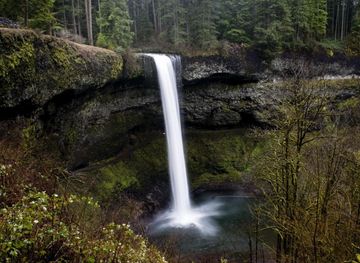
Silver Falls State Park lies in Oregon’s western foothills, about 20 miles east of Salem and near the small town of Silverton. Covering more than 9,000 acres, it is Oregon’s largest state park and is best known for the Trail of Ten Falls, a footpath following the forested ravine of Silver Creek. The route leads past a remarkable sequence of waterfalls, several of which can be viewed from paths passing behind the falling water. South Falls is the park’s most recognised feature, while Lower South Falls, North Falls and Winter Falls give the circuit its varied character. The canyon combines moss-covered rock, Douglas fir, western hemlock and deciduous woodland, with seasonal changes in water volume and colour.Read more about Silver Falls State Park
History and Visitor Character
Exploring the Park
When is the best time to visit Silver Falls State Park?
Best: June–August · 22–26°C| Month | High (°C) | Rainfall (mm) |
|---|---|---|
| January | 8 | 200 |
| February | 9 | 160 |
| March | 12 | 160 |
| April | 14 | 120 |
| May | 18 | 90 |
| June (best) | 22 | 50 |
| July (best) | 26 | 20 |
| August (best) | 26 | 20 |
| September | 22 | 50 |
| October | 16 | 120 |
| November | 11 | 180 |
| December | 8 | 200 |
Getting to and around Silver Falls State Park
How to get there
Transportation
Explore Silver Falls State Park on the map
Plan your trip on one map. See where the top attractions, landmarks, restaurants and hotels are, and book hotels and experiences in a few clicks.
Best hotels in Silver Falls State Park
Get your free copy of our complete guide to Silver Falls State Park, delivered straight to you.
Everything on this page, from attractions and restaurants to essentials and local phrases, in one PDF you can read offline, print or share.
Already have an account? Sign in
Your Silver Falls State Park guide is ready.
We'll send it to · Not you? Sign out

Getting your guide ready…
We are putting together a fresh copy of the Silver Falls State Park guide. This can take up to a minute.
This can take a few moments. If your browser asks, choose Allow so the download can start. You'll find the guide in your Downloads folder.
Nothing happened? Download it again
Sorry, the guide is taking longer than usual. Please try again in a minute, or get it by email instead.
Silver Falls State Park essentials
Currency and Payment
Safety
Emergency Situations
Do's and Don'ts
Local Tips
From Eve
Local phrases worth knowing
You don't need to get them perfect. A few words go a long way, and locals appreciate the effort.
Basics
| English | Local | Say it |
|---|---|---|
| Hello | Howdy | [haw-dee] |
| Goodbye | See ya | [see yah] |
| Yes | Yup | [yuhp] |
| No | Nah | [nah] |
| Please/You're welcome | Please/No worries | [pleez / no wurr-eez] |
| Thank you | Thanks a bunch | [thanks uh bunch] |
| Excuse me/Sorry | Pardon me/My bad | [par-dun me / my bad] |
| How are you? | Howdy partner? | [haw-dee par-tner?] |
| Fine. And you? | All good. You? | [awl good. yoo?] |
| Do you speak English? | Y'all speak English? | [yawll speak ing-glish?] |
| I don't understand | I'm lost | [ahm lost] |
Eating & Drinking
| English | Local | Say it |
|---|---|---|
| I'd like to see the menu, please | I'll take a gander at the grub, please | [ah'll take uh gan-der at the gruhb, pleez] |
| I don't eat meat | I'm a veggie | [ahm uh veh-jee] |
| Cheers! | Bottoms up! | [bot-ums up] |
| I would like to pay, please | I reckon it's time to settle the bill, please | [ah wreck-un its tahm tuh set-ul the bill, pleez] |
Emergencies
| English | Local | Say it |
|---|---|---|
| Help! | Send help! | [send help] |
| Go away! | Git! | [git] |
| Call the Police! | Ring the Sheriff! | [ring the shair-iff] |
| Call a doctor! | Fetch a doc! | [fetch uh doc] |
| I'm lost | I've gone astray | [ahv gone uh-stray] |
| I'm ill | I ain't feelin' right | [ahnt fee-lin rite] |
Shopping
| English | Local | Say it |
|---|---|---|
| I'd like to buy... | I'm fixin' to purchase... | [ahm fix-in tuh pur-chase] |
| I'm just looking | Just browsin' | [just brow-zin'] |
| How much is it? | What's the damage? | [wuts the dam-ij] |
| That's too expensive | That's a bit steep | [thats uh bit steep] |
| Can you lower the price? | Can ya do me a solid and drop the cost? | [can ya do me uh sahl-id and drop the cost] |
Time & Numbers
| English | Local | Say it |
|---|---|---|
| What time is it? | What's the hour? | [wuts the our] |
| It's one o'clock | It's high noon | [its hi noon] |
| Half past (10) | Half past ten | [half past ten] |
| Morning | Mornin' | [morn-in] |
| Afternoon | Afternoon | [after-noon] |
| Evening | Evenin' | [even-in] |
| Yesterday | Yest'day | [yest-duh] |
| Today | Today | [tuh-day] |
| Tomorrow | Tomorra | [tom-or-uh] |
| 1 | One | [wun] |
| 2 | Two | [too] |
| 3 | Three | [three] |
| 4 | Four | [four] |
| 5 | Five | [five] |
| 6 | Six | [six] |
| 7 | Seven | [seven] |
| 8 | Eight | [ate] |
| 9 | Nine | [nine] |
| 10 | Ten | [ten] |
Transport & Directions
| English | Local | Say it |
|---|---|---|
| Where's a/the...? | Where's the... | [wheres the...] |
| What's the address? | What's the street? | [whuts the street] |
| Can you show me (on the map)? | Can you point it out? | [can ya point it out] |
| When's the next (bus)? | When's the next ride? | [whens the next rahd] |
| A ticket (to ....) | A pass (to ....) | [a pass to] |
History of Silver Falls State Park
Volcanic Foundations and Forest Formation
The landscape around Silver Falls was shaped over long geological periods by volcanic activity and the erosion of basalt, a dark volcanic rock that forms the canyon walls and waterfall ledges. Silver Creek and its tributaries cut through these resistant layers, creating the narrow ravines and stepped cascades that define the park. The modern forest developed within Oregon’s moist Willamette Valley foothills, where Douglas fir, western hemlock, bigleaf maple and other native trees thrive in a climate of wet winters and relatively dry summers.
Indigenous Landscapes and Early Settlement
The area lies within the traditional homeland of Indigenous peoples of the central Willamette Valley, including communities associated with the Kalapuya cultural region. Native communities used the valley, foothills, waterways and forests for food, materials and travel before sustained Euro-American settlement. During the nineteenth century, farms, roads and timber activity expanded through the surrounding countryside, while the steep canyon landscape remained less intensively developed than the more accessible valley floor. Silverton, established in the nineteenth century, became the closest historic town and remains an important gateway.
From Private Land to Public Park
In the early twentieth century, Silver Falls attracted growing attention as a scenic destination, but parts of the area were threatened by proposals for logging and commercial development. Public campaigns helped preserve the waterfall country, and the state acquired land for a public park during the 1920s and 1930s. This transition changed the area from a working forest landscape with limited access into a protected recreational setting, while retaining the canyon’s natural character as the central attraction.
Civilian Conservation Corps Development
The Civilian Conservation Corps played a major role in developing Silver Falls State Park during the New Deal era. Corps workers built roads, trails, bridges, stone features and other facilities that enabled visitors to experience the waterfalls without transforming the canyon into an urbanised attraction. Silver Falls Lodge, constructed in the early 1940s in a rustic style using local materials, is the best-known surviving building from this period and is listed on the National Register of Historic Places. Much of the park’s visitor identity still rests on this combination of conservation and carefully designed public works.
A Protected Recreation Landscape
Silver Falls State Park has developed into a major destination for walking, picnicking, camping and nature observation while retaining a strong emphasis on forest and water conservation. The Trail of Ten Falls has become the park’s defining recreational route, linking individual cascades within one connected canyon experience. Management today balances heavy visitor use around South Falls and other popular sites with the protection of soils, vegetation, waterways and historic structures. Seasonal weather, trail conditions and maintenance work continue to influence how different parts of the park can be explored.
Silver Falls State Park in Photos
Browse through our photo collection highlighting the charm and character of the destination.
Neighbouring destination travel guides
The closest destinations to Silver Falls State Park, if you have time for more than one.
-

-

-

-
-


Swipe for more destinations
Explore more
Explore more of Marion County
Marion County, Oregon combines Salem’s museums and gardens with Willamette Valley farms, historic towns, river parks and Cascade foothill waterfalls.
Explore Marion County
Explore more of Oregon
Discover Oregon's diverse landscapes, vibrant cities, and rich culture. From stunning coastlines to lush forests, this Pacific Northwest gem offers endless adventures.
Explore Oregon