

Chapter House, York Travel Guide
Free Guide: Explore the stunning 13th-century octagonal Chapter House at York Minster, famed for its unique timber vaulted ceiling and medieval craftsmanship.


A brief summary of Chapter House
Explore the stunning 13th-century octagonal Chapter House at York Minster, famed for its unique timber vaulted ceiling and medieval craftsmanship.
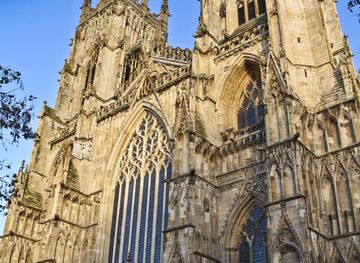
The Chapter House at York Minster, completed in the late 13th century, is an octagonal meeting chamber renowned for its unique timber vaulted ceiling without a central supporting column. Serving as a historic ecclesiastical assembly room, it features intricate stone carvings, large tracery windows, and an adjoining Mason's Loft used for medieval architectural design. This architectural gem exemplifies the Decorated Gothic style and stands as a testament to medieval craftsmanship and innovation in York.
On-site amenities
 Restrooms
 Information boards
 Visitor centre
 Seating areas
- Address
- The Cathedral and Metropolitical Church of St Peter in York, Deangate, Minster Yard, York YO1 7HH
Getting there
Train and Walk
Bus Service
Car and Parking
Discover more about Chapter House
Architectural Innovation and Design
The Chapter House at York Minster was constructed during the 1280s under Archbishop John le Romeyn and completed by the early 1290s. It is distinguished by its octagonal shape and an extraordinary vaulted ceiling supported not by a central stone column, as was typical, but by a complex timber roof structure. This design allowed for an open, column-free interior space, enhancing acoustics and visibility for meetings. The star-shaped ribbed vaulting and timber supports represent a remarkable engineering achievement of the medieval period.
Historical and Functional Significance
Historically, chapter houses functioned as meeting rooms where clergy and monastic communities conducted business and governance. York’s Chapter House was used for ecclesiastical assemblies and even parliamentary meetings by 1296. The space’s design with built-in stone seating around the perimeter facilitated communal gatherings and decision-making processes. Its location north of the choir and access through a vestibule from the north transept integrates it seamlessly into the Minster’s overall layout.
Artistic Details and Interior Features
The interior is adorned with large tracery windows characteristic of the early Decorated Gothic style, allowing abundant natural light to fill the chamber. Many of the carved stone heads and statues remain, some featuring detailed drilled eyes that add lifelike expression. The walls include a recessed sedilia with decorated rib-vaulted canopies on Purbeck marble piers, highlighting the craftsmanship of the period. Although much of the original painted decoration has been lost, the surviving elements provide insight into the iconographic schemes of the late 13th century.
The Mason’s Loft: A Medieval Design Workshop
Above the Chapter House lies the Mason’s Loft, accessed by a spiral staircase within the west wall. Completed in the 1290s, this loft served as a tracing room where the Master Mason created plaster designs and templates for stone carving. The floor still bears etched designs used as guides for the masons who worked on the Minster and other local churches. The loft also contains some original roof timbers and a medieval garderobe, illustrating the functional aspects of this workspace.
Context Within York Minster’s Gothic Evolution
The Chapter House was part of a broader Gothic rebuilding program initiated in the early 13th century, which transformed York Minster into one of England’s grandest cathedrals. Its construction followed the completion of the north and south transepts and preceded the building of the vast nave. The Chapter House’s Decorated Gothic style contrasts with the earlier Early English Gothic transepts and the later Perpendicular Gothic eastern arm, reflecting the architectural evolution over two centuries.
Legacy and Preservation
York Minster’s Chapter House remains a vital example of medieval ecclesiastical architecture and craftsmanship. Its innovative timber vaulting and octagonal plan influenced other English chapter houses and continue to inspire architects today. Preservation efforts maintain the stone carvings, stained glass, and structural integrity, allowing visitors to experience this remarkable space as it was intended: a place of gathering, governance, and artistic achievement.
Evendo Review Centre
 Google
Guest reviews
Best time to go
Quietest: Jan, Feb & Dec · before 6am or at 10pm
Busy times are Evendo estimates for a typical year, to help you plan. Actual crowds vary with events, school holidays and the weather.
Explore Chapter House on the map
A handpicked selection of must-see spots near Chapter House, mapped for you.
Get your free copy of our complete guide to Chapter House, delivered straight to you.
Everything on this page, from opening hours and how to get there to Eve’s tips and the best time to go, in one PDF you can read offline, print or share.
Already have an account? Sign in
Your Chapter House guide is ready.
We'll send it to · Not you? Sign out

Getting your guide ready…
We are putting together a fresh copy of the Chapter House guide. This can take up to a minute.
This can take a few moments. If your browser asks, choose Allow so the download can start. You'll find the guide in your Downloads folder.
Nothing happened? Download it again
Sorry, the guide is taking longer than usual. Please try again in a minute, or get it by email instead.
Other nearby places you may find interesting
The closest places of the same kind, if this one is not quite what you had in mind.
-
-
-
-
-


Swipe for more places
More to explore near Chapter House

 Best experiences near Chapter House
 Best hotels near Chapter House
 Best landmarks near Chapter House
 Best attractions near Chapter House
 Best shops near Chapter House
 Best restaurants near Chapter House
 Best bars near Chapter House
Do you manage this location?
Take control to get all the benefits, like improved information, better appearance, and stronger visibility across AI-powered discovery.
Explore more
Explore more of York
Explore York, a captivating city where medieval history meets modern charm. Discover York Minster, The Shambles, and a vibrant food scene in this must-visit UK destination.
Explore York
Explore more of United Kingdom
Discover the United Kingdom: A blend of rich history, stunning landscapes, and vibrant cities, offering a unique travel experience for every visitor.
Explore United Kingdom
