Lille Langebro
A graceful ribbon of steel for cyclists and pedestrians, Lille Langebro floats across Copenhagen’s Inner Harbour, blending everyday utility with sculptural elegance.
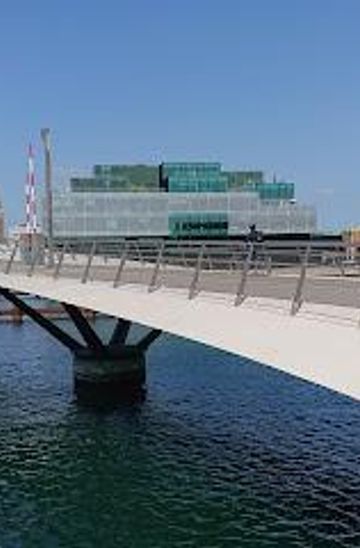
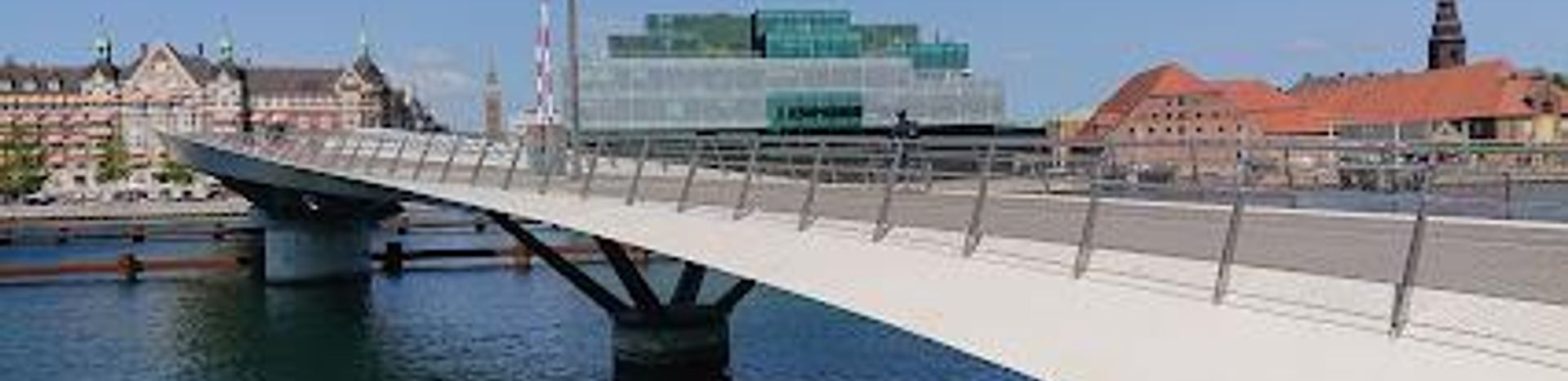
Lille Langebro is a sleek pedestrian and cycling bridge sweeping across Copenhagen’s Inner Harbour between Indre By and Christianshavn. Opened in 2019, the 160 m steel structure curves gently over the water like a pale ribbon, with separate lanes for walkers and cyclists and handrail lighting that turns it into a glowing line after dark. Its double-swing mechanism allows the central spans to rotate aside for passing boats, making it both everyday shortcut and kinetic urban sculpture.
A brief summary to Lille Langebro
- Lille Langebro, Copenhagen, Indre By, DK
- Click to display
- Duration: 0.5 to 1.5 hours
- Free
-
 Outdoor
- Mobile reception: 5 out of 5
- Monday 12 am-12 am
- Tuesday 12 am-12 am
- Wednesday 12 am-12 am
- Thursday 12 am-12 am
- Friday 12 am-12 am
- Saturday 12 am-12 am
- Sunday 12 am-12 am

Know before you go
Hi, I'm Eve. Here are a few practical things to know before exploring Lille Langebro.
- Time your visit for early morning or late evening to experience the bridge with softer light and fewer commuters, and to enjoy reflections of the skyline on the still harbour water.
- Walk one way and cycle the other if you can; the separated lanes make it easy to switch perspective while respecting the flow of daily Copenhagen bike traffic.
- Bring a windproof layer outside the summer months; the low deck sits fully exposed above the harbour and can feel noticeably cooler than the surrounding streets.
- Stay alert to fast-moving bicycles in the cycle lanes and keep to the pedestrian side for photos; the bridge is a key commuter route as well as a sightseeing spot.
- Visit after dark to see the concealed handrail lighting transform the bridge into a glowing curve of light, ideal for architectural night photography.
Do you manage this location?
Take control to get all the benefits, like improved information, better appearance, and stronger visibility across AI-powered discovery. Learn more
Activate your presenceOther nearby places you may find interesting
Getting There
-
Metro
From central Copenhagen, the simplest public transport access is via the metro. Ride any line serving Christianshavn Station, then walk about 10–15 minutes on mostly level pavements to reach the bridge. Standard single tickets within the city zones typically cost around 20–30 DKK, and metro trains run every few minutes from early morning until late at night.
-
City Bus
Several city bus routes run along axes parallel to the harbour and stop within a 10–15 minute walk of Lille Langebro on both the Indre By and Christianshavn sides. Travel times from the inner city are usually 10–20 minutes depending on traffic. A bus ticket within the central zones is generally in the 20–30 DKK range, and services are frequent during the day, with reduced frequency in the late evening.
-
Bicycle
Cycling is one of the most convenient ways to arrive, as Lille Langebro is integrated into Copenhagen’s network of marked bike lanes. From the historic centre or Vesterbro, expect a 5–15 minute ride on segregated cycle tracks almost the entire way. You can use a rental or shared bike from numerous docking points across the city; typical short-term rentals cost roughly 75–150 DKK for a day, with helmets and lights usually available as optional extras.
-
Walking
If you are already in the inner harbour area, the bridge is easily reached on foot along continuous, well-paved quayside routes. From City Hall Square or the main shopping streets, the walk is about 15–25 minutes each way on mostly flat terrain. The route is suitable for most mobility levels, though strong winds along the waterfront can make it feel more exposed in winter months.
For the on-the-go comforts that matter to you
-
 Seating Areas
-
 Trash Bins
-
 Information Boards
Discover more about Lille Langebro
A ribbon of steel across Copenhagen’s Inner Harbour
Lille Langebro, literally “Little Long Bridge”, glides low over Copenhagen’s Inner Harbour, just south of the city centre. Its pale, streamlined deck describes a subtle curve between the waterfront by BLOX and the quays of Christianshavn, creating an elegant counterpoint to the heavier traffic bridge of Langebro just upstream. Designed from the outset for people on foot and on two wheels, it provides a calm, car-free crossing between historic neighbourhoods.From a distance, the bridge reads as a slim white band with dark, almost recessive piers, so the structure appears to hover above the water. The bridge’s profile rises gently towards the middle to provide clearance for smaller vessels, giving anyone crossing a slow reveal of the skyline: the spires of the old town, the towers of Christianshavn and the shifting reflections of glass-fronted contemporary buildings.Design that plays with light, shade and movement
The architecture is all about controlled geometry and careful detailing. On each side of the deck, triangular wing-like edges dip down at the banks and sweep upward towards midspan, sharpening into a fine line where light meets shade. This simple move gives the bridge its characteristic silhouette and makes the structure feel thinner than it actually is.Handrails in brushed stainless steel frame the deck, filled with delicate mesh that keeps views open to the harbour. Discreet LED strips are hidden within the railings, illuminating both the walkway and the sculpted wings without visible fixtures. After dark, the structure becomes a twisting line of light, echoing in the water below and linking the city’s banks with a luminous stroke.A kinetic bridge built for everyday life
Beneath the refined surface lies sophisticated engineering. The bridge is split into five spans, with two central sections that can swing horizontally to create a passage for taller ships. When closed, mechanical and hydraulic components lock the moving parts together so precisely that the joint is almost imperceptible underfoot. When opened, the continuous curve suddenly breaks apart, offering a brief theatrical moment on the working harbour.At deck level, the layout is straightforward and generous: a wide cycleway divided into two lanes and a separate pedestrian path. The surfaces are robust and weather-resistant, designed to withstand year-round use in wind, rain and occasional snow. It is a piece of high-tech infrastructure that feels surprisingly human-scaled, with low parapets and clear sightlines making it easy to navigate, even at commuter rush hour.Connecting historic quarters and contemporary culture
Lille Langebro does more than shorten journeys; it stitches together different layers of Copenhagen. On one side lies the city centre with its museums, civic buildings and commercial streets. On the other is Christianshavn, laid out in the 17th century with canals and earth ramparts that once defended the harbour. The bridge’s curved alignment subtly echoes the long arc of those historic fortifications, making a quiet nod to the city’s past.Immediately by the western end stands the BLOX complex, home to the Danish Architecture Center and a cluster of creative and public spaces. The bridge funnels walkers and cyclists straight into this cultural hub, reinforcing the idea of the harbourfront as an active urban room rather than a barrier. In the opposite direction, its low height and open views draw you towards the quays and cobbled streets of Christianshavn, encouraging exploration on foot.A place to pause between city and water
Although Lille Langebro is primarily a route, it doubles as a viewing platform and quiet pause point. Midway across, the raised deck offers one of the best low-level vistas along the Inner Harbour, framed by passing kayaks, harbour buses and the occasional sailing boat. The subtle swell of the structure and its protective wings create a sense of enclosure without obstructing the panorama.In the early morning, you might share the bridge with joggers and determined cyclists; on bright evenings, it becomes a leisurely promenade with people stopping to photograph reflections or watch the sky change colour. Even in grey weather, the off-white steel catches muted light, and the minimal detailing keeps the focus firmly on the city and water it connects.Explore the best of what Lille Langebro has to offer















More about North Zealand
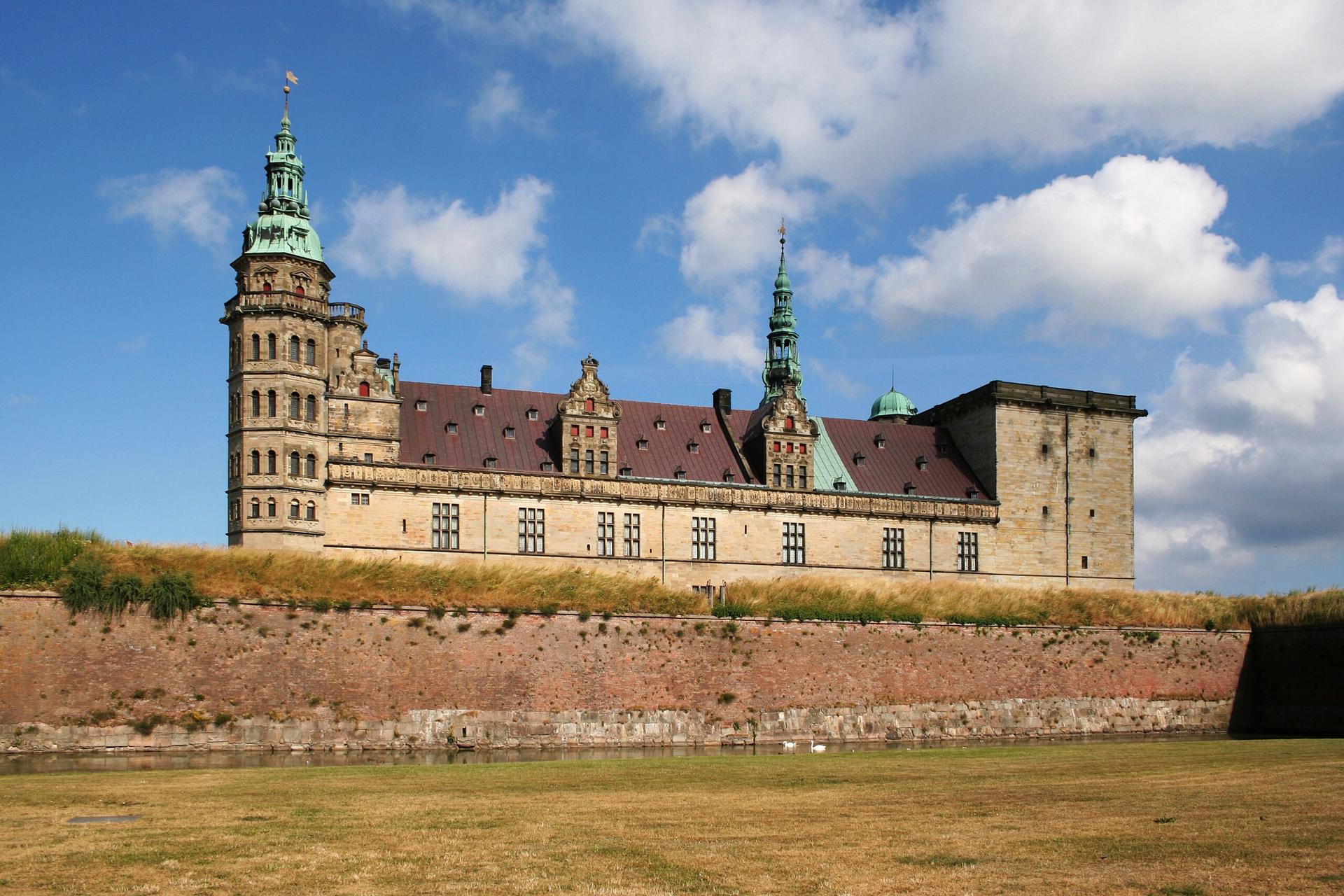
Explore North Zealand, Denmark's enchanting region of castles, beaches, and royal estates, perfect for history buffs, nature enthusiasts, and seaside lovers.
Tell me more about North Zealand
Stand on Nyhavnsbroen for the classic view of Nyhavn’s colourful facades, wooden ships and lively canal life where Copenhagen’s maritime past meets its relaxed present.

A modest former service house on Frederiksholms Kanal, quietly recalling the working lives behind Copenhagen’s royal stables and the grandeur of nearby Christiansborg.