Christiansborg Palace, Køge Travel Guide
Free Guide: Where Denmark’s monarchy and democracy share a single address, Christiansborg Palace layers 800 years of power, architecture and ceremony in the heart of Copenhagen.


A brief summary of Christiansborg Palace
Where Denmark’s monarchy and democracy share a single address, Christiansborg Palace layers 800 years of power, architecture and ceremony in the heart of Copenhagen.
Rising over the tiny island of Slotsholmen in central Copenhagen, Christiansborg Palace is Denmark’s powerhouse of politics and pageantry. Home to the Danish Parliament, Supreme Court and Prime Minister’s Office, it also houses the opulent Royal Reception Rooms, atmospheric ruins from a medieval fortress and working Royal Stables. Blending neo-Baroque, neoclassical and baroque remnants, it is the only building in the world where all three branches of government share space with a modern monarchy.
On-site amenities
 Restrooms
 Drink options
 Drinking water
 Food options
 Seating areas
 Sheltered areas
 Trash bins
 Information boards
 Visitor centre
Opening hours
- MonClosed
- Tue10 am–5 pm
- Wed10 am–5 pm
- Thu10 am–5 pm
- Fri10 am–5 pm
- Sat10 am–5 pm
- Sun10 am–5 pm
Opening hours as listed on the venue’s Google Business Profile. Hours can change for services and special events, so check with the venue before you go.
- Address
- Prins Jørgens Gård 1, 1218 København
- Phone
- Website
Getting there
Metro and short walk from central Copenhagen
City bus to Slotsholmen area
Bicycle from inner Copenhagen districts
On foot within the historic centre
Discover more about Christiansborg Palace
A seat of power on Copenhagen’s Castle Island
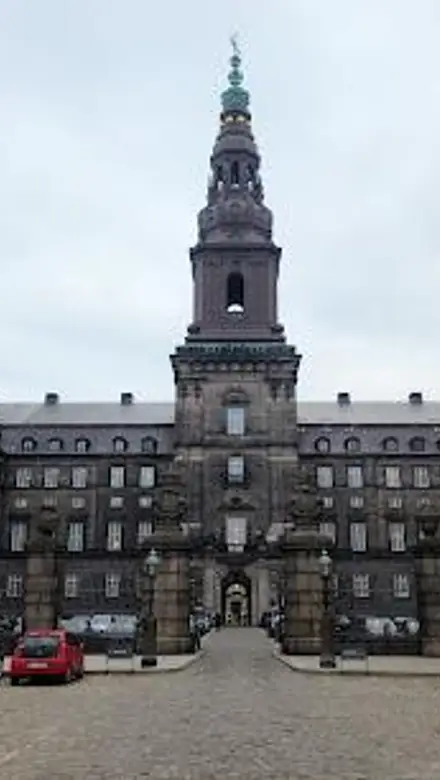
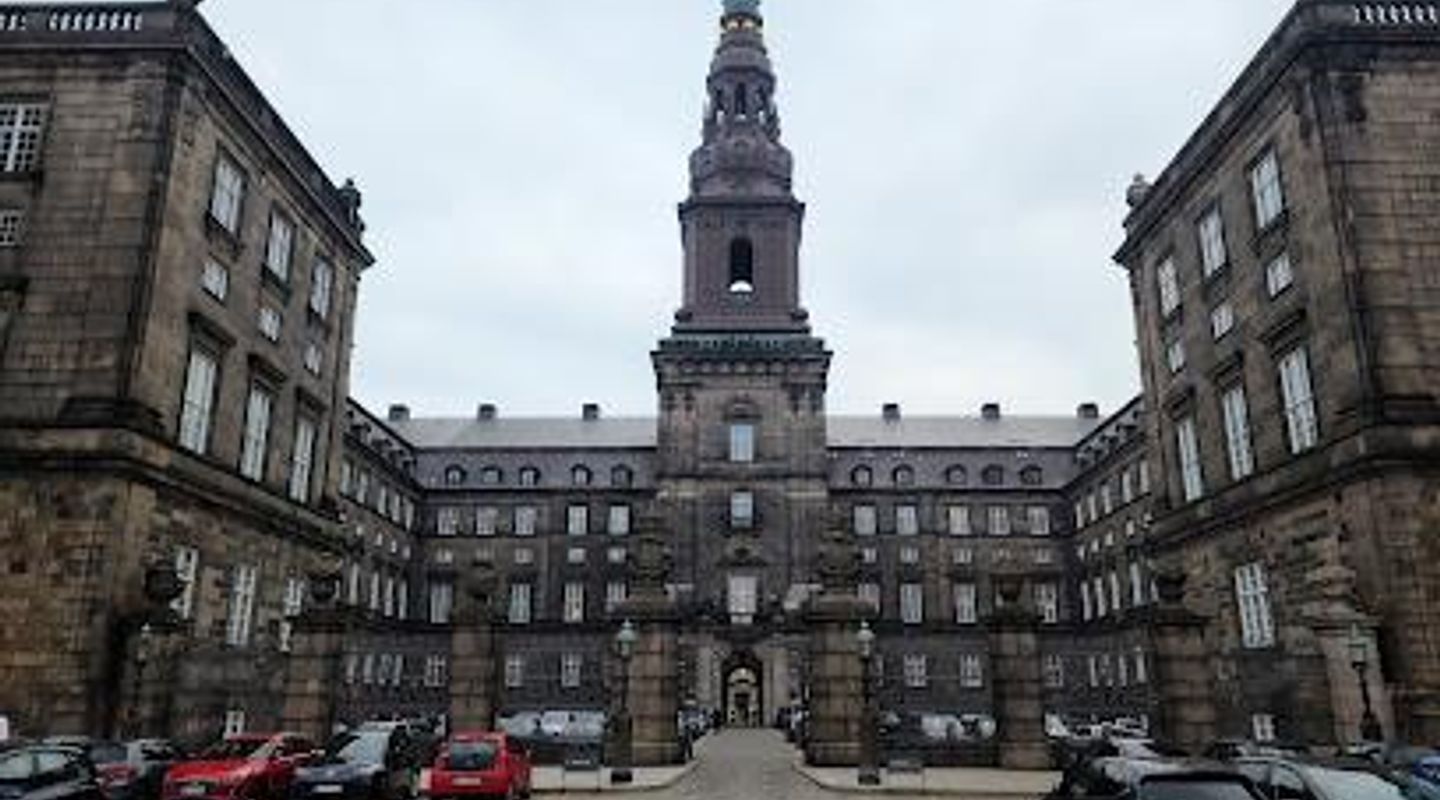
Christiansborg Palace dominates Slotsholmen, a small islet wrapped by canals in the historic heart of Copenhagen. From its high central tower, copper roofs and monumental façades, the complex makes clear that this has long been Denmark’s political stage. Today the palace uniquely houses the Danish Parliament, the Supreme Court and the Prime Minister’s Office, while select wings remain in ceremonial use by the Royal Family for state banquets, audiences and official celebrations.Wandering into the main courtyard, you stand on ground that has been fortified since the 12th century. Beneath your feet lie centuries of castles, palaces and defensive walls, successively rebuilt after fires, wars and shifting royal tastes. The current palace, completed in the 1920s, is the third Christiansborg and layers modern statehood onto a medieval foundation.
From Bishop Absalon’s fortress to royal residence
The story begins around 1167, when Bishop Absalon, the powerful churchman credited with founding Copenhagen, built a fortified castle here to guard the harbour and trade routes. That fortress stood for around two centuries before being destroyed in the late 1300s. Its successor, Copenhagen Castle, evolved into the principal residence of Danish kings and the centre of royal administration.In the 1700s King Christian VI swept away the old castle to erect the first Christiansborg Palace, a lavish baroque residence that was once the largest palace in northern Europe. That palace burned in 1794; a second, built in an elegant neoclassical idiom, followed in the early 1800s, only to be devastated by another fire in 1884. The present Christiansborg, constructed between 1907 and 1928, consciously weaves together echoes of its predecessors while embracing its new role as the home of constitutional power rather than a royal household.
Architecture that tells three different stories
Architecture lovers will notice that Christiansborg does not belong to a single era. The main palace and tower are designed in a historicist neo-Baroque style, all heavy stonework, statues and ornamentation that convey authority and continuity. Tucked within the complex, the palace chapel reflects early 19th‑century neoclassicism, with a restrained, light-filled interior and harmonious proportions that contrast with the more muscular exterior of the later palace.Elsewhere, the baroque riding grounds and show buildings, dating to the 18th century, survive from the first Christiansborg. Together, these layers turn the site into a three-dimensional timeline of Danish architecture, from baroque pomp through neoclassical clarity to early 20th‑century revivalism, all arranged around courtyards designed for parades, pageantry and public life.
Inside the Great Hall and royal state rooms
The palace’s most theatrical interiors are the Royal Reception Rooms, used for state dinners, royal audiences and diplomatic ceremonies. Visitors who enter via the grand King’s Staircase emerge into a suite of salons lined with gilded stuccowork, crystal chandeliers and portraits of monarchs and statesmen. Among these spaces, the Oval Throne Room stands out, its twin thrones facing French doors that open onto the balcony where new Danish monarchs are formally proclaimed.At the heart of this enfilade lies the Great Hall, a long, high-ceilinged chamber renowned for a cycle of 17 vibrant tapestries designed by artist Bjørn Nørgaard. Woven between 1990 and 2000, they reimagine a thousand years of Danish history in dense, colourful scenes that mix Viking ships and medieval kings with modern politics, creating an unexpectedly contemporary focal point in a very traditional setting.
Ruins, stables and the tower above the city
Beneath the palace courtyards, excavated ruins reveal the foundations of Bishop Absalon’s original fortress and the later Copenhagen Castle. Low-lit walkways lead past massive stone walls and remnants of moats, giving a tangible sense of how strategic this island once was. Above ground, the Royal Stables still house the royal horses during the colder months, along with historic coaches and gilded state carriages used for major ceremonies.Crowning it all is Christiansborg’s tower, the highest viewpoint in central Copenhagen. From its galleries you can look out across terracotta roofs, church spires and the harbour, tracing the geography that made this site so important. Between the subterranean ruins and the views from the tower, the palace spans the full vertical range of the city’s history in a single visit.
Experiencing Christiansborg in modern Copenhagen
Despite its grandeur, Christiansborg is very much a working building. On weekdays, the courtyards and colonnades buzz with politicians, civil servants and journalists heading to the Folketing, Denmark’s parliament, which meets in chambers within the palace. At the same time, museum staff welcome visitors to ticketed areas including the Royal Reception Rooms, the ruins and the Royal Kitchen, where historic copper pots and recreated table settings evoke preparations for royal banquets.Located within easy walking distance of many other central sights, the palace often anchors a wider exploration of Copenhagen’s historic core. You can easily combine time in the ceremonial rooms with quieter moments in the chapel or a circuit of the surrounding canals. Whether you come for constitutional history, royal spectacle, architecture or simply the city views, Christiansborg Palace offers insight into how Denmark’s monarchy and democracy have learned to share a single, symbolically charged address.
Evendo Review Centre
 Google
Guest reviews
Best time to go
Quietest: Jan, Feb & Mar · before 7am or from 8pm
Busy times are Evendo estimates for a typical year, to help you plan. Actual crowds vary with events, school holidays and the weather.
Explore Christiansborg Palace on the map
A handpicked selection of must-see spots near Christiansborg Palace, mapped for you.
Get your free copy of our complete guide to Christiansborg Palace, delivered straight to you.
Everything on this page, from opening hours and how to get there to Eve’s tips and the best time to go, in one PDF you can read offline, print or share.
Already have an account? Sign in
Your Christiansborg Palace guide is ready.
We'll send it to · Not you? Sign out

Getting your guide ready…
We are putting together a fresh copy of the Christiansborg Palace guide. This can take up to a minute.
This can take a few moments. If your browser asks, choose Allow so the download can start. You'll find the guide in your Downloads folder.
Nothing happened? Download it again
Sorry, the guide is taking longer than usual. Please try again in a minute, or get it by email instead.
Unlock the best of Christiansborg Palace
Skip-the-line tickets, guided tours with entry, and walking tours of the area, booked in a few clicks.
 Tour with entry
Copenhagen Self-Guided Tour
from $7.43 Tour with entry
Half Day Self-Guided Audio Walking Private Tour in Copenhagen
from $14.10 Tour with entry
GhostWalk Copenhagen: Self-Guided Audio Experience from StoryHunt
from $14.10 Tour with entry
The Murder by Christiansborg Palace: Interactive Mystery Hunt
from $26.54


Other nearby places you may find interesting
The closest places of the same kind, if this one is not quite what you had in mind.
-
Køge Miniby Step into Køge’s past at 1:10 scale, where hand-built model houses, harbour scenes and church spires recreate the market town of 1865 in a tranquil seaside garden.
-
Køge Museum Time‑travel through Køge’s past inside a 17th‑century merchant’s house where Viking treasures, buried secrets and a tranquil courtyard meet in one intimate museum.
-
Ølsemagle Revle A shifting sandbar of shallow lagoons, rich birdlife and wide sandy beaches, where Køge’s urban edge gives way to one of Zealand’s most evocative coastal nature reserves.
-
Solgårdsparken Romantic coastal park between Køge Bay and Tryggevælde River, where historic garden design, tranquil nature, play areas and reflective audio stories meet in one green retreat.
-
Vandkunsten - Stationspladsen A sculptural fountain anchoring Køge’s station square, where moving water, stone and light turn a busy transport hub into an inviting urban meeting place.
Swipe for more places
More to explore near Christiansborg Palace

 Best experiences near Christiansborg Palace
 Best hotels near Christiansborg Palace
 Best landmarks near Christiansborg Palace
 Best attractions near Christiansborg Palace
 Best shops near Christiansborg Palace
 Best restaurants near Christiansborg Palace
 Best bars near Christiansborg Palace
Do you manage this location?
Take control to get all the benefits, like improved information, better appearance, and stronger visibility across AI-powered discovery.
Explore more
Explore more of Køge
Explore Køge, Denmark's coastal gem, with its medieval charm, beautiful marina, and close proximity to the stunning Stevns Klint UNESCO World Heritage site.
Explore Køge
Explore more of Denmark
Discover Denmark: A perfect blend of history, modern design, and the cozy concept of hygge. Explore vibrant cities, serene landscapes, and world-class cuisine.
Explore Denmark