Frederik's Church, Koge Travel Guide
Copenhagen’s monumental Marble Church, crowned by one of Europe’s largest domes, unites royal ambition, Baroque grandeur and serene worship in Frederiksstaden.
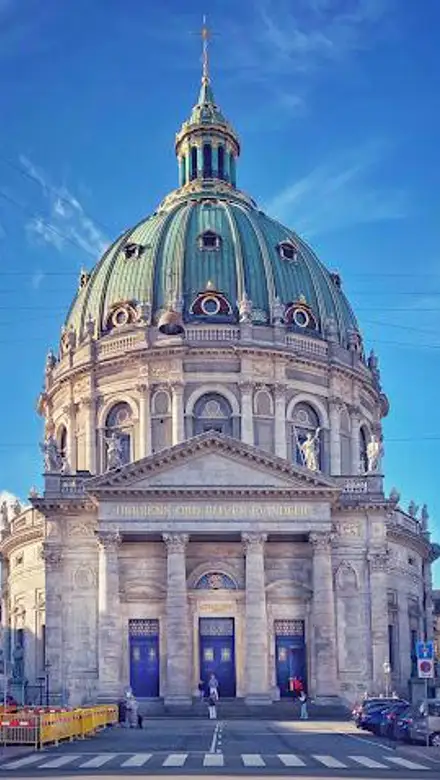
Frederik's Church, better known as the Marble Church, anchors Copenhagen’s elegant Frederiksstaden district with its immense copper-green dome – one of the largest in Europe. Conceived in the mid-18th century as a royal monument and finally consecrated in 1894 after more than a century of delay, it blends Baroque grandeur with Nordic restraint. Step inside for soaring frescoed ceilings, marble-clad pillars and a calm circular nave, or climb the dome on select days for panoramic views over Amalienborg Palace, the harbour and the city skyline. A working Lutheran parish church, it remains both a place of worship and one of Copenhagen’s most iconic landmarks.
A brief summary to Frederik's Church
- Frederiksgade 4, Copenhagen, Indre By, 1265, DK
- Click to display
- Click to display
- Duration: 0.5 to 2 hours
- Free
-
 Indoor
- Mobile reception: 5 out of 5
- Monday 10 am-5 pm
- Tuesday 10 am-5 pm
- Wednesday 10 am-5 pm
- Thursday 10 am-5 pm
- Friday 10 am-5 pm
- Saturday 10 am-5 pm
- Sunday 12:30 pm-5 pm

Know before you go
Hi, I'm Eve. Here are a few practical things to know before exploring Frederik's Church.
- Plan your visit for mid-morning or late afternoon on weekdays to enjoy the nave with softer light and fewer people than around lunchtime.
- Check current dome opening times in advance; access is typically by set time slots and may be weather-dependent or seasonal.
- Walk to Amalienborg’s square and the waterfront to appreciate the formal axial view that lines up the church, palace and opera house.
- Remember it is an active parish church: dress respectfully, speak quietly and avoid photography during services and ceremonies.
- Bring a light jacket if you plan to climb the dome; the stairway and gallery can feel noticeably cooler and breezier than the nave.
Do you manage this location?
Take control to get all the benefits, like improved information, better appearance, and stronger visibility across AI-powered discovery. Learn more about listing your business on Evendo
Activate your presenceOther nearby places you may find interesting
The closest places of the same kind, if this one is not quite what you had in mind.
Explore Frederik's Church on the Map
A handpicked selection of must-see spots near Frederik's Church, mapped for you.
Unlock the Best of Frederik's Church
Buy tickets
-
No tickets available
Book tours with entry


Getting There
-
Metro
From central Copenhagen, take the M3 or M4 metro line to Marmorkirken Station, which sits directly beside Frederik’s Church. The ride from Nørreport or Kongens Nytorv typically takes 3–6 minutes, with trains running every few minutes throughout the day. A single 2-zone ticket usually costs around 20–25 DKK and is valid across metro, bus and S-train within the inner city.
-
City Bus
Several city bus routes run through the Frederiksstaden area; services along Store Kongensgade or nearby Bredgade place you within a 5–8 minute walk of the church. Typical journey times from the inner city are 10–20 minutes depending on traffic, and fares match metro pricing, around 20–25 DKK for a 2-zone ticket. Buses operate frequently during the day, with reduced frequency in the late evening.
-
Bicycle
Copenhagen’s cycle-friendly streets make it easy to reach Frederik’s Church by bike from most central districts in about 5–15 minutes. Dedicated bike lanes lead through the city centre and into Frederiksstaden, and there are usually railings or designated stands nearby for locking bikes. Riding is generally flat and suitable for casual cyclists, but be mindful of cobblestones and busy junctions in peak commute hours.
-
On Foot from City Hall Square
From the City Hall Square area, a pleasant urban walk to Frederik’s Church through the historic centre and past Kongens Nytorv typically takes 25–35 minutes at a relaxed pace. The route is mostly flat and on paved sidewalks, suitable for most visitors, though those with limited mobility may prefer public transport due to the overall distance and occasional cobblestones.
For the on-the-go comforts that matter to you
-
 Restrooms
-
 Seating Areas
-
 Information Boards
Discover more about Frederik's Church
A royal vision at the heart of Frederiksstaden
Frederik's Church stands at the centre of Frederiksstaden, the 18th-century royal district laid out to celebrate 300 years of the Oldenburg royal dynasty. Commissioned by King Frederik V and designed by court architect Nicolai Eigtved, the church was conceived as the spiritual and visual focal point of a grand new neighbourhood of palaces and mansions. In 1749 the king himself laid the foundation stone, marking the start of what was intended to be Denmark’s most impressive church.The ambitions were immense. The church was planned as a monumental Baroque building lined with Norwegian marble, echoing the great basilicas of Rome. But the scale, and the cost, soon became a burden. After Eigtved’s death the project passed to French architect Nicolas-Henri Jardin, plans were reworked, and political and financial turmoil eventually halted construction. For more than a century the site remained a half-finished ruin, a reminder of an unfinished royal dream.From picturesque ruin to completed masterpiece
In the 19th century a renewed push to complete the church gathered pace. Civic voices and churchmen argued for finishing the monument that dominated the district as an elegant ruin. Industrialist Carl Frederik Tietgen eventually provided the capital needed, commissioning architect Ferdinand Meldahl to realise a version of the original design. Budget constraints meant a change from solid marble to limestone faced with marble, but the overall Baroque character and monumental dome were preserved.After decades of renewed work, the church was finally consecrated in 1894, 145 years after the first stone was laid. The completion transformed the skyline of Copenhagen. What had long been an abandoned shell became a fully realised landmark, its green dome aligned on a powerful axial view running from the harbour and the Opera House through Amalienborg Palace to the church itself.The great dome and its serene interior
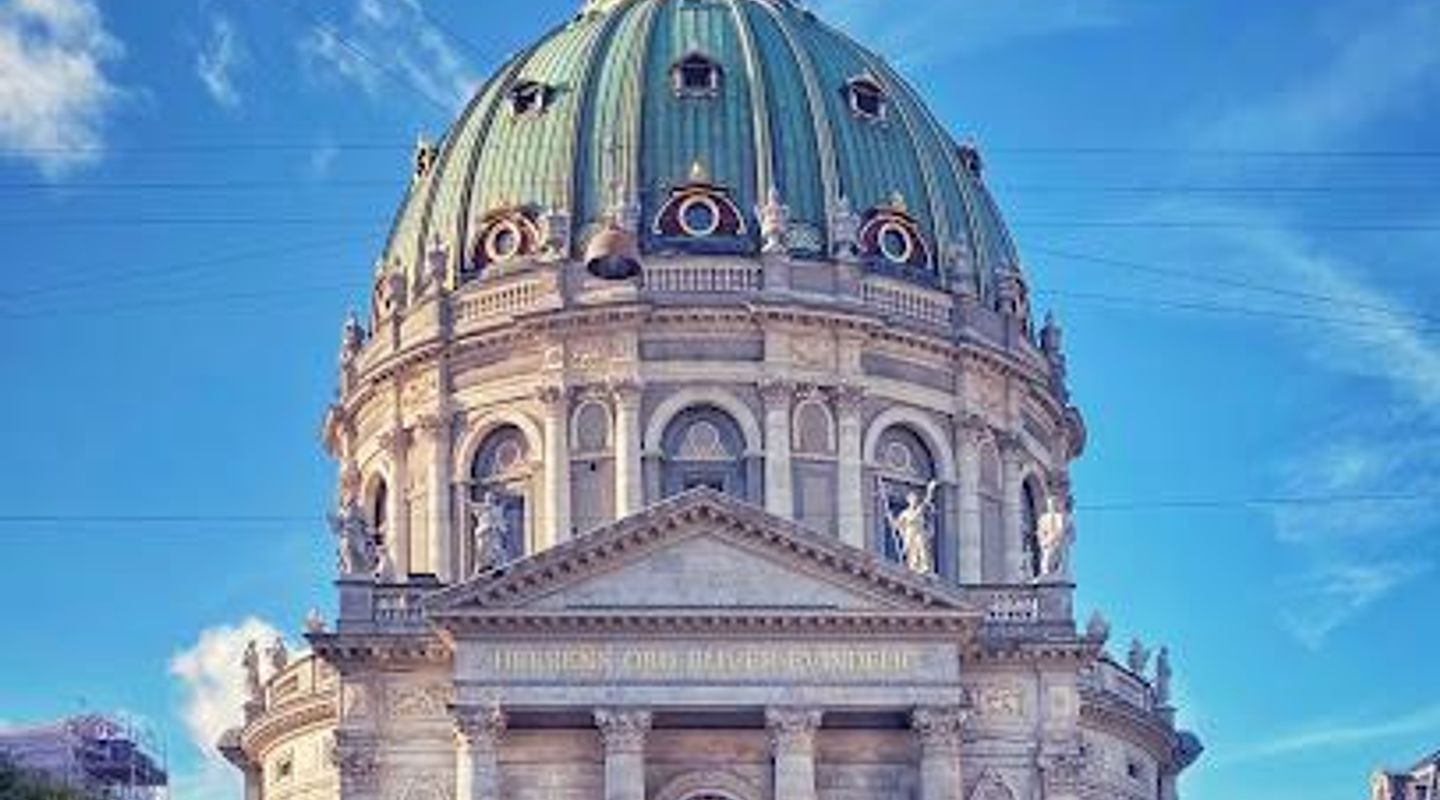
The most striking feature of Frederik's Church is its immense dome, inspired by St Peter’s in Rome. With a diameter of about 31 metres, it ranks among the largest church domes in Europe and dominates the cityscape with its copper-clad, weathered-green silhouette. Twelve massive pillars carry the weight of the circular structure, creating a sense of balance and strength as you step inside.Within the nave, the space rises about 46 metres to the base of the dome, where frescoes of the Apostles encircle the interior. Warm light filters through high windows, catching the pale stone, gilded details and painted decoration. Beneath the dome, symbolic medallions and biblical inscriptions frame views towards the Baroque altar, while elegant columns and marble floors emphasise the church’s ceremonial geometry.A living parish church in the modern city
Despite its monumental scale, Frederik’s Church functions as a neighbourhood parish church within the Evangelical-Lutheran Church in Denmark. Regular services, baptisms and weddings shape its weekly rhythm, and the sound of organ music frequently fills the vast interior. On many Fridays and Saturdays the bells ring out for bridal processions, adding a festive note to the otherwise tranquil atmosphere of the area.The building’s role as both landmark and local church gives it a distinctive character. You may find quiet moments of reflection between services, or encounter rehearsals and small concerts that bring the grand acoustics to life. Information about religious life and cultural events is usually available just inside, and staff and volunteers help balance the church’s spiritual role with its appeal as a major architectural attraction.Views, perspectives and the surrounding ensemble
On selected days, visitors can climb to a gallery near the top of the dome, rewarded with sweeping views over rooftops, the royal palaces and the harbour. From here, the urban planning of Frederiksstaden becomes clear: the octagonal square of Amalienborg below, the straight axis to the waterfront, and the interplay between church, palace and opera house.At ground level, the church repays a slow walk around its exterior. From Amalienborg’s square, the dome rises perfectly framed between royal façades. From the opposite side on Store Kongensgade, the building’s mass and drum are more apparent. Around the church, elegant streets, courtyards and gardens complete the impression of a carefully composed royal quarter, with Frederik’s Church as its spiritual and visual anchor.












Your all‑in‑one travel companion app
Explore expert travel guides, compare and book tours, experiences, hotels, and more—all from the palm of your hand. Download now for seamless trip planning wherever your wanderlust takes you.


Explore More of Koge
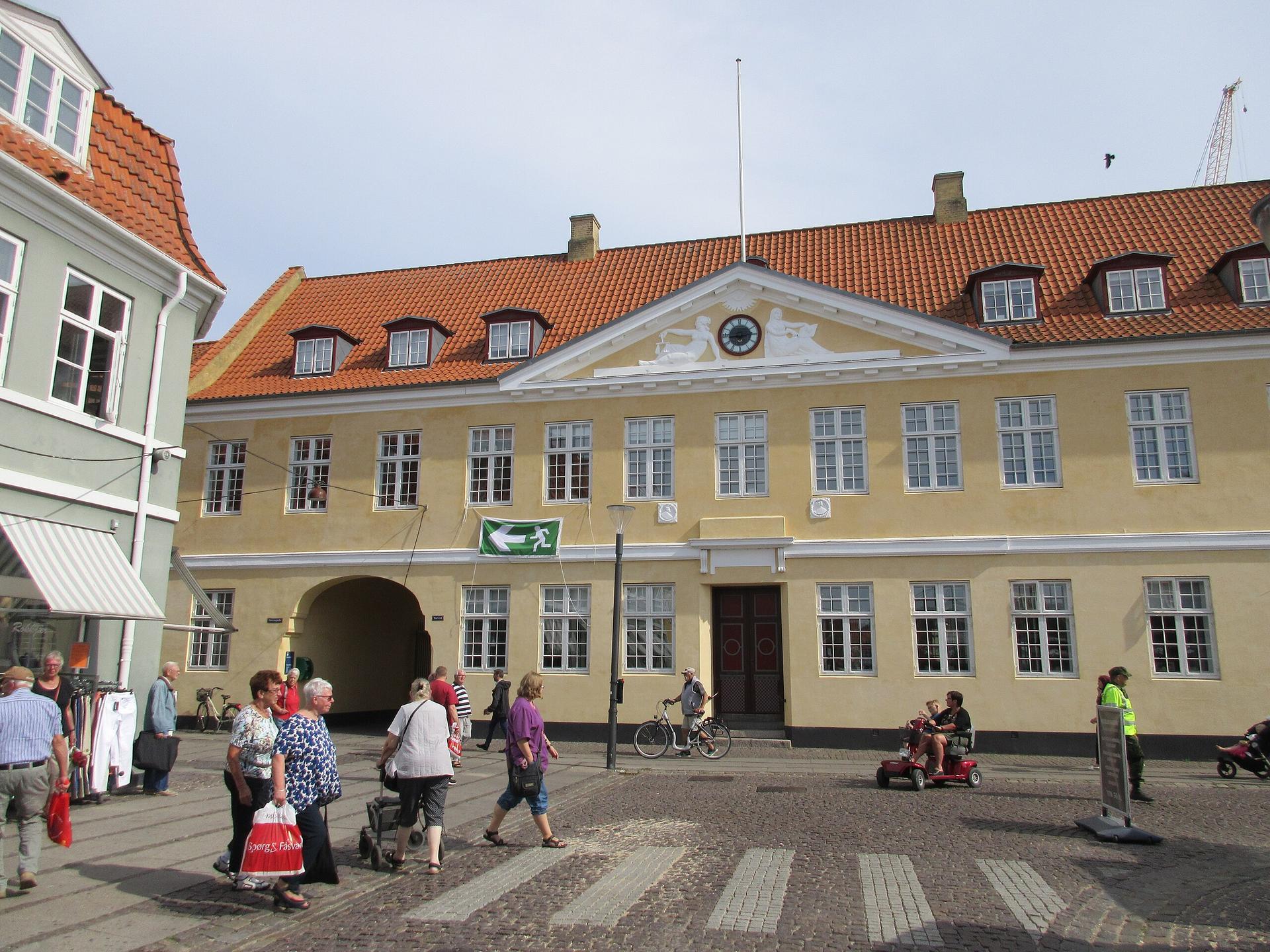
Looking beyond Frederik's Church? Discover Koge for broader travel guides, local hot-spots, and regional highlights.
Explore Koge