Odense Cathedral - St. Canute's Church, Odense Travel Guide
Free Guide: A luminous Brick Gothic cathedral in central Odense, where Denmark’s last Viking king, royal tombs and a masterpiece altarpiece share a serene, living sacred space.


A brief summary of Odense Cathedral - St. Canute's Church
A luminous Brick Gothic cathedral in central Odense, where Denmark’s last Viking king, royal tombs and a masterpiece altarpiece share a serene, living sacred space.
Odense Cathedral, also known as St. Canute’s Church, is a soaring Brick Gothic landmark in the heart of Odense, named for King Canute IV, Denmark’s last Viking king and first canonised saint. Inside its bright, high nave you’ll find an exquisite 16th‑century altarpiece by Claus Berg, royal tombs, and a crypt where the reliquaries of Saint Canute and his brother Benedict rest – a rare fusion of medieval piety, royal history, and serene Scandinavian church architecture.
On-site amenities
 Restrooms
 Seating areas
 Sheltered areas
 Trash bins
 Information boards
 Visitor centre
Opening hours
- Mon12 pm–4 pm
- Tue10 am–4 pm
- Wed10 am–4 pm
- Thu10 am–4 pm
- Fri10 am–4 pm
- Sat10 am–4 pm
- Sun12 pm–4 pm
Opening hours as listed on the venue’s Google Business Profile. Hours can change for services and special events, so check with the venue before you go.
- Address
- Klingenberg 19, 5000 Odense
- Phone
- Website
Getting there
Train and short walk from Odense Station
City bus within Odense
Bicycle within Odense
Taxi from Odense Station or city districts
Discover more about Odense Cathedral - St. Canute's Church
A Gothic cathedral at the heart of Odense
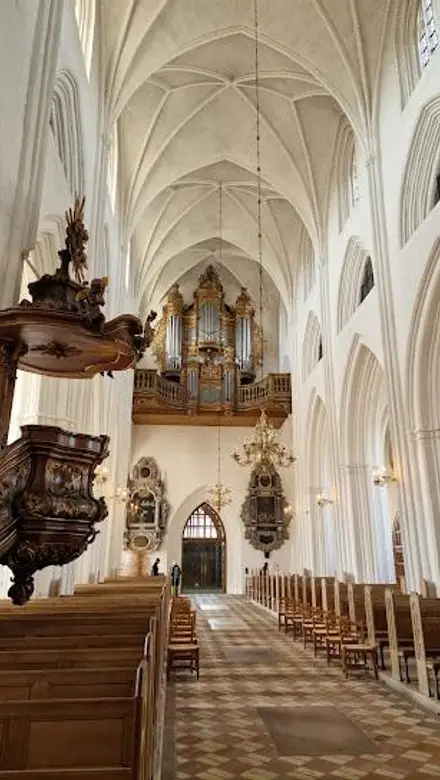
Odense Cathedral, or St. Canute’s Church, rises in red brick above the old centre of the city, its tall tower and sharply pointed gables marking one of Denmark’s finest Brick Gothic churches. Step through the modest portal and the exterior’s austerity gives way to a surprisingly luminous interior: a long, slender nave, whitewashed walls and ribbed vaults that pull your gaze upward. The architecture feels at once solemn and airy, embodying the northern Gothic ideal of height, light and clarity.Built mainly in the 14th and 15th centuries to replace an earlier stone church, the cathedral’s form is characteristically Danish: restrained ornament, elongated proportions, and careful brickwork that rewards a closer look. Walking the central aisle, you pass sturdy clustered pillars and understated side chapels that hint at centuries of additions and restorations, yet the whole still reads as a cohesive medieval space.
The story of King Canute and his martyrdom
The cathedral takes its name from King Canute IV, who ruled Denmark from 1080 to 1086 and is often described as the country’s last Viking king. His attempt to strengthen royal power and church privileges ended violently when a peasant revolt forced him to seek sanctuary in a nearby church. There, in front of the altar, he, his brother Benedict and their companions were killed, an episode that quickly gave rise to tales of martyrdom.Within a generation, Canute was canonised and his relics were transferred to a church on this site, transforming Odense into a major pilgrimage destination in the Middle Ages. That long tradition of veneration still shapes the atmosphere of the cathedral today; even in its current Lutheran form, the building feels anchored by the presence of a royal saint whose life and death helped define Denmark’s medieval identity.
Crypt, reliquaries and traces of the first church
Beneath the chancel lies one of the cathedral’s most compelling spaces: the crypt. This low, subtly lit chamber preserves fragments of the earlier travertine church that stood here around the year 1100, including sections of heavy stone walls that contrast with the delicate brickwork above. In the floor you can see tombstones of nobles and royals, reminders that this was long a favoured burial place for the powerful.At the heart of the crypt stand two wooden shrines containing the skeletal remains of King Canute and Benedict. The reliquaries, with their quiet, almost understated craftsmanship, stand more as historical witnesses than as objects of lavish display. Information panels explain how the shrines were once hidden during the Reformation and rediscovered centuries later. The setting is intimate and contemplative, a space where the political drama of 11th‑century Denmark suddenly feels very close.
Royal tombs and a magnificent Renaissance altarpiece
Back in the main church, the eye is inevitably drawn to the great altarpiece behind the high altar. Carved in the early 1500s by the sculptor Claus Berg, it is a dense, gilded forest of saints, apostles and biblical scenes. The carving combines late Gothic intricacy with emerging Renaissance naturalism: draped garments ripple in painted folds, faces carry individual expressions, and small narrative details reward patient viewing.The cathedral is also a royal resting place. Among those buried here are King Hans and Christian II, whose tombs connect the building to the story of the Danish monarchy in the late Middle Ages and early modern period. Their understated monuments, set within such a stripped‑back northern interior, heighten the sense that political power and spiritual aspiration once met in this space.
Music, daily rhythm and contemporary worship
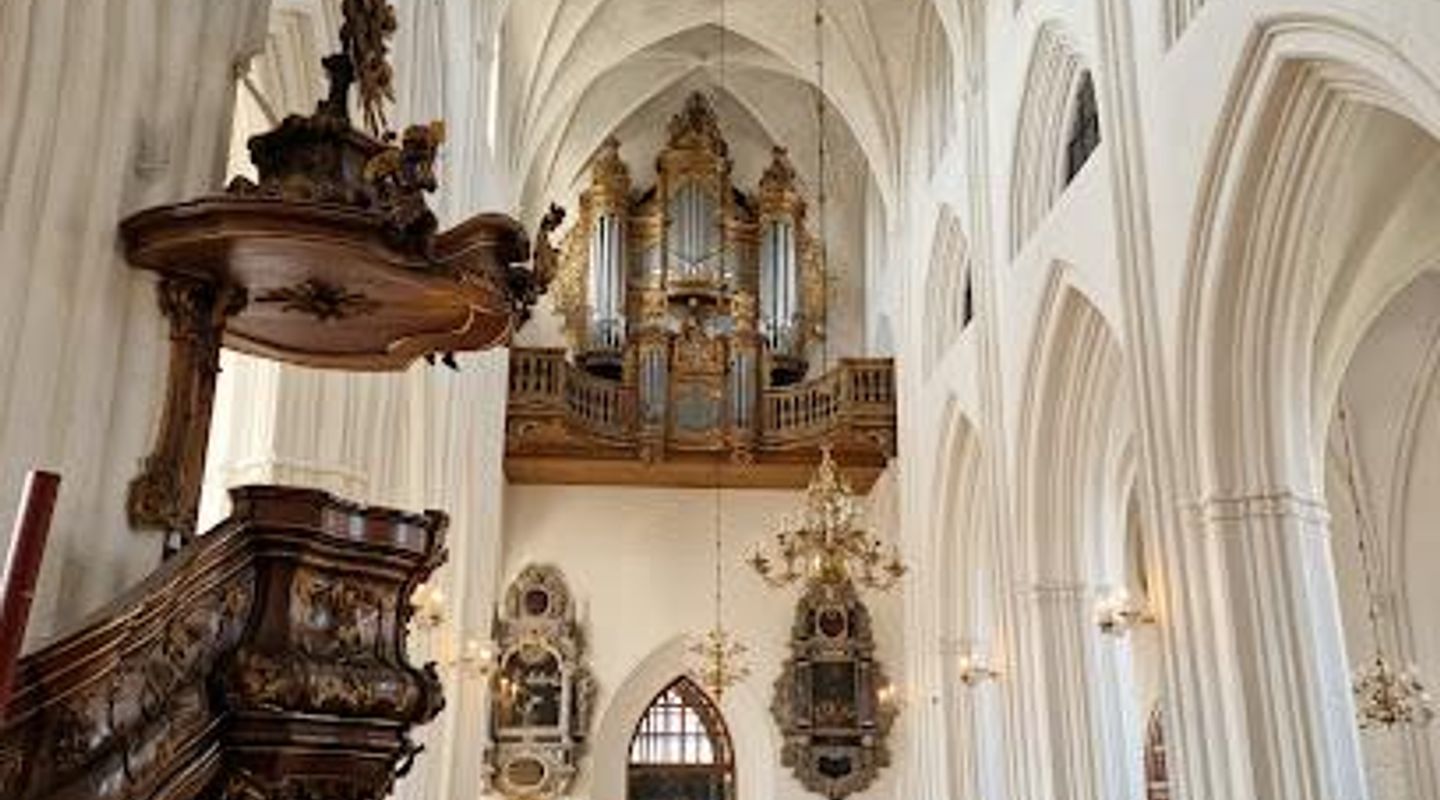
Odense Cathedral is not only a monument but an active parish church. On many days, the interior fills with organ music from the large instrument at the west end, whose richly carved façade dates back centuries even though its workings have been modernised over time. Regular services, midday prayers and concerts add a living soundtrack to the historic surroundings, subtly changing how the space feels from hour to hour.The daily rhythm is gentle rather than busy. At one moment you may find quiet individual prayer in the pews; at another, a small group listening to a guide in front of the altarpiece; later, the hush of the nave is broken only by the distant sounds of Odense drifting in through a half‑open door. It is a place where the city’s contemporary life brushes up against a thousand years of Christian worship.
Experiencing atmosphere in the city centre
Because the cathedral stands just steps from Odense’s pedestrian streets, it is easy to weave into a broader exploration of the old town. The exterior, framed by neighbouring buildings and small open spaces, offers good vantage points to appreciate the vertical rhythm of buttresses, windows and tower against the often changeable Danish sky.Inside, the overall impression is one of calm order. Light filters through tall, clear windows rather than dramatic stained glass, giving an even glow that shifts with the weather and time of day. Whether you linger over the details of the altarpiece, descend to the crypt, or simply sit for a few quiet minutes in a pew, the cathedral offers a thoughtful pause in the centre of Odense, connecting architectural elegance with some of the country’s most resonant royal and religious stories.
Evendo Review Centre
 Google
Guest reviews
Best time to go
Quietest: Jan, Feb & Mar · before 7am or from 9pm
Busy times are Evendo estimates for a typical year, to help you plan. Actual crowds vary with events, school holidays and the weather.
Explore Odense Cathedral - St. Canute's Church on the map
A handpicked selection of must-see spots near Odense Cathedral - St. Canute's Church, mapped for you.
Get your free copy of our complete guide to Odense Cathedral - St. Canute's Church, delivered straight to you.
Everything on this page, from opening hours and how to get there to Eve’s tips and the best time to go, in one PDF you can read offline, print or share.
Already have an account? Sign in
Your Odense Cathedral - St. Canute's Church guide is ready.
We'll send it to · Not you? Sign out

Getting your guide ready…
We are putting together a fresh copy of the Odense Cathedral - St. Canute's Church guide. This can take up to a minute.
This can take a few moments. If your browser asks, choose Allow so the download can start. You'll find the guide in your Downloads folder.
Nothing happened? Download it again
Sorry, the guide is taking longer than usual. Please try again in a minute, or get it by email instead.
Unlock the best of Odense Cathedral - St. Canute's Church
Skip-the-line tickets, guided tours with entry, and walking tours of the area, booked in a few clicks.


Other nearby places you may find interesting
The closest places of the same kind, if this one is not quite what you had in mind.
-
-
-
-
-


Swipe for more places
More to explore near Odense Cathedral - St. Canute's Church
-
 Best experiences near Odense Cathedral - St. Canute's Church
-
 Best hotels near Odense Cathedral - St. Canute's Church
-
 Best landmarks near Odense Cathedral - St. Canute's Church
-
 Best attractions near Odense Cathedral - St. Canute's Church
-
 Best shops near Odense Cathedral - St. Canute's Church
-
 Best restaurants near Odense Cathedral - St. Canute's Church
-
 Best bars near Odense Cathedral - St. Canute's Church


Do you manage this location?
Take control to get all the benefits, like improved information, better appearance, and stronger visibility across AI-powered discovery.
Explore more

Explore more of Odense
Discover Odense, Denmark's enchanting city where fairy tales come to life amidst historic streets, vibrant culture, and scenic beauty.
Explore Odense
Explore more of Denmark
Discover Denmark: A perfect blend of history, modern design, and the cozy concept of hygge. Explore vibrant cities, serene landscapes, and world-class cuisine.
Explore Denmark