

The Darning Needle, Odense Travel Guide
Free Guide: A provocative Hans Christian Andersen–inspired granite sculpture on Odense’s main shopping street, where a simple needle becomes a playful, ambiguous urban conversation.


A brief summary of The Darning Needle
A provocative Hans Christian Andersen–inspired granite sculpture on Odense’s main shopping street, where a simple needle becomes a playful, ambiguous urban conversation.
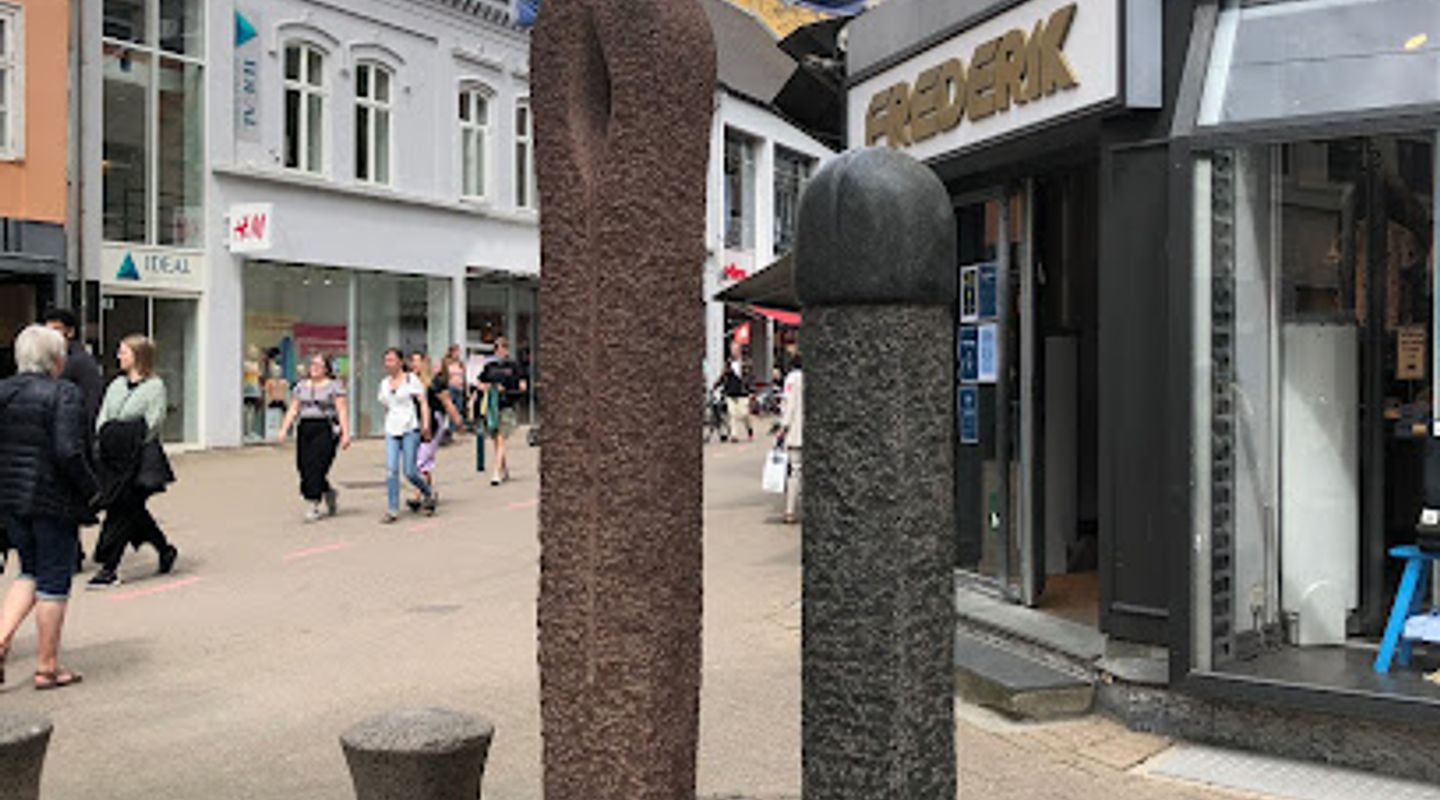
Tucked into the pedestrian bustle of Vestergade in central Odense, The Darning Needle is a provocative granite sculpture by Frede Troelsen, inspired by Hans Christian Andersen’s lesser-known fairy tale. Erected in 1988, its two abstract needle forms in red and black granite symbolise the tale’s darning needle and pin while also hinting at themes of pride, gender and desire. Free to view at any time, it is one of Odense’s most debated Andersen-related artworks.
On-site amenities
 Restrooms
 Drink options
 Drinking water
 Food options
 Seating areas
 Trash bins
 Information boards
- Address
- Vestergade 48, 5000 Odense
Getting there
On foot from central Odense
From Odense Banegård Center by public transport
By bicycle in central Odense
Discover more about The Darning Needle
A fairy tale brought into stone
The Darning Needle stands just off Vestergade, in the heart of Odense’s shopping streets, yet it is rooted firmly in the world of Hans Christian Andersen. Created in 1988 by Danish sculptor Frede Troelsen, the work is based on Andersen’s 1840s tale about a vain darning needle that considers itself finer than all the other tools around it. In the original story, the needle’s snobbery leads it through gutters, mud and broken glass; here, that journey is distilled into two bold, granite forms.Troelsen chose materials with care. One figure, representing the darning needle, is carved from Swedish red granite, its surface partially rough, partially polished. The other, slimmer form symbolises a pin and is shaped from dark Bornholm granite capped with a glossy, black "head". Together they translate Andersen’s moral about pride and downfall into a tactile, physical encounter in the middle of the city.
Ambiguous forms and hidden meanings
On first glance, the sculpture reads as a pair of stylised needles, leaning and intersecting in an almost playful dialogue. Look a little longer and the forms suggest something more charged: curves, hollows and protrusions that many interpret as a visual conversation between feminine and masculine. Troelsen deliberately embraced this ambiguity, using abstraction to hint at the tension between softness and hardness, receptivity and penetration.This layered symbolism connects back to Andersen’s tale, where everyday objects reveal secret worlds of emotion and status. The Darning Needle, convinced of its superiority, becomes a mirror for human vanity. In granite, the story’s themes of self-importance and vulnerability are reworked into a compact sculptural drama, open to personal interpretation whether you know the fairy tale or not.
Part of Odense’s Andersen landscape
Odense is scattered with public sculptures referencing Andersen’s stories, from steadfast tin soldiers to wild swans and fragile paper boats. The Darning Needle is one of the more compact pieces in this informal open-air collection, but it occupies a prominent position amid shops, cafés and everyday errands. Encountering it unexpectedly, you are reminded that Andersen’s imagination still threads through the modern city.Unlike the more figurative statues nearby, this work is resolutely abstract. There are no recognisable characters or narrative scenes, only simplified shapes that invite you to supply the story yourself. For visitors tracing an Andersen-themed walk through Odense, it offers a change of tone: sharper, wittier and more conceptual than many of its bronze neighbours.
A quiet sculpture with a noisy reputation
For years after its installation, The Darning Needle simply existed as part of the streetscape, familiar to locals and easily overlooked by those hurrying past. More recently, its suggestive forms have sparked heated debate, especially when highlighted in municipal promotions of the city’s art. The same curves that an art historian might read as a gender metaphor can strike others as deliberately risqué.Standing by the sculpture, you may notice this friction in real time. Some people barely glance at it, treating it as urban furniture. Others stop, point, laugh or exchange comments, suddenly aware of what the shapes might resemble. The work’s power lies in this ability to shift from invisible to impossible-to-ignore, depending on your angle, mood and imagination.
Experiencing the piece up close
The Darning Needle is entirely open and free to approach. You can walk all the way around the two granite elements, noticing how they change against the backdrop of surrounding shopfronts and paving. From certain viewpoints the forms almost align, evoking two needles stitched into the city’s fabric; from others they separate, becoming individual characters in an ongoing dialogue.Because it sits on a busy pedestrian route, the sculpture is best appreciated at a slightly quieter moment, when you can linger without being swept along by the crowd. Soft Danish daylight emphasises the contrast between the red and black surfaces, while low evening sun brings out the polished highlights. In rain, the granite darkens and gleams, underscoring the tale’s association with gutters and flowing water.
A small stop with a long aftertaste
Most visits to The Darning Needle are brief: a pause between shops, a quick photo, a moment of curiosity on an Andersen-themed stroll. Yet the sculpture has a way of lingering in memory. Its scale is modest, but the questions it poses about vanity, identity and how we read bodies into abstract art are surprisingly long-lived.Whether you arrive already familiar with Andersen’s story or encounter it for the first time here, the sculpture invites you to rethink a simple object. A darning needle becomes a character, then a symbol, then a pair of stones that reveal more about the viewer than about the granite itself. In a city famous for fairy tales, this is one of the places where the moral is carved not on a page, but in the street beneath your feet.
Evendo Review Centre
 Google
Guest reviews
Best time to go
Quietest: Jan, Feb & Mar · before 7am or from 10pm
Busy times are Evendo estimates for a typical year, to help you plan. Actual crowds vary with events, school holidays and the weather.
Explore The Darning Needle on the map
A handpicked selection of must-see spots near The Darning Needle, mapped for you.
Get your free copy of our complete guide to The Darning Needle, delivered straight to you.
Everything on this page, from opening hours and how to get there to Eve’s tips and the best time to go, in one PDF you can read offline, print or share.
Already have an account? Sign in
Your The Darning Needle guide is ready.
We'll send it to · Not you? Sign out

Getting your guide ready…
We are putting together a fresh copy of the The Darning Needle guide. This can take up to a minute.
This can take a few moments. If your browser asks, choose Allow so the download can start. You'll find the guide in your Downloads folder.
Nothing happened? Download it again
Sorry, the guide is taking longer than usual. Please try again in a minute, or get it by email instead.
Other nearby places you may find interesting
The closest places of the same kind, if this one is not quite what you had in mind.
-
-
-
-
-


Swipe for more places
More to explore near The Darning Needle

 Best experiences near The Darning Needle
 Best hotels near The Darning Needle
 Best landmarks near The Darning Needle
 Best attractions near The Darning Needle
 Best shops near The Darning Needle
 Best restaurants near The Darning Needle
 Best bars near The Darning Needle
Do you manage this location?
Take control to get all the benefits, like improved information, better appearance, and stronger visibility across AI-powered discovery.
Explore more

Explore more of Odense
Discover Odense, Denmark's enchanting city where fairy tales come to life amidst historic streets, vibrant culture, and scenic beauty.
Explore Odense
Explore more of Denmark
Discover Denmark: A perfect blend of history, modern design, and the cozy concept of hygge. Explore vibrant cities, serene landscapes, and world-class cuisine.
Explore Denmark
