

Papirbåden
Free Guide: A delicate paper boat turned gleaming sculpture, Papirbåden floats on Odense’s Fairytale Garden lake, quietly celebrating H.C. Andersen’s “Steadfast Tin Soldier.”


A brief summary of Papirbåden | H.C. Andersen
A delicate paper boat turned gleaming sculpture, Papirbåden floats on Odense’s Fairytale Garden lake, quietly celebrating H.C. Andersen’s “Steadfast Tin Soldier.”
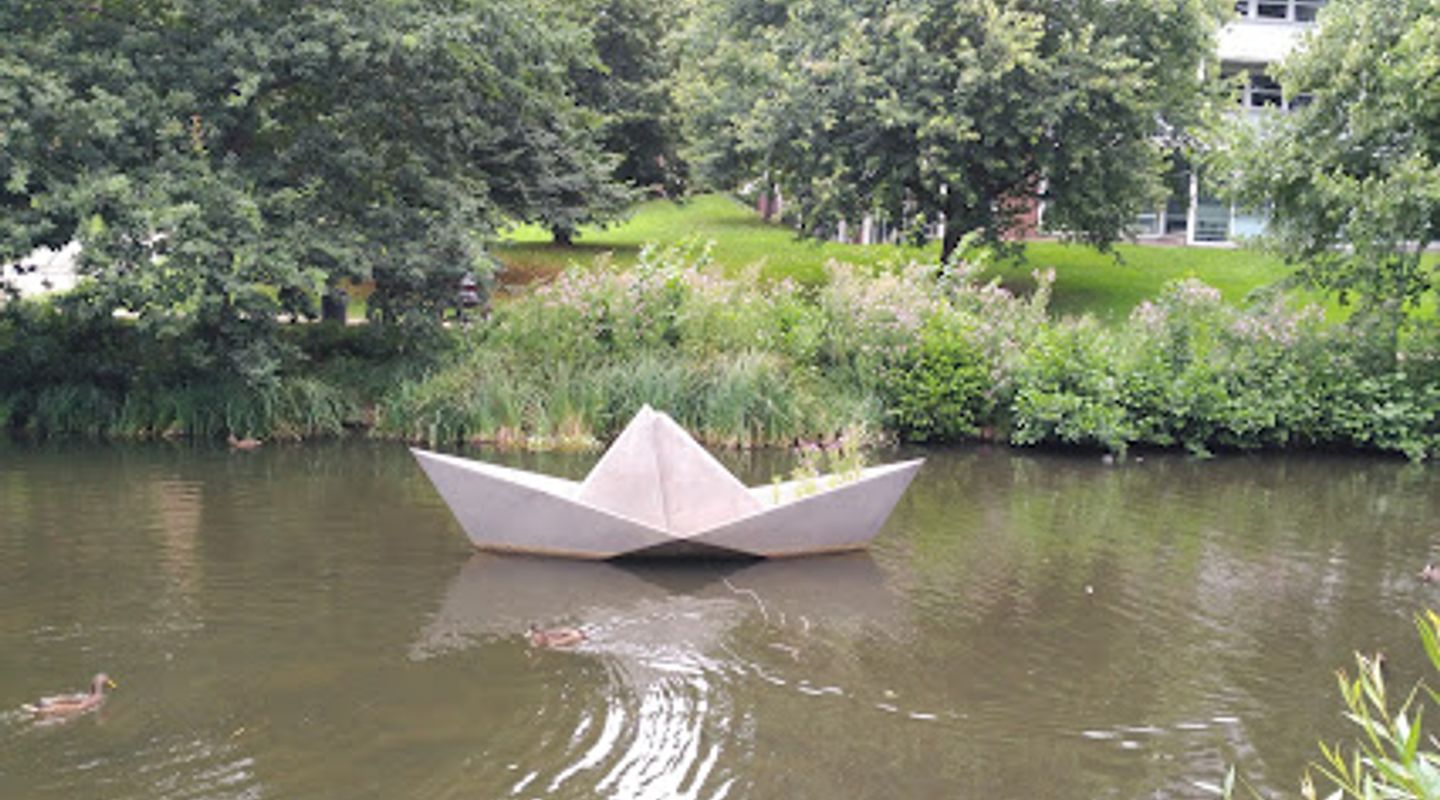
Floating gently on the lake in Odense’s Fairytale Garden, Papirbåden is a gleaming metal sculpture shaped like a delicate paper boat, inspired by Hans Christian Andersen’s tale “The Steadfast Tin Soldier.” Surrounded by landscaped greenery, flowerbeds and views of nearby church spires, this small but evocative artwork captures the bittersweet romance and quiet drama of Andersen’s universe. It’s an easy, atmospheric stop along any walking route through central Odense’s Hans Christian Andersen sites.
On-site amenities
 Seating areas
 Trash bins
 Information boards
 Restrooms
Opening hours
- Every dayOpen 24 hours
Opening hours as listed on the venue’s Google Business Profile. Hours can change for services and special events, so check with the venue before you go.
- Address
- Odense Å
Getting there
On foot from central Odense
City bus within Odense
Bicycle in the city
Discover more about Papirbåden | H.C. Andersen
A fairy-tale boat in the heart of Odense
Papirbåden, or The Paper Boat, seems at first glance like a child’s folded scrap of paper, set adrift on the still water of the Fairytale Garden in central Odense. Step closer and you see it is crafted from gleaming metal, its sharp folds catching light and reflections from the surrounding pond. The sculpture appears to “sail” quietly in place, anchored in the small lake with lawns, flowerbeds and mature trees forming a soft green frame.The setting is part of what makes the piece memorable. Church towers and historic roofs rise beyond the treetops, while paths curve gently around the water’s edge. Even on a busy day in the city, the immediate impression here is calm: the slow ripple of the water, the rustle of leaves, perhaps a duck gliding past the boat as if escorting it on an imagined journey.
From tin soldier to sculpted symbol
The sculpture pays tribute to Hans Christian Andersen’s story “The Steadfast Tin Soldier,” where a toy soldier, swept away by fate, eventually sails in a paper boat along gutters and streams. In the tale, that fragile vessel carries him toward both danger and his beloved ballerina, turning a simple child’s game into a symbol of devotion and courage in the face of uncertainty.Here in Odense, Andersen’s hometown, the paper boat becomes a sculpted symbol for that moment in the story: the fragile, hopeful voyage into the unknown. The choice of durable metal to depict something as delicate as folded paper underlines the staying power of Andersen’s imagination, still floating through the city generations after the stories were first told.
The Fairytale Garden as an open-air storybook
Papirbåden is just one of several sculptures scattered through the Fairytale Garden, each echoing a different tale or character. Nearby, a statue of Andersen himself keeps watch over the lawns, while other figures from his stories appear around the city, turning Odense into an informal open-air gallery.The garden itself dates back to the 19th century and feels like a small urban refuge. Benches along the water invite you to pause and read, sketch the reflections of the boat, or simply watch the play of light on its metallic surfaces. The gentle scale of the space makes it easy to appreciate details: the angles of the hull, the mirrored sky on the steel, the way the sculpture changes mood with shifting weather.
A quiet pause on the Andersen trail
Many visitors weave Papirbåden into a broader walk linking Andersen’s house, childhood home, cathedral and the riverside parks. The boat offers a natural pause on this circuit, requiring no ticket, queue or structured visit, just a few unhurried minutes by the water. Children often recognise the shape instantly, while adults tend to connect it to memories of folding paper boats or hearing Andersen’s stories.The site works in all seasons: spring flowers reflected around the boat, high-summer greenery, autumn leaves drifting onto the water, even winter days when the metallic folds stand out against bare branches and low northern light. It is a modest piece in scale, but one that rewards anyone who slows down long enough to let the story behind it come to mind.
Small details that bring the story to life
What lingers is the interplay between sculpture and surroundings. On overcast days the boat can look almost monochrome, a quiet silhouette on the dark water. On bright afternoons it throws back glints of silver and blue, as if catching some invisible current. Stand at different points along the shore and the folds of its hull rearrange into new patterns.In this way Papirbåden functions both as a tribute to a specific fairy tale and as a reminder of Andersen’s broader themes: journeys, longing, transformation and the thin line between play and peril. For a brief moment beside the lake in Odense, a simple boat in a city garden becomes a vessel for memory and imagination.
Evendo Review Centre
 Google
Guest reviews
Best time to go
Quietest: Jan, Feb & Mar · before 7am or from 9pm
Busy times are Evendo estimates for a typical year, to help you plan. Actual crowds vary with events, school holidays and the weather.
Explore Papirbåden | H.C. Andersen on the map
A handpicked selection of must-see spots near Papirbåden | H.C. Andersen, mapped for you.
Get your free copy of our complete guide to Papirbåden | H.C. Andersen, delivered straight to you.
Everything on this page, from opening hours and how to get there to Eve’s tips and the best time to go, in one PDF you can read offline, print or share.
Already have an account? Sign in
Your Papirbåden | H.C. Andersen guide is ready.
We'll send it to · Not you? Sign out

Getting your guide ready…
We are putting together a fresh copy of the Papirbåden | H.C. Andersen guide. This can take up to a minute.
This can take a few moments. If your browser asks, choose Allow so the download can start. You'll find the guide in your Downloads folder.
Nothing happened? Download it again
Sorry, the guide is taking longer than usual. Please try again in a minute, or get it by email instead.
Other nearby places you may find interesting
The closest places of the same kind, if this one is not quite what you had in mind.
-
-
-
-
-


Swipe for more places
More to explore near Papirbåden | H.C. Andersen
-
 Best experiences near Papirbåden | H.C. Andersen
-
 Best hotels near Papirbåden | H.C. Andersen
-
 Best landmarks near Papirbåden | H.C. Andersen
-
 Best attractions near Papirbåden | H.C. Andersen
-
 Best shops near Papirbåden | H.C. Andersen
-
 Best restaurants near Papirbåden | H.C. Andersen
-
 Best bars near Papirbåden | H.C. Andersen


Do you manage this location?
Take control to get all the benefits, like improved information, better appearance, and stronger visibility across AI-powered discovery.
Explore more

Explore more of Odense
Discover Odense, Denmark's enchanting city where fairy tales come to life amidst historic streets, vibrant culture, and scenic beauty.
Explore Odense
Explore more of Denmark
Discover Denmark: A perfect blend of history, modern design, and the cozy concept of hygge. Explore vibrant cities, serene landscapes, and world-class cuisine.
Explore Denmark
