

Whitby Travel Guide - Free Web & App
Your ultimate guide to Whitby. Discover top landmarks, proposed trips, and local tips. Free on the web or via the Evendo companion app.


Whitby, United Kingdom: explore its Gothic abbey, harbour, Jurassic Coast fossils, sandy beaches, maritime history and North Yorkshire coastal walks.
Coastal Setting and Character
Whitby occupies both sides of the River Esk where it reaches the North Sea on the Yorkshire coast. The town is shaped by its harbour, steep streets, sea-facing cliffs and the prominent ruins of Whitby Abbey, which stand above the eastern side on the headland of the former East Cliff. The west side centres on the harbour, Church Street, the market place and the long sweep of West Cliff, while the east side leads through the atmospheric old town towards the abbey and the fishing village of Sandsend lies a short distance to the north.Read more about Whitby
History, Literature and the Sea
Landscape and Coastal Experiences
When is the best time to visit Whitby?
Best: June–August · 20–22°C| Month | High (°C) | Rainfall (mm) |
|---|---|---|
| January | 7 | 34 |
| February | 7 | 26 |
| March | 9 | 24 |
| April | 12 | 23 |
| May | 16 | 21 |
| June (best) | 20 | 21 |
| July (best) | 22 | 24 |
| August (best) | 21 | 24 |
| September | 19 | 24 |
| October | 15 | 28 |
| November | 11 | 32 |
| December | 8 | 35 |
Getting to and around Whitby
How to get there
Transportation
Best attractions in Whitby
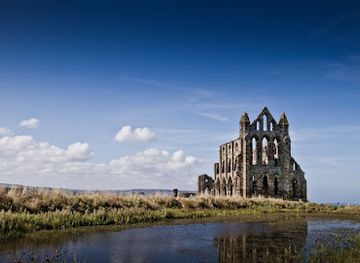
Whitby Abbey is the town's defining attraction, with its ruined Gothic architecture, elevated position and views across the North Sea and River Esk. Below it, the 199 steps lead through the old town to St Mary's Church and its atmospheric churchyard, while Church Street contains historic buildings, independent shops and links to Bram Stoker's Dracula. The harbour is central to everyday Whitby, with fishing vessels, bridges, piers and boat excursions creating a strong maritime setting. Captain Cook Memorial Museum occupies the house where Cook lodged during his apprenticeship, and Whitby Museum explores local natural history, archaeology and social history. West Cliff provides a broad promenade, beach access and views towards the abbey, while the shoreline north towards Sandsend offers fossil-rich Jurassic rocks and coastal walking. Longer excursions can follow the Cleveland Way to Robin Hood's Bay or cross into the North York Moors, although these surrounding landscapes should be treated as wider regional destinations rather than parts of Whitby's built-up centre.
-
Beach
Whitby Beach
Experience the vibrant charm and natural beauty of Whitby Beach, where sandy shores meet historic cliffs and family fun awaits.
-
Scenic point
199 Steps
Climb the legendary 199 Steps in Whitby, where history, faith, and Dracula’s shadow converge atop the scenic East Cliff.
-
Historical place
North Yorkshire and Cleveland Heritage Coast
Explore dramatic cliffs, fossil-rich shores, and charming fishing villages along England’s stunning North Yorkshire and Cleveland Heritage Coast.
-
Tourist attraction
Whalebone Arch
A towering tribute on Whitby’s West Cliff, the Whalebone Arch honors the town’s daring whaling past with stunning sea views and historic resonance.



Best landmarks in Whitby
Whitby Abbey is the principal landmark, its dramatic stone ruins occupying the East Cliff above the harbour and representing the site of both the early monastery associated with St Hilda and the later Benedictine foundation. The 199 steps and St Mary's Church form a historic approach that has become inseparable from the town's identity and its Gothic literary associations. Whitby's harbour, piers and swing bridge express the continuing importance of the River Esk and the sea, while the Captain Cook Memorial Museum marks the town's connection with one of Britain's most significant naval explorers. Along the coast, the cliffs and wave-cut shore reveal Jurassic rocks and fossil-bearing strata, linking Whitby to the wider Yorkshire Jurassic Coast. West Pier Lighthouse and the sea-facing promenade provide recognisable maritime features, though access and views can depend on weather and operational conditions.
-
 Historical landmark
Whitby Abbey
Gothic ruins on a Yorkshire cliff where history, legend, and literary inspiration converge.
-
Historical landmark
Whitby Harbour West Lighthouse
Historic sentinel guiding ships since 1831—climb 81 steps for harbour views and maritime heritage.
-
Historical landmark
Whitby Harbour East Lighthouse
Historic sandstone lighthouse guarding Whitby Harbour’s entrance, offering timeless maritime charm and stunning coastal views.
-
Historical landmark
Larpool Viaduct
Explore Whitby’s iconic 13-arch Victorian brick viaduct soaring 120 feet above the River Esk, now a scenic walking, cycling, and bungee jumping landmark.


Explore Whitby on the map
Plan your trip on one map. See where the top attractions, landmarks, restaurants and hotels are, and book hotels and experiences in a few clicks.
Best hotels in Whitby
Best restaurants in Whitby
Whitby's food culture is closely connected with the North Sea and the town's long fishing tradition. Fish and chips remain a characteristic choice around the harbour and old town, while seafood, crab, dressed shellfish and locally sourced fish may appear on menus when available. Cafés, bakeries, traditional pubs and restaurants are concentrated in the town centre, the old town and around the harbour, with further options along the seafront and in nearby villages such as Sandsend. Yorkshire produce, farmhouse cheeses, seasonal vegetables and regional ales also feature in the area's informal dining. Visitors staying outside Whitby may find village pubs and country restaurants in the surrounding coast and moorland communities, but facilities become more limited away from established settlements. During busy periods, popular establishments can fill quickly, and coastal walking plans should not assume that food or refreshments will be available between villages.
-
British
Magpie Café
Experience Whitby's iconic waterfront dining with the freshest seafood and stunning harbour views at the historic Magpie Café.
-
Seafood
Trenchers
Savor Whitby's freshest fish and chips in a spacious, family-friendly setting with harbor views and a rich local heritage.
-
Seafood
Abbey Wharf
Experience fresh seafood and vibrant bar culture with stunning harbour views at Whitby's Abbey Wharf.
-
Seafood
The Fisherman's Wife Whitby
Experience fresh, locally sourced seafood with breathtaking sea views at Whitby’s beloved Fisherman’s Wife restaurant.


Best bars in Whitby
Whitby's evening life is primarily based around traditional pubs, small bars, hotel lounges and relaxed restaurants rather than a large nightclub scene. The harbour and old town provide the greatest concentration of places for an evening drink, with historic interiors and maritime surroundings shaping the atmosphere. Some venues host live music or cultural events at particular times, but programmes and opening arrangements vary and should be checked locally. The town's seasonal visitor calendar can bring additional evening activity, while the surrounding villages offer quieter pub-based hospitality rather than dedicated nightlife districts. Visitors seeking a later or more extensive entertainment scene generally need to travel to larger towns outside Whitby, so evenings here are more naturally suited to food, conversation, harbour walks and views across the illuminated headland.
-
Bar
Abbey Wharf
Lively harbourfront bar and seafood restaurant in Whitby with stunning views, fresh local dishes, and a vibrant atmosphere for all ages and pets.
-
Pub
Duke of York Whitby
Historic Whitby pub and cozy hotel with classic fare, real ales, and stunning harbour views at the foot of the iconic 199 Steps.
-
Hotel
The Dolphin
A charming harbourfront hotel and pub in Whitby offering spacious rooms, hearty breakfasts, and a welcoming atmosphere right on the waterfront.
-
Pub
Station Inn Whitby
Charming pub and cozy rooms in Whitby’s harbour heart, blending historic character with modern comfort and lively local spirit.


Best shops in Whitby
Shopping in Whitby is concentrated in the old town, around Church Street, the market area and the harbour, where independent shops, galleries, bookshops, cafés and small food retailers serve visitors and residents. Whitby jet is the town's best-known traditional product, reflecting the fossilised wood found in the surrounding Jurassic rocks, and jewellery made from genuine jet is sold alongside contemporary designs. Local art, prints, ceramics, gifts, regional produce and maritime-themed goods are also common, while outdoor shops cater to walkers exploring the coast and moors. Fossils and geological specimens appear in specialist and general gift shops, but buyers should choose responsibly sourced material and avoid removing specimens from unstable cliffs or restricted areas. Larger everyday shopping is available in Whitby, with more extensive retail facilities found in regional towns beyond the destination.
-
Shop
Yorkshire Trading Company
A trusted Whitby department store offering diverse home, garden, and everyday essentials with friendly service and great value.
-
Clothing Shop
The Great Goth
Discover Whitby’s ultimate gothic fashion destination with unique clothing, accessories, and a welcoming atmosphere at The Great Goth.
-
Gift shop
Furbellow & Co
A classic Whitby barber and menswear shop where timeless style meets warm, personal service in a charming riverside setting.
-
Clothing Shop
GutsyGingers
Discover Whitby’s vibrant boutique offering handcrafted fashion, unique accessories, and eclectic homewares with a bohemian soul.


Get your free copy of our complete guide to Whitby, delivered straight to you.
Everything on this page, from attractions and restaurants to essentials and local phrases, in one PDF you can read offline, print or share.
Already have an account? Sign in
Your Whitby guide is ready.
We'll send it to · Not you? Sign out

Getting your guide ready…
We are putting together a fresh copy of the Whitby guide. This can take up to a minute.
This can take a few moments. If your browser asks, choose Allow so the download can start. You'll find the guide in your Downloads folder.
Nothing happened? Download it again
Sorry, the guide is taking longer than usual. Please try again in a minute, or get it by email instead.
Whitby essentials
Currency and Payment
Safety
Emergency Situations
Do's and Don'ts
Local Tips
From Eve
Local phrases worth knowing
You don't need to get them perfect. A few words go a long way, and locals appreciate the effort.
Basics
| English | Local | Say it |
|---|---|---|
| Hello | Ey up | [ay up] |
| Goodbye | See thee later | [see thee lay-ter] |
| Yes | Aye | [eye] |
| No | Nay | [nay] |
| Please/You're welcome | Please/No bother | [pleez/no bother] |
| Thank you | Ta | [tah] |
| Excuse me/Sorry | Excuse me/Sorry | [excuse me/sorry] |
| How are you? | How's it going? | [how's it goin?] |
| Fine. And you? | Reet. And thee? | [reet. And thee?] |
| Do you speak English? | D'ya speak English? | [d'ya speak English?] |
| I don't understand | I dunna understand | [eye dunna understand] |
Eating & Drinking
| English | Local | Say it |
|---|---|---|
| I'd like to see the menu, please | Could I see th' menu, please? | [could I see th' menu, pleez?] |
| I don't eat meat | I dunna eat meat | [eye dunna eat meat] |
| Cheers! | Cheers! | [cheers] |
| I would like to pay, please | I'd like to pay, please | [I'd like to pay, pleez] |
Emergencies
| English | Local | Say it |
|---|---|---|
| Help! | Help! | [help] |
| Go away! | Clear off! | [clear off] |
| Call the Police! | Ring the coppers! | [ring the coppers] |
| Call a doctor! | Get a doctor! | [get a doctor] |
| I'm lost | I'm lost | [I'm lost] |
| I'm ill | I'm feeling poorly | [I'm feelin' poorly] |
Shopping
| English | Local | Say it |
|---|---|---|
| I'd like to buy... | I'd like to buy... | [I'd like to buy...] |
| I'm just looking | I'm just having a gander | [I'm just havin' a gander] |
| How much is it? | How much's this? | [how much's this?] |
| That's too expensive | That's a bit steep | [that's a bit steep] |
| Can you lower the price? | Can ya drop the price? | [can ya drop the price?] |
Time & Numbers
| English | Local | Say it |
|---|---|---|
| What time is it? | What time's it? | [what time's it?] |
| It's one o'clock | It's one o'clock | [it's one o'clock] |
| Half past (10) | Half past ten | [half past ten] |
| Morning | Morning | [morning] |
| Afternoon | Afternoon | [afternoon] |
| Evening | Evening | [evening] |
| Yesterday | Yesterday | [yesterday] |
| Today | Today | [today] |
| Tomorrow | Tomorrow | [tomorrow] |
| 1 | One | [one] |
| 2 | Two | [two] |
| 3 | Three | [three] |
| 4 | Four | [four] |
| 5 | Five | [five] |
| 6 | Six | [six] |
| 7 | Seven | [seven] |
| 8 | Eight | [eight] |
| 9 | Nine | [nine] |
| 10 | Ten | [ten] |
Transport & Directions
| English | Local | Say it |
|---|---|---|
| Where's a/the...? | Where's a/the...? | [where's a/the...?] |
| What's the address? | What's the address? | [what's the address?] |
| Can you show me (on the map)? | Can ya show me (on t' map)? | [can ya show me (on t' map)?] |
| When's the next (bus)? | When's t' next (bus)? | [when's t' next (bus)?] |
| A ticket (to ....) | A ticket (to ....) | [a ticket (to ....)] |
History of Whitby
The Abbey's Early Christian Origins
Whitby's earliest recorded historical identity is linked to Streoneshalch, a double monastery founded in 657 under Abbess Hild, later known as St Hilda. The community included both monks and nuns and became an important religious centre in the Anglo-Saxon kingdom of Northumbria. The Synod of Whitby, held in 664 according to the traditional account, addressed differences between Roman and Irish Christian practices, including the calculation of Easter. Although the surviving abbey ruins belong to a much later building, this early foundation established Whitby's enduring importance as a place of religious history.
Viking Raids and Medieval Renewal
The monastery was destroyed during Viking raids in the ninth century, contributing to a long period in which the headland was no longer the centre of the original religious community. After the Norman Conquest, Reinfrid founded a new Benedictine monastery at Whitby in 1078. The abbey was rebuilt and expanded over subsequent centuries, and its position above the harbour reflected both spiritual prominence and the strategic geography of the coast. The monastic house was dissolved in 1539 during the reign of Henry VIII, after which the buildings gradually fell into ruin.
A Medieval Harbour Town
Whitby's growth was closely tied to the River Esk and its sheltered harbour. Fishing, coastal trade and shipbuilding became central to the local economy, while the town developed on both sides of the river beneath the abbey headland. St Mary's Church, whose churchyard occupies the eastern cliff, preserves part of the town's historic setting, and the steep flight now known as the 199 steps connected the old settlement with the religious precinct above. The harbour continued to shape Whitby's identity long after the abbey ceased to function as a monastery.
Seafaring, Whaling and Captain Cook
During the eighteenth century Whitby became a significant shipbuilding and maritime centre, producing vessels suited to North Sea trade and longer voyages. Whaling also formed part of the town's commercial life, and the economic legacy of these industries can still be read in its harbour and historic buildings. Captain James Cook came to Whitby as a young man in 1746 to apprentice with the shipowner John Walker. Cook later commanded the Endeavour on his first Pacific voyage, and the house now known as Captain Cook Memorial Museum preserves the connection between his early training and the town's maritime culture.
Jet, Tourism and the Railway
Whitby jet, a fossilised wood found in local Jurassic rocks, became a fashionable material for mourning jewellery during the nineteenth century. Jet working created specialised local skills and helped distinguish Whitby's craft economy. At the same time, the town developed as a seaside resort, with promenades, bathing facilities and hotels serving visitors attracted by the coast. Railway connections strengthened Whitby's links with inland Yorkshire and supported both tourism and regional trade. The harbour, beaches and cliff scenery increasingly became as important to the town's public identity as fishing and shipbuilding.
Dracula and Modern Heritage
Bram Stoker's Dracula, published in 1897, brought Whitby into international literary imagination. In the novel, the ship Demeter arrives during a storm, and the abbey, churchyard and town streets contribute to the story's Gothic atmosphere. This association sits alongside Whitby's older religious and maritime history rather than replacing it. In the modern era, conservation of Whitby Abbey, the old town and the wider coastline has supported heritage tourism, while the town continues to balance visitor activity with the needs of its resident community, working harbour and fragile cliff environment.
Whitby in Photos
Browse through our photo collection highlighting the charm and character of the destination.
Neighbouring destination travel guides
The closest destinations to Whitby, if you have time for more than one.
-

-

-

-

-


Swipe for more destinations
Explore more

Explore more of Yorkshire and the Humber
Discover Yorkshire and the Humber: A captivating blend of stunning landscapes, historic cities, and culinary delights in the heart of Northern England.
Explore Yorkshire and the Humber
Explore more of United Kingdom
Discover the United Kingdom: A blend of rich history, stunning landscapes, and vibrant cities, offering a unique travel experience for every visitor.
Explore United Kingdom