Sønderho Mølle Travel Guide
Free Guide: A Dutch-style windmill from 1895 that grinds flour and tells a story of preservation against the odds.


A brief summary of Sønderho Mølle
A Dutch-style windmill from 1895 that grinds flour and tells a story of preservation against the odds.
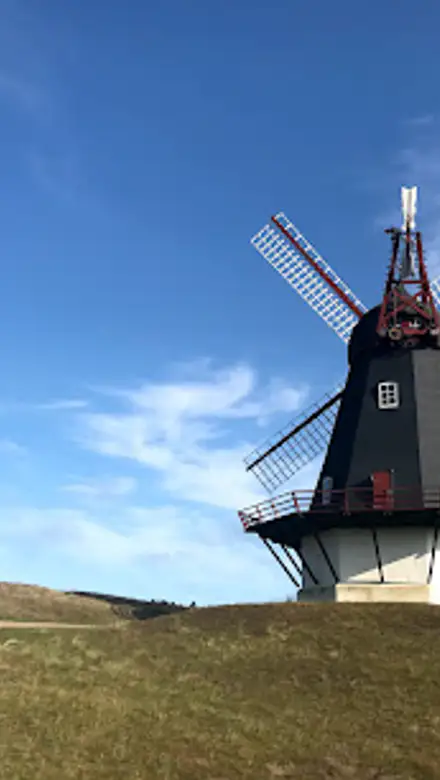
A beautifully preserved Dutch-style windmill built in 1895 on the island of Fanø, Denmark. This octagonal grain mill stands as a testament to 19th-century engineering, featuring an ingenious self-rotating cap system that automatically adjusts the sails to face the wind. Rescued from demolition in 1928 by the Gamle Sønderho Foundation and meticulously restored, the mill still grinds flour using its original stone grinder. Visitors can explore the interior across multiple levels, from the grinding loft to the cap loft, and purchase freshly milled flour as a tangible memory of this working heritage site.
On-site amenities
 Trash bins
- Address
- Vester Land 44, 6720 Fanø
- Website
Getting there
Ferry from Esbjerg
Car with vehicle ferry
Bicycle from Fanø town
Taxi or ride-share from ferry terminal
Discover more about Sønderho Mølle
A Mill Saved from Oblivion
Sønderho Mølle stands as a remarkable survival story in Danish industrial heritage. Built in 1895 in the Dutch architectural style as a grain mill, this octagonal structure was designed to harness the strong winds that sweep across the island of Fanø. By 1923, changing times and new technologies rendered the mill obsolete, and it fell into severe disrepair. Condemned for demolition, the mill faced an uncertain fate until 1928, when the Gamle Sønderho Foundation (Fonden Gamle Sønderho) acquired it with the explicit mission to preserve this engineering marvel for future generations. What followed was a decades-long restoration effort that would eventually return the mill to working condition.
Engineering Ingenuity in Wood and Stone
The mill's construction exemplifies centuries of accumulated windmill-building knowledge distilled into elegant simplicity. The structure consists of an octagonal masonry lower floor (the undermill) supporting a wooden body and rotating cap. Eight corner posts anchor the entire structure to the masonry foundation, while the rotating cap rests on eight steel rollers that glide along a rail at the hull's top. This ingenious design allows the entire cap—holding the roof, sails, windshaft, brake wheel, and fantail mechanism—to rotate smoothly as wind direction changes.The mill contains four distinct levels: the grinding loft where grain was processed, the star wheel loft (remarkably low-ceilinged), the cap loft, and the beam layer of the cap itself. An external gallery encircles the grinding loft, providing the miller with access to the sails and mechanisms for operating the brake rope and adjusting the sail flaps. The crowning achievement is the wind rose—a small eight-winged wheel mounted on the cap that automatically turns the entire structure so the sails always face into the wind, eliminating the need for manual adjustment.
From Ruin to Renaissance
The restoration journey proved challenging and protracted. After the foundation's acquisition in 1928, the mill was ceremonially reinaugurated on Sønderho Day in 1930, though the windrose and surrounding gallery remained incomplete. Decades of deferred maintenance had left the structure severely compromised, and comprehensive restoration work was necessary to prevent total loss. The foundation persevered through various obstacles, eventually transforming the decaying ruin into a functioning mill. The culmination of this effort came in 2003, when the mill was inaugurated in its current restored form. Today, a dedicated group of volunteers known as the Mill Guild maintains the structure, ensuring that this piece of industrial heritage continues to operate and educate visitors about traditional milling practices.
A Living Monument to Craft
What distinguishes Sønderho Mølle from many preserved mills is its continued functionality. The mill still grinds flour using its original stone grinder, and visitors can purchase freshly milled flour during their visit—a tangible connection to the mill's original purpose. This working status transforms the site from a static museum piece into a living demonstration of 19th-century grain processing. The mill's location on a hilltop at the edge of Sønderho village provides the wind conditions essential for its operation, the same advantage that determined its original placement over a century ago.
Visiting the Mill
The mill operates as an unmanned facility, allowing visitors complete freedom to explore both interior and exterior spaces at their own pace and risk. Access to the interior is seasonal, typically open from Easter through the end of week 42 (mid-October). Visitors can ascend through the multiple levels, experiencing the spatial progression from the grinding loft upward, and gain intimate understanding of how the mill functioned. The modest entrance fee supports ongoing maintenance and preservation efforts, with payment accepted via MobilePay or cash deposited in the collection box.
Evendo Review Centre
 Google
Guest reviews
Best time to go
Quietest: Jan, Feb & Nov · before 7am or at 7pm
Busy times are Evendo estimates for a typical year, to help you plan. Actual crowds vary with events, school holidays and the weather.
Explore Sønderho Mølle on the map
A handpicked selection of must-see spots near Sønderho Mølle, mapped for you.
Get your free copy of our complete guide to Sønderho Mølle, delivered straight to you.
Everything on this page, from opening hours and how to get there to Eve’s tips and the best time to go, in one PDF you can read offline, print or share.
Already have an account? Sign in
Your Sønderho Mølle guide is ready.
We'll send it to · Not you? Sign out

Getting your guide ready…
We are putting together a fresh copy of the Sønderho Mølle guide. This can take up to a minute.
This can take a few moments. If your browser asks, choose Allow so the download can start. You'll find the guide in your Downloads folder.
Nothing happened? Download it again
Sorry, the guide is taking longer than usual. Please try again in a minute, or get it by email instead.
Other nearby places you may find interesting
The closest places of the same kind, if this one is not quite what you had in mind.
-
-
-
-
-


Swipe for more places
More to explore near Sønderho Mølle

 Best experiences near Sønderho Mølle
 Best hotels near Sønderho Mølle
 Best landmarks near Sønderho Mølle
 Best attractions near Sønderho Mølle
 Best shops near Sønderho Mølle
 Best restaurants near Sønderho Mølle
 Best bars near Sønderho Mølle
Do you manage this location?
Take control to get all the benefits, like improved information, better appearance, and stronger visibility across AI-powered discovery.
Explore more

Explore more of Fanø
Discover Fanø, Denmark's hidden coastal gem, offering stunning beaches, charming villages, and rich wildlife, perfect for a tranquil getaway and nature adventures.
Explore Fanø
Explore more of Denmark
Discover Denmark: A perfect blend of history, modern design, and the cozy concept of hygge. Explore vibrant cities, serene landscapes, and world-class cuisine.
Explore Denmark