

Egeskov Castle Travel Guide
Free Guide: A storybook Renaissance water castle on Funen, where historic halls, award‑winning gardens, playful museums and forest adventures create a full day in the Danish countryside.


A brief summary of Egeskov Castle
A storybook Renaissance water castle on Funen, where historic halls, award‑winning gardens, playful museums and forest adventures create a full day in the Danish countryside.
Egeskov Castle is a remarkably well‑preserved Renaissance water castle on the island of Funen, set in a mirror‑still moat and wrapped in some of Denmark’s finest historic gardens. Beyond its fairy‑tale towers, the estate is a full‑day destination with classic car and motorcycle museums, a camping and rescue exhibition, vast playgrounds, mazes and seasonal events. Still home to the Ahlefeldt family, it combines aristocratic history, landscaped parkland and hands‑on fun in one sprawling countryside estate.
On-site amenities
 Restrooms
 Drink options
 Drinking water
 Food options
 Seating areas
 Sheltered areas
 Picnic areas
 Trash bins
 Information boards
 Visitor centre
Opening hours
- Every day10 am–7 pm
Opening hours as listed on the venue’s Google Business Profile. Hours can change for services and special events, so check with the venue before you go.
- Address
- Egeskov Gade 22, 5772 Kværndrup
- Phone
- Website
Getting there
Car from Odense
Train and bus from Odense
Cycling from nearby towns on Funen
Guided day tour from Odense or Copenhagen
Discover more about Egeskov Castle
A Renaissance stronghold floating on water
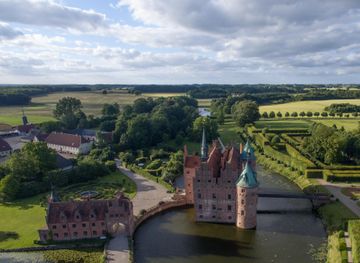
Egeskov Castle rises directly from a broad moat, its warm brick walls and pointed turrets reflected in the water that once served as a vital line of defence. Built in 1554 as a Renaissance fortress, it is considered one of Northern Europe’s best‑preserved moat castles, designed to withstand unrest in a turbulent period of Danish history. The complex is formed by two elongated buildings joined by a thick double wall, a clever layout that allowed defenders to retreat from one section to the other while still holding out against attackers.Look closely at the façade and you can still see the practicalities of warfare: rows of embrasures pierce the outer walls and machicolations hang above, from which boiling liquids could be poured on enemies below. Today these details read as decorative flourishes against the tranquil backdrop of lawns and water, but they hint at a time when the castle was far more than a picturesque residence. Inside, grand halls, panelled rooms and collections of furniture and art carry the story forward from fortified stronghold to aristocratic country home.
Living heritage and the Ahlefeldt family story
Egeskov is not a museum frozen in time but a lived‑in family seat. The estate has passed through several noble lineages, and since the late 18th century it has been in the hands of the Bille‑Ahlefeldt family. Their stewardship is visible in the way historic fabric and contemporary life intertwine: portraits look down over polished floors, hunting trophies share space with modern interpretation, and family memorabilia adds an intimate layer to the castle’s official narrative.In the later 20th century, key rooms such as the banqueting hall were carefully restored and gradually opened to the public, making it possible to step into finely proportioned chambers that still feel connected to a private home. One of the estate’s most cherished treasures is Titania’s Palace, an extraordinarily intricate doll’s house filled with miniature artworks and furnishings. It offers a completely different, almost magical, scale of storytelling beside the full‑size halls and staircases of the main building.
Gardens shaped over centuries
Surrounding the castle is an expansive park, laid out in distinct garden rooms that together form one of Denmark’s most admired historic landscapes. Some features date back hundreds of years: monumental hedges of linden, beech and hornbeam, planted in the early 18th century, now soar to impressive heights and carve out green corridors. An old maze from the 1730s was originally created as a noble family amusement and still invites visitors to lose themselves in its leafy passages.Elsewhere the mood shifts from formal to romantic. The rose garden erupts in summer colour, while the dahlia and fuchsia gardens showcase careful plant curation and bold displays. A dedicated scent garden encourages you to touch and smell aromatic leaves and flowers, turning a stroll into a sensory experience. Wide lawns, reflective ponds and framed views of the red‑brick castle create countless vantage points, especially striking in the long light of northern evenings.
Museums, machines and playful collections
The outbuildings and barns around Egeskov hold an unexpectedly rich series of museums. A large veterans’ collection brings together vintage cars, motorcycles and aircraft assembled over decades, ranging from early Fords and Chevrolets to elegant European marques and historic vehicles linked to Danish royalty. Nearby, themed exhibitions explore camping culture, complete with classic caravans and tents, and a fire and rescue collection displays engines, uniforms and equipment from different eras.These displays are presented with a sense of curiosity and delight rather than dry cataloguing. Unusual objects, themed corners and changing arrangements encourage you to wander and discover rather than simply follow a fixed route. Together, they broaden the story of the estate beyond aristocratic life to include everyday mobility, leisure and public service in modern Denmark.
Play forests, mazes and seasonal magic
Egeskov’s parkland doubles as a vast adventure zone, especially for younger visitors. The Play Forest is dotted with imaginative installations: Denmark’s tallest climbing net, swings, themed play zones and a substantial hedge maze challenge balance and orientation. High above the ground, a treetop walkway offers a bird’s‑eye perspective of the canopy and glimpses back toward the castle, adding a little thrill to the experience on breezy days.Across the season, different corners of the estate take on new characters. Summer evenings occasionally see the castle illuminated and the gardens animated for special nights. In autumn, Halloween decorations thread through paths and courtyards, while winter brings a different programme focused on indoor exhibitions and selected outdoor areas. Rather than closing down entirely, the estate reconfigures its spaces, so returning visitors can experience new atmospheres over the year.
A full‑day countryside escape on Funen
Set among fields and low wooded hills in the heart of Funen, Egeskov feels both grand and accessible. The drive in along rural roads sets the tone for a day that blends culture and nature. You might move from absorbing the details of Renaissance brickwork to watching children run across lawns, or from contemplating antique engineering in the vehicle halls to pausing under ancient trees in the park.Food kiosks and cafés around the grounds provide easy refreshment, and there are inviting spots to lay out a picnic if you bring your own supplies. With so many strands woven together – castle interiors, world‑class gardens, specialist museums and generous play areas – the estate easily fills several unhurried hours. It works as a destination in its own right or as a centrepiece of a wider exploration of Funen’s villages and landscapes, offering a concentrated taste of Danish history, design and outdoor life in one carefully tended place.
Evendo Review Centre
 Google
Guest reviews
Best time to go
Quietest: Jan, Feb & Dec · before 8am or from 8pm
Busy times are Evendo estimates for a typical year, to help you plan. Actual crowds vary with events, school holidays and the weather.
Explore Egeskov Castle on the map
A handpicked selection of must-see spots near Egeskov Castle, mapped for you.
Get your free copy of our complete guide to Egeskov Castle, delivered straight to you.
Everything on this page, from opening hours and how to get there to Eve’s tips and the best time to go, in one PDF you can read offline, print or share.
Already have an account? Sign in
Your Egeskov Castle guide is ready.
We'll send it to · Not you? Sign out

Getting your guide ready…
We are putting together a fresh copy of the Egeskov Castle guide. This can take up to a minute.
This can take a few moments. If your browser asks, choose Allow so the download can start. You'll find the guide in your Downloads folder.
Nothing happened? Download it again
Sorry, the guide is taking longer than usual. Please try again in a minute, or get it by email instead.
Unlock the best of Egeskov Castle
Skip-the-line tickets, guided tours with entry, and walking tours of the area, booked in a few clicks.

Other nearby places you may find interesting
The closest places of the same kind, if this one is not quite what you had in mind.
-
The Funen Village Step into a full‑scale Funen village of thatched farms, mills and animals, where 18th‑ and 19th‑century rural Denmark is carefully brought back to life.
-
Parsonage Experience authentic 18th-century Danish village life through restored buildings, costumed interpreters, and hands-on traditional crafts.
-
The Sea Horse A powerful bronze sea horse with a mermaid rider bursts from the Odense River, bringing Hans Christian Andersen’s underwater world to life at Munke Mose’s edge.
-
Brickworks Authentic 19th-century brick-making workshop preserving Denmark's industrial heritage within a living open-air village museum.
-
King's Garden Odense’s historic royal garden: a baroque-era green gateway where castle views, sculptures and summer concerts meet everyday city life.
Swipe for more places
More to explore near Egeskov Castle

 Best experiences near Egeskov Castle
 Best hotels near Egeskov Castle
 Best landmarks near Egeskov Castle
 Best attractions near Egeskov Castle
 Best shops near Egeskov Castle
 Best restaurants near Egeskov Castle
 Best bars near Egeskov Castle
Do you manage this location?
Take control to get all the benefits, like improved information, better appearance, and stronger visibility across AI-powered discovery.
Explore more
Explore more of Funen
Discover Funen, Denmark's lush island treasure, where fairy tales come to life amidst scenic landscapes, historic castles, and vibrant cultural heritage.
Explore Funen
Explore more of Denmark
Discover Denmark: A perfect blend of history, modern design, and the cozy concept of hygge. Explore vibrant cities, serene landscapes, and world-class cuisine.
Explore Denmark
