

Damestenen Travel Guide
Free Guide: Denmark's colossal 1,200-tonne ice-age boulder, transported from Sweden 18,000 years ago.


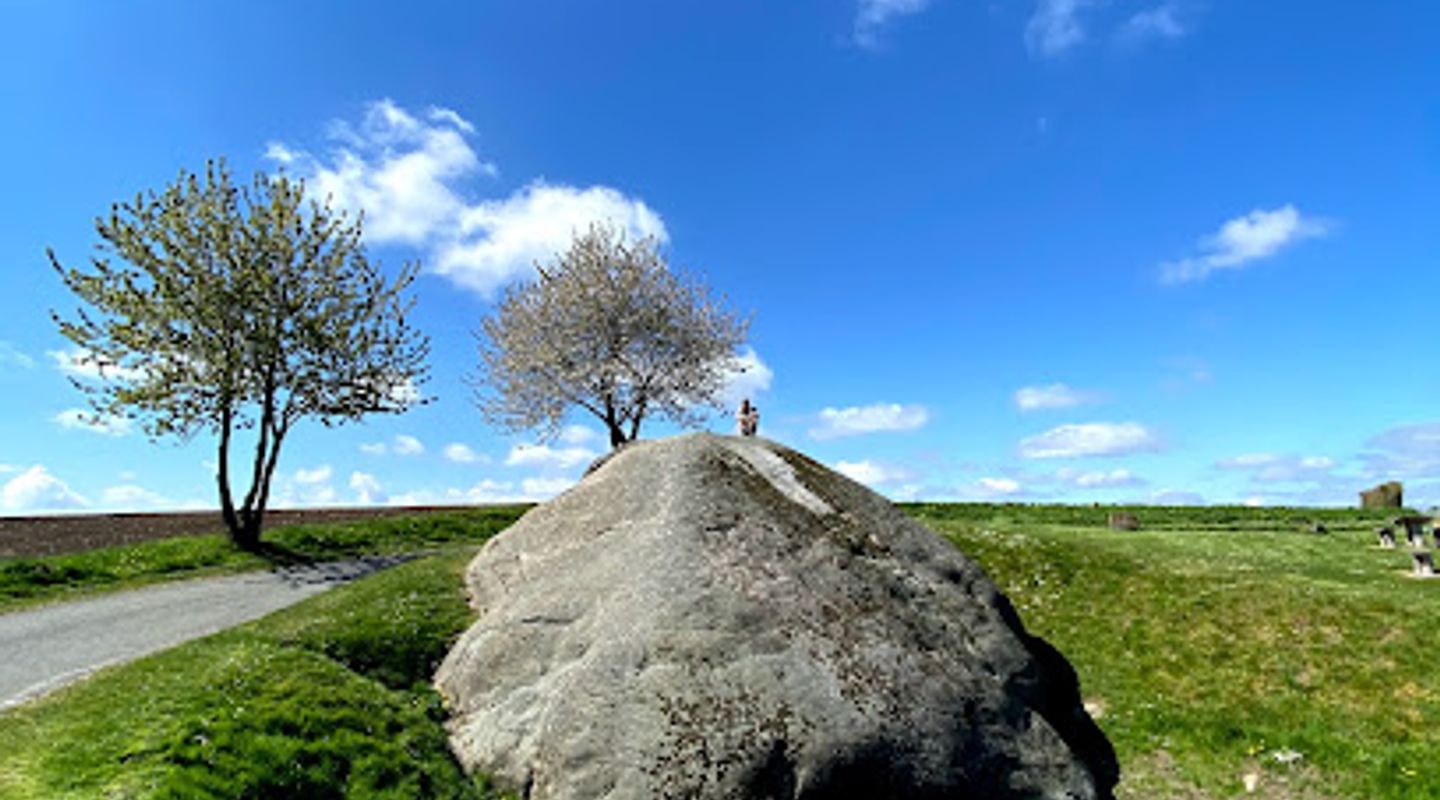
A brief summary of Damestenen
Denmark's colossal 1,200-tonne ice-age boulder, transported from Sweden 18,000 years ago.
Damestenen, known as the Lady Stone, is Denmark's largest glacial erratic boulder, weighing over 1,200 tonnes and measuring 13 metres long. Located in open fields near the village of Hesselager on East Funen, this colossal granite block has captivated visitors since 1763. Transported from Sweden during the last ice age approximately 18,000 years ago, the boulder bears 12 Bronze Age cup marks and stands as a remarkable testament to the power of ancient glaciers. A dedicated car park and walking trails make this geological wonder easily accessible.
On-site amenities
 Seating areas
 Trash bins
 Information boards
Opening hours
- Every dayOpen 24 hours
Opening hours as listed on the venue’s Google Business Profile. Hours can change for services and special events, so check with the venue before you go.
- Address
- Damestensvej 1, 5874 Hesselager
- Website
Getting there
Car from Svendborg
Bicycle from Hesselager
Bus from Svendborg
Walking from Hesselager
Discover more about Damestenen
A Colossus from the Ice Age
Damestenen stands as a silent witness to Denmark's glacial past, a massive granite boulder that arrived from Sweden during the last ice age, roughly 18,000 years ago. Originally part of the bedrock far to the north, this colossal stone was wrenched free by advancing glaciers, rounded and polished during its journey south, and finally deposited beneath the moraine clay at Hesselager. The boulder's journey likely involved being tossed between several different ice streams before finding its final resting place, a testament to the immense power of the Weichselian glaciation.The stone itself is composed of light grey granite and gneiss, materials that have endured millions of years of erosion and crustal movements. Today, the visible portion measures approximately 13 metres long, 10 metres wide, and 6.5 metres high, with a circumference of 46.8 metres and an estimated weight exceeding 1,200 tonnes. However, the boulder has never been fully excavated, so its true dimensions remain a mystery—it may extend considerably deeper into the earth than what meets the eye.
Historical Investigations and Royal Interest
Damestenen has attracted scholarly attention for centuries. The boulder was first documented in 1763 by Danish theologian Erik Pontoppidan in his comprehensive work Den Danske Atlas. In 1840, geologist J.G. Forchhammer examined the stone and theorized that it might extend far deeper into the ground than its visible surface suggested. This curiosity prompted King Christian VIII to order an excavation on the north-eastern side of the boulder, an investigation designed to determine whether Damestenen was solid bedrock protruding from Funen's soil or merely an unusually large loose boulder. The excavation confirmed it was indeed a transported erratic, not bedrock.On 8 April 1846, the boulder was formally protected and donated to the state by landowner Dons of Hesselagergård, ensuring its preservation for future generations. This act of stewardship transformed Damestenen into a public treasure, accessible to all who wished to marvel at its scale and geological significance.
Archaeological Significance and Local Legend
Beyond its geological importance, Damestenen carries cultural and archaeological weight. The surface of the boulder bears 12 Bronze Age cup marks—small circular depressions created by prehistoric peoples—though they are subtle and require careful observation to discern. These marks connect the stone to Denmark's distant past, suggesting it held ritual or symbolic significance for ancient communities.Local folklore adds another layer of intrigue. A folk legend tells of a female giant from the north of Langeland island who hurled the stone at the spire of Svindinge's church in an act of destruction. Despite her supernatural strength, the stone fell midway, landing at Hesselager where it remains today. This tale reflects humanity's tendency to explain the inexplicable through mythology, transforming a geological marvel into a narrative of power and fate.
A Modern Tourist Destination
Since its first documented mention in 1763, Damestenen has been a magnet for visitors and curious minds. The site is well-equipped for tourism, with a car park capable of accommodating both private vehicles and tour coaches, along with directional signage guiding visitors to the location. Benches are provided for those wishing to rest and contemplate the stone's immensity, and the open field setting allows for unobstructed views and photography from all angles.The boulder's impressive dimensions and the story of its geological journey make it an ideal educational stop for those interested in glacial processes, Scandinavian prehistory, and natural wonders. It exemplifies the raw power of ice-age glaciers, which could transport and deposit objects of such staggering weight and size across vast distances.
Evendo Review Centre
 Google
Guest reviews
Best time to go
Quietest: Jan, Feb & Nov · before 6am or at 9pm
Busy times are Evendo estimates for a typical year, to help you plan. Actual crowds vary with events, school holidays and the weather.
Explore Damestenen on the map
A handpicked selection of must-see spots near Damestenen, mapped for you.
Get your free copy of our complete guide to Damestenen, delivered straight to you.
Everything on this page, from opening hours and how to get there to Eve’s tips and the best time to go, in one PDF you can read offline, print or share.
Already have an account? Sign in
Your Damestenen guide is ready.
We'll send it to · Not you? Sign out

Getting your guide ready…
We are putting together a fresh copy of the Damestenen guide. This can take up to a minute.
This can take a few moments. If your browser asks, choose Allow so the download can start. You'll find the guide in your Downloads folder.
Nothing happened? Download it again
Sorry, the guide is taking longer than usual. Please try again in a minute, or get it by email instead.
Other nearby places you may find interesting
The closest places of the same kind, if this one is not quite what you had in mind.
-
Langdyssen "Kong Humbles Grav" A 55‑metre Stone Age long dolmen in the fields north of Humble, where legend, prehistoric engineering and soft Langeland landscapes meet in quiet simplicity.
-
Tranekær Castle A red-plastered island fortress turned noble family home, Tranekær Castle crowns a hat-shaped hill on Langeland, blending medieval power, romance and working estate life.
-
Leuchtturm A modest 1897 lighthouse at the quiet end of Bukkeskovvej, Tranekær Fyr offers big sea views, maritime history and island solitude rather than formal attractions.
-
Lindelse Kirke Langeland's longest church, a whitewashed medieval landmark with stepped gable tower and historic rectory.
-
Langdysse i Ormstrup An ancient Stone Age long barrow revealing secrets of Neolithic burial practices and the tragtbægerkulturen civilization.
Swipe for more places
More to explore near Damestenen

 Best experiences near Damestenen
 Best hotels near Damestenen
 Best landmarks near Damestenen
 Best attractions near Damestenen
 Best shops near Damestenen
 Best restaurants near Damestenen
 Best bars near Damestenen
Do you manage this location?
Take control to get all the benefits, like improved information, better appearance, and stronger visibility across AI-powered discovery.
Explore more

Explore more of Langeland
Discover Langeland: Denmark's idyllic island retreat with scenic landscapes, rich history, and vibrant culture. Perfect for nature lovers, history buffs, and festival goers.
Explore Langeland
Explore more of Denmark
Discover Denmark: A perfect blend of history, modern design, and the cozy concept of hygge. Explore vibrant cities, serene landscapes, and world-class cuisine.
Explore Denmark
