Christiansborg Palace
Where medieval castle ruins, royal state rooms and Denmark’s modern parliament all share one imposing palace on a small island in the heart of Copenhagen.
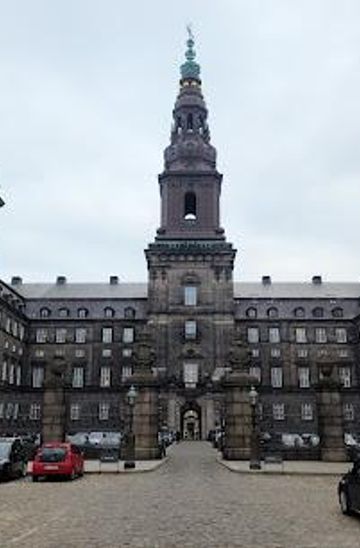
Rising over the tiny islet of Slotsholmen in central Copenhagen, Christiansborg Palace is Denmark’s modern seat of power and a showcase of 800 years of history. Today it uniquely houses Parliament, the Supreme Court and the Prime Minister’s Office while also containing the Royal Reception Rooms, palace chapel, royal stables, historic kitchen and atmospheric ruins from earlier castles, all wrapped in imposing neo‑Baroque stone and crowned by Copenhagen’s tallest tower.
A brief summary to Christiansborg Palace
- Prins Jørgens Gård 1, Copenhagen, Indre By, 1218, DK
- Click to display
- Click to display
- Duration: 1.5 to 4 hours
- Mid ranged
-
 Mixed
Mixed
- Mobile reception: 5 out of 5
- Tuesday 10 am-5 pm
- Wednesday 10 am-5 pm
- Thursday 10 am-5 pm
- Friday 10 am-5 pm
- Saturday 10 am-5 pm
- Sunday 10 am-5 pm

Know before you go
Hi, I'm Eve. Here are a few practical things to know before exploring Christiansborg Palace.
- Allow at least 2–3 hours if you want to see the Royal Reception Rooms, the ruins, the kitchens and the Royal Stables on a combined ticket without feeling rushed.
- Arrive near opening time to enjoy the Great Hall and throne rooms before group visits, then head to the tower later in the day when skies are clearest.
- Check in advance for days when state events may close some areas of the palace, especially the Royal Reception Rooms and the chapel.
- Bring a light layer: the underground ruins can feel noticeably cooler and more humid than the palace rooms above.
- Look closely at Bjørn Nørgaard’s tapestries in the Great Hall and see how many historical figures and events from Danish history you can identify.
Do you manage this location?
Take control to get all the benefits, like improved information, better appearance, and stronger visibility across AI-powered discovery. Learn more
Activate your presenceOther nearby places you may find interesting

Getting There
-
Metro
From central Copenhagen, take the M3 or M4 metro line to Gammel Strand Station, which is on the same small island as Christiansborg Palace. The ride from major hubs like København H or Kongens Nytorv takes about 3–8 minutes, with departures every few minutes throughout the day. A standard adult single-zone ticket costs around DKK 24 and can be bought from station machines or via local transport apps.
-
City bus
Several city bus routes serve the streets around Slotsholmen from districts across Copenhagen, with typical travel times of 10–25 minutes depending on traffic and starting point. Use buses that stop near Højbro Plads or along the main thoroughfares by the canals, then walk a short distance to the palace. A single bus journey on the standard tariff is about DKK 24 for adults, and buses run at least every 10–15 minutes during the day.
-
Bicycle
Cycling is one of the most convenient ways to reach Christiansborg Palace from neighbourhoods such as Vesterbro, Nørrebro or Østerbro, with most journeys taking 10–20 minutes on Copenhagen’s dedicated bike lanes. There is bicycle parking around Slotsholmen, though spaces closest to the palace fill up at busy times. The route is flat and suitable for most riders; use a rented city bike if you do not have your own.
-
On foot from the historic centre
If you are already staying within the inner city, plan a 10–20 minute walk through the pedestrian streets and across one of the low bridges to reach Christiansborg Palace. The terrain is flat and paved, making it accessible for most visitors and manageable with strollers or wheelchairs, though cobblestones in some areas may be uneven. This option costs nothing and allows you to approach the palace while enjoying views of the canals and nearby historic buildings.
For the on-the-go comforts that matter to you
-
 Restrooms
-
 Drink Options
-
 Drinking Water
-
 Food Options
-
 Seating Areas
-
 Sheltered Areas
-
 Trash Bins
-
 Information Boards
-
 Visitor Center
Discover more about Christiansborg Palace
A seat of power on Slotsholmen
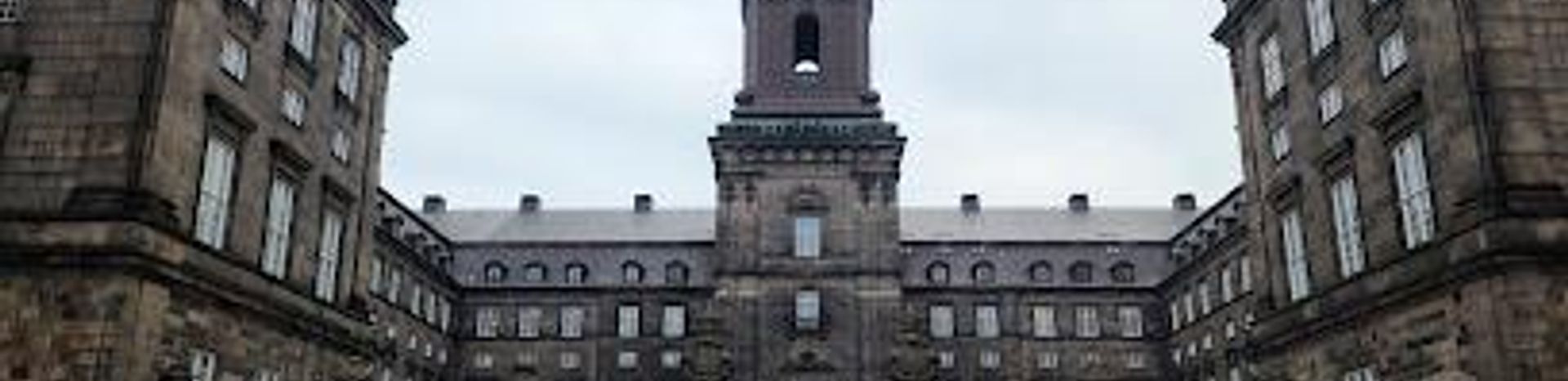
Christiansborg Palace dominates the small island of Slotsholmen, right in the historic heart of Copenhagen. For more than eight centuries this patch of ground has been the political centre of Denmark, evolving from medieval fortress to royal residence and, today, the hub of a modern parliamentary democracy. The present palace, with its deep stone façades and copper‑clad tower, forms a dramatic backdrop to the surrounding canals and bridges, making it one of the city’s defining silhouettes.Step into the spacious outer courtyards and you immediately sense the formality of a working seat of government. Vehicles and bicycles share space with tour groups, while security posts, flags and official cars underline that this is not a frozen monument but an active power centre. Yet amid the bustle there is an air of ceremony, especially when the royal horses cross the cobbles on their way to the stables.Layers of castles, palaces and fires
Long before the current palace, this site was home to a fortified stronghold built in the 12th century by Bishop Absalon, often regarded as the founder of Copenhagen. That fortress was destroyed in the 14th century, replaced by Copenhagen Castle, which became the main royal residence and seat of government. In the 1700s King Christian VI swept aside the aging castle to create the first Christiansborg Palace, a lavish baroque complex that briefly ranked among northern Europe’s grandest.Fire reshaped the site again and again. The first Christiansborg burned in 1794, prompting the royal family to move permanently to Amalienborg. A second Christiansborg rose in the early 1800s, only to be devastated by another blaze in 1884. The current palace, completed in 1928, was designed to house democratic institutions rather than a resident monarch, but it still nods to its predecessors in its historicist blend of baroque and neoclassical elements.Gilded halls and royal ceremonies
Much of the palace’s enduring fascination lies in the Royal Reception Rooms, which the monarchy still uses for state occasions. Approaching via the grand King’s Staircase, you emerge into a sequence of richly decorated salons, each with its own colour scheme, chandeliers, stucco and portraits. The Abildgaard and Alexander Rooms preserve paintings and sculptures rescued from earlier palaces, creating a sense of continuity despite the fires.At the heart of this suite is the Great Hall, a 40‑metre gallery famous for its series of modern tapestries by artist Bjørn Nørgaard. Woven in vivid colours between 1990 and 2000, they depict a thousand years of Danish history in a dense tapestry of kings, battles and cultural milestones. Nearby, the Oval Throne Room leads to the balcony from which new monarchs are traditionally proclaimed to the people gathered below, giving this otherwise quiet space a powerful symbolic weight.Ruins, stables and chapel
Below ground, a different world awaits. Here, atmospheric ruins reveal foundations and walls from Absalon’s fortified castle and later Copenhagen Castle. Dim lighting, exposed stone and interpretive displays bring to life sieges, demolitions and centuries of rebuilding, offering a tangible link to the city’s medieval origins. It is one of the most evocative parts of any visit, especially for those fascinated by archaeology and urban history.In the palace’s outbuildings, the Royal Stables maintain the tradition of ceremonial horse‑drawn carriages. Stalls, harness rooms and carriages illustrate how royal transport has evolved, while the scent of hay and the sound of hooves contrast sharply with the formality of the state rooms. The neoclassical palace chapel, reconstructed in the 1800s, has hosted royal christenings, weddings and lying‑in‑state ceremonies, its restrained interior providing a calm, echoing counterpoint to the ornamented halls nearby.The tower and today’s visitor experience
Crowning the complex is Christiansborg Tower, the tallest in Copenhagen. A lift ride brings you to a viewing platform with sweeping panoramas of the inner city’s spires, rooftops and waterways, making it a favourite spot for orienting yourself in the capital. On clear days you can trace the line of canals to the harbour and pick out landmarks like the stock exchange spire and the domes of other royal palaces.A visit typically weaves between these varied spaces: from open‑air courtyards into formal interiors, down into the cool semi‑darkness of the ruins and up again to light‑filled views. Interpretive panels and changing exhibitions explain both the architectural story and the ongoing political role of the complex. Combined tickets allow access to several areas, and it is easy to spend a good part of a day exploring the many layers of Christiansborg Palace.Explore the best of what Christiansborg Palace has to offer













More about North Zealand
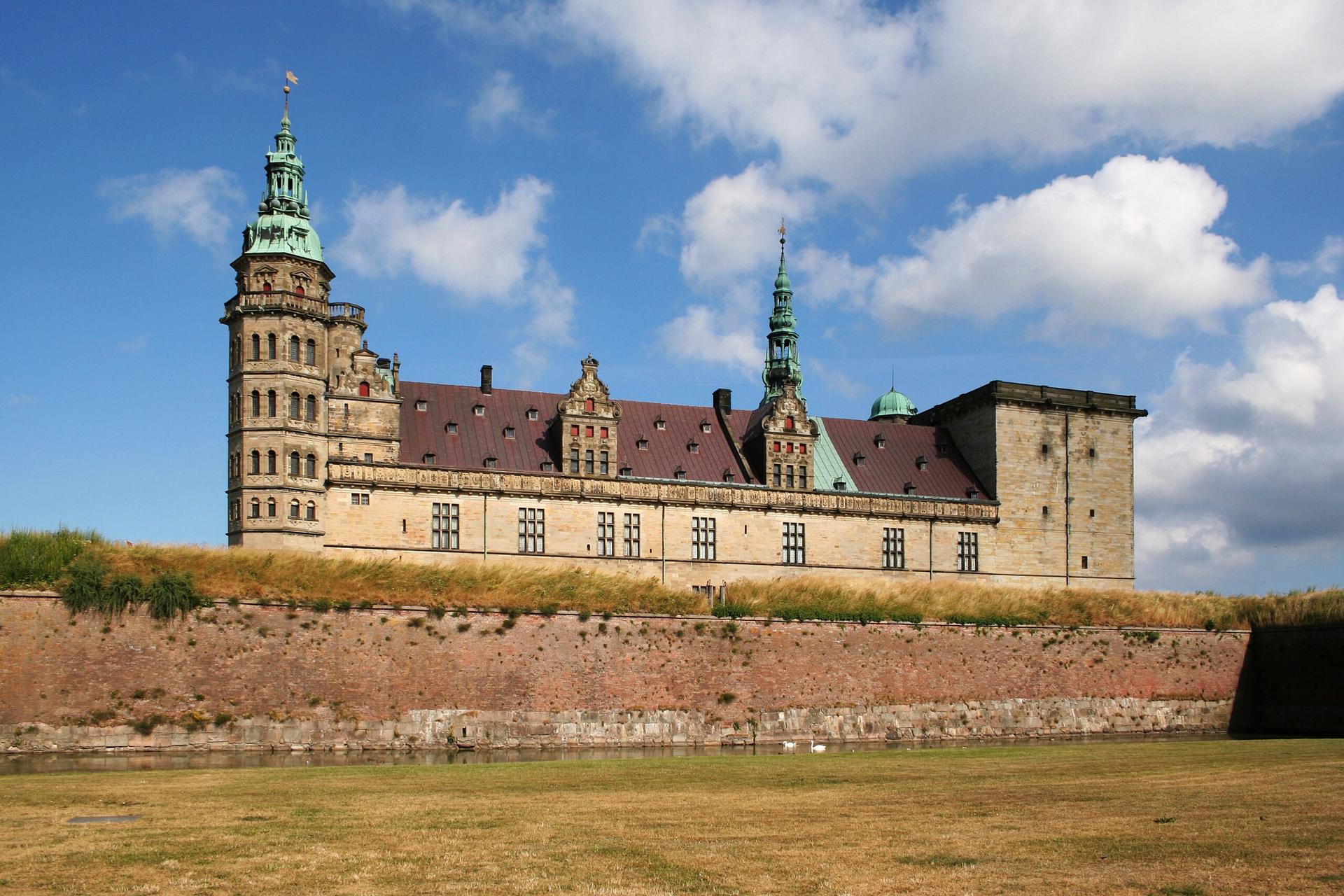
Explore North Zealand, Denmark's enchanting region of castles, beaches, and royal estates, perfect for history buffs, nature enthusiasts, and seaside lovers.
Tell me more about North Zealand
Architect Daniel Libeskind’s intimate "Mitzvah" interior turns a 17th‑century royal boathouse into a powerful, quietly absorbing journey through 400 years of Jewish life in Denmark.

Denmark’s first public art museum, a colour‑rich neoclassical gem on Slotsholmen where Bertel Thorvaldsen’s sculptures, collections and tomb share a single evocative space.