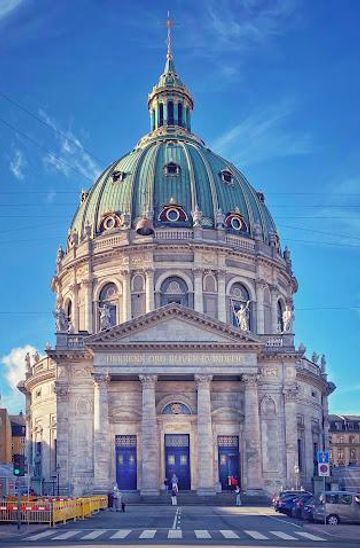
Frederik's Church (The Marble Church)
Copenhagen's copper-domed masterpiece—a 145-year architectural journey from ruin to resurrection.
Frederik's Church, known as the Marble Church, is Copenhagen's most iconic religious landmark, crowned by a magnificent copper-green dome measuring 31 meters in diameter—one of the largest in Europe. Located in the elegant Frederiksstaden district, this Neoclassical masterpiece took 145 years to complete, from its foundation stone laid by King Frederik V in 1749 to its consecration in 1894. The circular interior rises 46 meters high, supported by 12 pillars representing the apostles, and features intricate marble columns, symbolic frescoes, and exceptional acoustics. Visitors can climb to the dome's observation deck for panoramic views across Copenhagen, attend organ concerts, or simply experience the serene atmosphere of this working parish church that symbolizes Danish resilience and architectural excellence.
A brief summary to Frederik's Church
- Frederiksgade 4, Copenhagen, Indre By, 1265, DK
- Click to display
- Click to display
- Duration: 1 to 3 hours
- Budget
-
 Mixed
Mixed
- Mobile reception: 5 out of 5
- Monday 10 am-5 pm
- Tuesday 10 am-5 pm
- Wednesday 10 am-5 pm
- Thursday 10 am-5 pm
- Friday 10 am-5 pm
- Saturday 10 am-5 pm
- Sunday 12:30 pm-5 pm

Know before you go
Hi, I'm Eve. Here are a few practical things to know before exploring Frederik's Church.
- Visit during early morning or late afternoon when light slants through the windows, creating dramatic illumination across the marble columns and dome interior. The golden hour light transforms the space into a photographer's dream.
- Climb to the dome observation deck for panoramic city views. Access is available daily at 1 PM during summer months and weekends only during winter; arrive early as capacity is limited.
- Attend a free organ recital if timing permits. The church's exceptional acoustics and one of Scandinavia's largest organs create an unforgettable musical experience that resonates through the entire space.
- Walk the circular nave slowly, tracing the marble columns and observing the symbolic details—the 12 pillars representing apostles, the frescoes in the dome, and the medallions below. Each element tells part of the church's story.
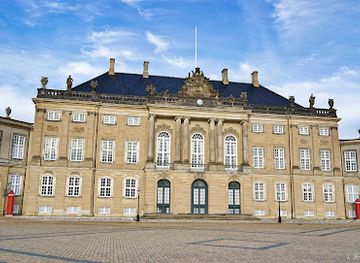
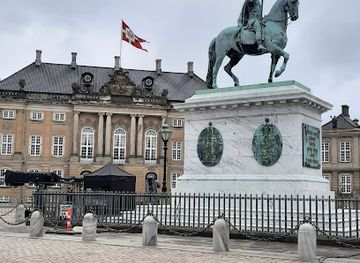
- Position yourself on Frederiksgade to view the perfect alignment between the church dome and Amalienborg Palace courtyard across the axis—a deliberately designed architectural dialogue created 250 years ago.
Do you manage this location?
Take control to get all the benefits, like improved information, better appearance, and stronger visibility across AI-powered discovery. Learn more
Activate your presenceOther nearby places you may find interesting

Getting There
-
Metro + Walking
Take the Copenhagen Metro Line M1 or M2 toward Vestamager or Vanløse, exiting at Kongens Nytorv station. From there, walk northeast through the historic streets toward Frederiksstaden, following signs to Amalienborg Palace. The church is located at Frederiksgade 4, approximately 8–10 minutes on foot from the metro station. This is the most direct and frequent public transport option, with trains departing every 3–4 minutes during peak hours.
-
Bus
Several bus routes serve the Frederiksstaden area. Routes 1A, 15, and 26 stop near Amalienborg Palace and Frederiksgade. Journey times vary between 15–25 minutes depending on traffic and starting location. Buses run frequently throughout the day, with reduced service in early morning and late evening hours.
-
Walking from Nyhavn
If exploring central Copenhagen, Nyhavn is approximately 1.2 kilometers away via a scenic walking route through historic streets. The walk takes 15–20 minutes and passes through charming neighborhoods, offering opportunities to explore other attractions along the way. This option is ideal for those with time to spare and interest in Copenhagen's architectural heritage.
-
Bicycle
Copenhagen's extensive cycling infrastructure makes reaching Frederik's Church by bicycle straightforward. Rent a bike from one of the city's many rental stations and follow dedicated cycle paths toward Frederiksstaden. Journey time is approximately 10–15 minutes from central areas. Secure bicycle parking is available near the church.
For the on-the-go comforts that matter to you
-
 Restrooms
-
 Drink Options
-
 Food Options
-
 Seating Areas
-
 Information Boards
-
 Visitor Center
Discover more about Frederik's Church
A Monument Born from Royal Vision and Perseverance
Fredrik's Church emerged from an ambitious 18th-century vision by King Frederik V to create Frederiksstaden, a grand new district that would showcase Danish royal power and urban sophistication. In 1749, the king himself laid the foundation stone in a ceremonial event that reflected the church's intended significance as a monument to the royal family's 300 years of reign. Architect Nicolai Eigtved designed the structure to rival the grandeur of St. Peter's Basilica in Rome, envisioning a marble-clad Baroque edifice that would dominate Copenhagen's skyline. However, this ambitious project encountered severe obstacles when Eigtved died in 1754, leaving the church incomplete. By 1770, financial constraints and political upheaval forced Prime Minister Struensee to abandon construction entirely, leaving behind only a picturesque ruin that would haunt the city's landscape for more than a century.From Ruin to Resurrection: A Century of Abandonment
For 145 years, the church site stood as a melancholic monument to unfulfilled ambition. The incomplete structure weathered Copenhagen's seasons, its stone skeleton gradually deteriorating while the city grew around it. Various proposals emerged to repurpose the abandoned site—some suggested converting it into a concert hall, others proposed a constitutional monument, a museum, or even a gas tank. These schemes reflected the desperation to resolve what had become an embarrassing symbol of Denmark's inability to complete its grandest architectural vision. The situation remained unchanged until the late 19th century, when wealthy industrialist Carl Frederik Tietgen intervened with both financial resources and determination. Tietgen purchased the ruins on the condition that a church would be built according to the original plans, commissioning architect Ferdinand Meldahl to oversee the project's completion.Architectural Triumph in Limestone and Light
The final realization of Frederik's Church represents a masterpiece of Neoclassical design, though with a pragmatic twist. Due to budget constraints, Meldahl substituted the original Norwegian marble with Danish limestone, polished to a lustrous finish that rivals marble in appearance. The circular nave rises 46 meters high, its soaring interior supported by 12 monumental Corinthian pillars, each symbolizing an apostle. The dome crowning this space measures 31 meters in diameter, making it one of the largest church domes in Europe. Inside, the dome's interior features frescoes depicting the Apostles, created by painter Chresten Overgaard, while below rest 12 symbolic medallions and baroque altar motifs drawn from the 42nd Psalm. The church's exceptional acoustics have made it renowned for organ music and choir performances, with one of Scandinavia's largest organs commanding the interior space. Light filters through tall arched windows, creating an atmosphere of serene contemplation that transforms the interior into a sanctuary of quiet reverence.Symbolic Alignment and Urban Design
The church's placement within Frederiksstaden reflects intentional architectural symbolism that extends beyond the building itself. The structure aligns perfectly with Amalienborg Palace across a carefully designed axis, creating a visual dialogue between heaven and earth, between the royal residence and the divine. This alignment was no accident but rather a deliberate expression of 18th-century ideals about the relationship between monarchy, faith, and civic order. The surrounding square and statuary reinforce this symbolism—street-level sculptures depict notable figures from Danish church history, while roof terrace statues represent important figures from broader church history, from Moses to Martin Luther. Walking through Frederiksstaden, one encounters a carefully orchestrated urban landscape where every element contributes to a unified vision of enlightened governance and spiritual aspiration.A Living Parish Church and Cultural Venue
Despite its status as a major tourist attraction, Frederik's Church functions as an active parish church within the Danish Evangelical-Lutheran Church. The building hosts regular services, weddings, and cultural events, maintaining its role as a living spiritual center rather than merely a historical monument. The church has become particularly popular for wedding ceremonies, with couples drawn to its architectural grandeur and symbolic significance. Free organ recitals fill the interior with music that seems to move through the listener's chest, while the exceptional acoustics make every performance memorable. The dome walkway, accessible seasonally, offers visitors panoramic views extending from Amalienborg Palace to the Øresund Strait, providing a perspective on Copenhagen that few other vantage points can match. Whether attending a concert, participating in a service, or simply sitting in quiet contemplation, visitors experience a space that honors both its historical significance and its continuing role in Copenhagen's spiritual and cultural life.Details That Reveal Deeper Stories
Close examination of Frederik's Church reveals numerous details that speak to its complex history and artistic ambition. The German woodcarving adorning the chapel entrance, the German ivory cross in the choir, and commemorative reliefs of Carl Frederik Tietgen and his wife all contribute to the church's rich visual narrative. The baptismal fonts—the original by Stefan Sinding now in storage, replaced by Joachim Skovgaard's 1925 design in the choir—mark different eras of the church's completion and use. The high altar features a magnificent altarpiece depicting the Ascension of Christ, while the frescoes and symbolic elements throughout the interior reflect Enlightenment ideals about reason, order, and harmony. Every architectural and decorative choice carries meaning, transforming the church into a text to be read by those patient enough to observe carefully.Explore the best of what Frederik's Church has to offer














More about North Zealand
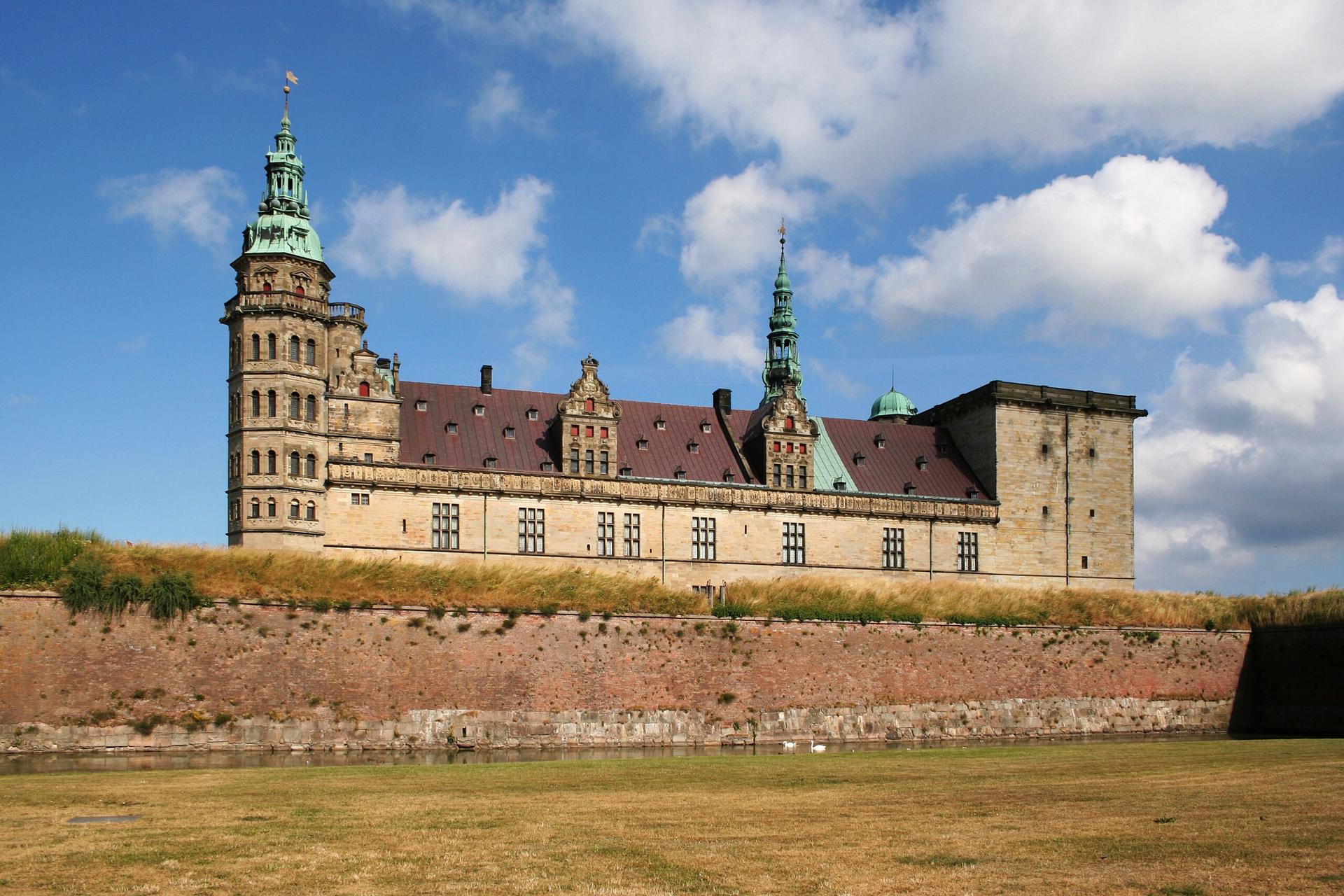
Explore North Zealand, Denmark's enchanting region of castles, beaches, and royal estates, perfect for history buffs, nature enthusiasts, and seaside lovers.
Tell me more about North Zealand
Copenhagen's historic 750-meter waterfront where 19th-century maritime heritage meets vibrant contemporary urban life.

A small yet lavish Russian Orthodox jewel with golden domes and royal ties, tucked between palaces and galleries in Copenhagen’s elegant Bredgade district.