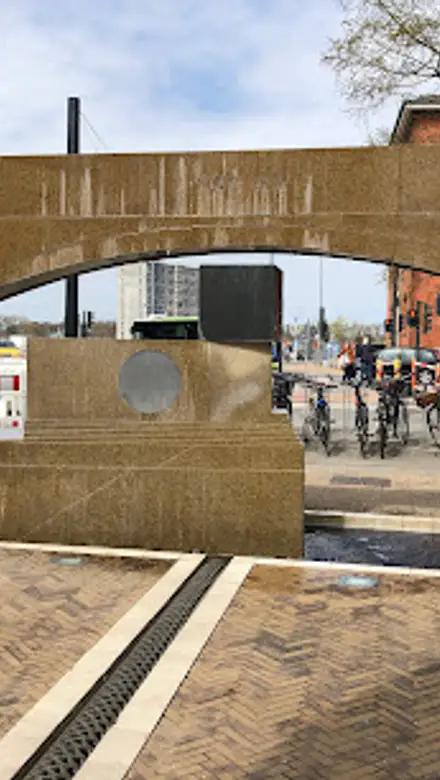
Hermes (gud for handlende) vandskulptur, Odense Travel Guide
Free Guide: A monumental Hermes of granite and water marks the gateway to Odense’s main shopping street, weaving myth, Viking history and urban everyday life into one sculpture.


A brief summary of Hermes (gud for handlende) vandskulptur
A monumental Hermes of granite and water marks the gateway to Odense’s main shopping street, weaving myth, Viking history and urban everyday life into one sculpture.
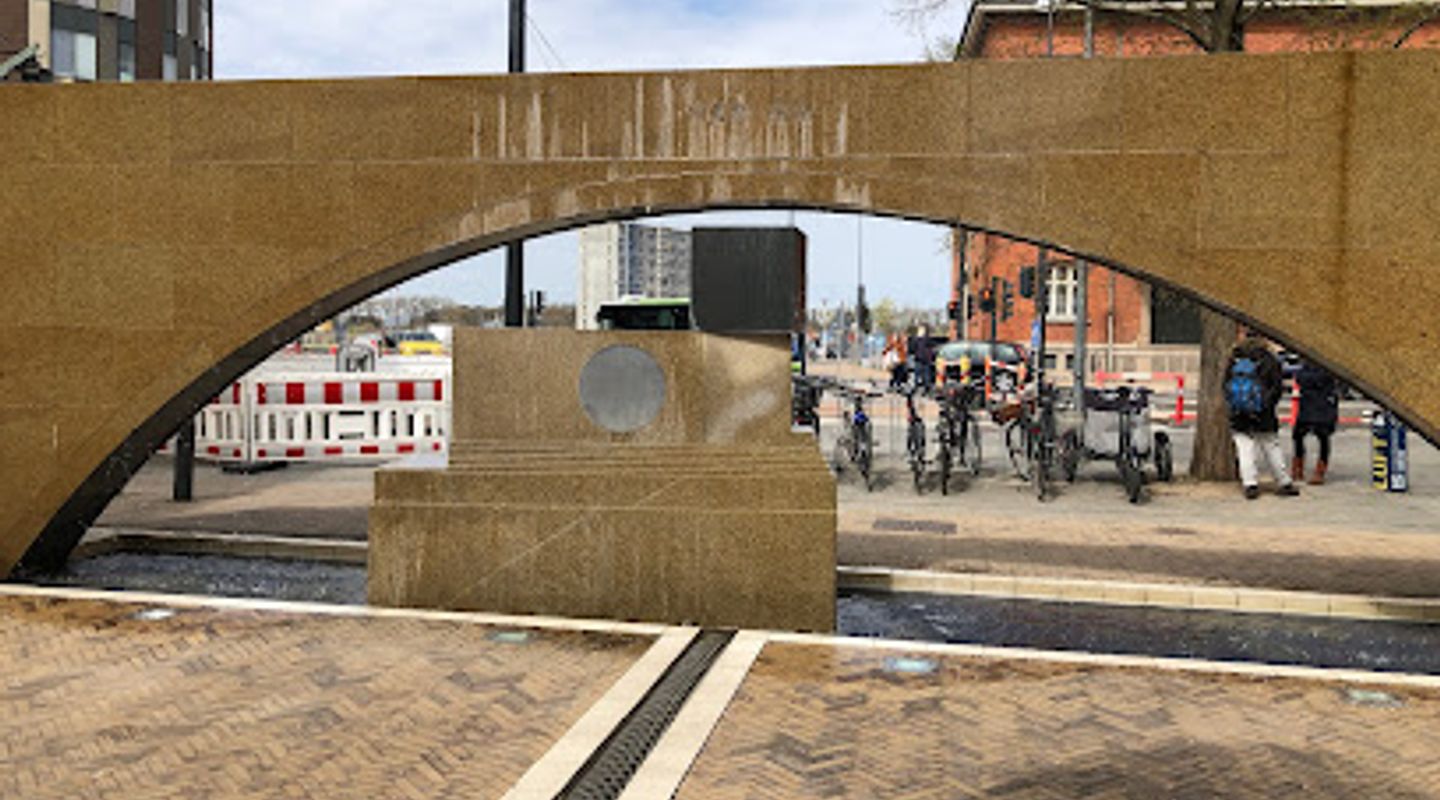
Marking the northern entrance to Odense’s main shopping street Kongensgade, the Hermes (Merchant God) vandskulptur is a striking piece of contemporary city art by Danish sculptor Mogens Møller. An 8.5‑metre granite “egg” form symbolizes Hermes, framed by a brick arch with a stylized sphinx and flanked by snakes and wings inspired by Viking jewellery unearthed on this very street. In summer, water elements animate the work, linking myth, trade and Odense’s urban everyday life.
On-site amenities
 Restrooms
 Drink options
 Drinking water
 Food options
 Seating areas
 Trash bins
 Information boards
Opening hours
- Every dayOpen 24 hours
Opening hours as listed on the venue’s Google Business Profile. Hours can change for services and special events, so check with the venue before you go.
- Address
- 5000 Odense
- Website
Getting there
From Odense Banegård Center by foot
City bus within Odense
Car or taxi from elsewhere on Funen
Discover more about Hermes (gud for handlende) vandskulptur
A gateway of myth at the edge of Kongensgade
Standing where Kongensgade meets Østre and Vestre Stationsvej, the Hermes (Merchant God) fountain announces the transition from traffic to pedestrian life with a bold sculptural gesture. Conceived as a gateway to Odense’s central shopping street, it fuses ancient mythology with local history in a way that feels both symbolic and surprisingly playful. In the middle of the bustle, luggage wheels and shop bags, Hermes presides over the comings and goings of modern trade.The sculpture dates from the early 2000s and was created as part of a broader redesign of this end of the pedestrian zone. Its presence gives a sense of arrival: you pass under, beside or around it almost without noticing that you are crossing an invisible threshold into a different rhythm of the city.
Mogens Møller’s monumental “egg”
At the heart of the work is an 8.5‑metre‑high granite form often compared to an oversized American football or a monumental egg. This abstract body represents Hermes, the Greek god of merchants, travellers and messages. Rather than a literal figure, the artist chose a simplified volume in dark stone, which lends the piece gravitas and a slightly mysterious air amid the shopfronts.On the front of the granite block the word “PEACE” is carved, a quiet but clear inscription that adds a contemporary layer of meaning. Hermes here becomes not only a patron of commerce, but also a guardian of coexistence in a busy, diverse urban street. The polished surfaces catch daylight and street lighting differently throughout the day, changing tone as the city moves around it.
Snakes, wings and a watchful sphinx
Flanking the central form is a brick wall with an arch, into which a stylized sphinx is set. The sphinx functions as a symbolic guardian, echoing the mythological creatures that once stood at city gates. Above and around the arch, you notice Hermes’ traditional attributes: wings and coiling snakes. They are rendered in a graphic, almost emblematic style, standing out clearly against the masonry.These elements are more than decorative. They hint at speed, communication and protection, all qualities linked to Hermes in classical mythology. Their placement on the wall, rather than on the central figure, invites you to scan the whole ensemble instead of focusing on a single statue. Seen from different sides, the work reveals new combinations of forms and symbols set against the linear perspective of Kongensgade.
Viking jewellery and traces of Odense’s past
One of the most intriguing aspects of the sculpture is its link to an archaeological find from the same street. During earlier excavations in Kongensgade, a piece of Viking jewellery was discovered. Mogens Møller enlarged and reinterpreted this ornament, incorporating its shapes alongside the sphinx as part of the composition. In doing so, he layered local Viking‑age craftsmanship into a work otherwise rooted in Mediterranean myth.This meeting of cultures reflects Odense’s long history as a trading centre on Funen. The Viking motif suggests centuries of exchange passing through the area, long before the modern shop windows. Standing here, you are literally at a crossroads of eras: Viking artisans, classical gods and twenty‑first‑century consumers all referenced in stone, brick and flowing water.
Water, city sounds and everyday encounters
In the warmer months, water turns the sculpture into a small urban fountain. Thin streams and basins soften the heavy granite and brick, adding sparkle and movement to a piece otherwise defined by strong, static forms. The sound of splashing water mixes with the murmur of conversations, bicycle bells and distant buses, creating a gentle acoustic backdrop.Benches and low edges nearby offer informal places to pause. Office workers sit with takeaway coffees, children weave around the granite obelisks that line the street as protective “guardians”, and shoppers use the sculpture as a meeting point. Even if you only pass through briefly, Hermes leaves a clear impression: this is where Odense’s stories of trade, travel and art intersect.
Reading the work as part of a wider city of sculpture
Hermes (Merchant God) is one of many public sculptures scattered across Odense, but it stands out for its scale and layered symbolism. It connects naturally with the city’s other myth and fairytale‑themed works, from mermaids and wild swans in the parks to historical figures on civic buildings. Taken together, they turn an ordinary errand route into an open‑air gallery.Spending a little extra time here allows you to read the details: the engraved word, the stylized snakes, the contrast between rough brick and polished stone, the nod to Viking jewellery on the sphinx. The more you look, the more clearly Hermes emerges as both a marker of place and a story in its own right, rooted firmly in Odense yet looking out to wider worlds of myth and exchange.
Evendo Review Centre
 Google
Guest reviews
Best time to go
Quietest: Jan, Feb & Nov · before 7am or from 9pm
Busy times are Evendo estimates for a typical year, to help you plan. Actual crowds vary with events, school holidays and the weather.
Explore Hermes (gud for handlende) vandskulptur on the map
A handpicked selection of must-see spots near Hermes (gud for handlende) vandskulptur, mapped for you.
Get your free copy of our complete guide to Hermes (gud for handlende) vandskulptur, delivered straight to you.
Everything on this page, from opening hours and how to get there to Eve’s tips and the best time to go, in one PDF you can read offline, print or share.
Already have an account? Sign in
Your Hermes (gud for handlende) vandskulptur guide is ready.
We'll send it to · Not you? Sign out

Getting your guide ready…
We are putting together a fresh copy of the Hermes (gud for handlende) vandskulptur guide. This can take up to a minute.
This can take a few moments. If your browser asks, choose Allow so the download can start. You'll find the guide in your Downloads folder.
Nothing happened? Download it again
Sorry, the guide is taking longer than usual. Please try again in a minute, or get it by email instead.
Other nearby places you may find interesting
The closest places of the same kind, if this one is not quite what you had in mind.
-
Bunkermuseum Of Odense Step into a fully preserved Cold War command bunker beneath Odense and explore an atmospheric maze of control rooms, exhibits and civil defence history.
-
The Funen Village Step into a living Funen countryside village of thatched farms, mills, orchards and heritage animals, where 18th- and 19th-century rural Denmark comes vividly to life.
-
Tidens Samling Hands-on time travel through 20th‑century Danish homes, fashion and design inside Odense’s historic Brandts Klædefabrik complex.
-
Munke Mose Central Odense’s riverside wetland park where fairy-tale sculptures, grand old trees and easygoing outdoor life meet along the gentle Odense River.
-
Bøgetoppen i Odense Zoo A gentle treetop adventure above Odense Zoo, Bøgetoppen lets you wander through the beech canopy, combining forest views, local nature stories and family-friendly fun.
Swipe for more places
More to explore near Hermes (gud for handlende) vandskulptur
-
 Best experiences near Hermes (gud for handlende) vandskulptur
-
 Best hotels near Hermes (gud for handlende) vandskulptur
-
 Best landmarks near Hermes (gud for handlende) vandskulptur
-
 Best attractions near Hermes (gud for handlende) vandskulptur
-
 Best shops near Hermes (gud for handlende) vandskulptur
-
 Best restaurants near Hermes (gud for handlende) vandskulptur
-
 Best bars near Hermes (gud for handlende) vandskulptur







Do you manage this location?
Take control to get all the benefits, like improved information, better appearance, and stronger visibility across AI-powered discovery.
Explore more

Explore more of Odense
Discover Odense, Denmark's enchanting city where fairy tales come to life amidst historic streets, vibrant culture, and scenic beauty.
Explore Odense
Explore more of Denmark
Discover Denmark: A perfect blend of history, modern design, and the cozy concept of hygge. Explore vibrant cities, serene landscapes, and world-class cuisine.
Explore Denmark