

Den blå sø Travel Guide
Free Guide: A vivid turquoise lake framed by towering white chalk walls, Den Blå Sø transforms Faxe Limestone Quarry into one of Denmark’s most surreal and photogenic landscapes.


A brief summary of Den blå sø
A vivid turquoise lake framed by towering white chalk walls, Den Blå Sø transforms Faxe Limestone Quarry into one of Denmark’s most surreal and photogenic landscapes.
Den Blå Sø is a striking turquoise lake set in the vast Faxe Limestone Quarry on South Zealand, where white chalk walls plunge towards intensely blue, crystal-clear water. Formed in a former extraction pit now filled with groundwater, this industrial landscape has transformed into a dramatic, otherworldly nature spot. Visitors come for the sweeping views, the unusual color contrasts, and walks along the quarry edge or down into selected areas of the pit, often combined with fossil hunting at nearby Geomuseum Faxe.
On-site amenities
 Restrooms
 Drinking water
 Food options
 Seating areas
 Sheltered areas
 Trash bins
 Information boards
 Visitor centre
Opening hours
- Every dayOpen 24 hours
Opening hours as listed on the venue’s Google Business Profile. Hours can change for services and special events, so check with the venue before you go.
- Address
- 747M+J3, 4640 Faxe
- Website
Getting there
Train and local walk from Copenhagen
Car from Copenhagen and Zealand
Regional bus within South Zealand
Discover more about Den blå sø
A Turquoise Lake in a Giant Chalk Landscape
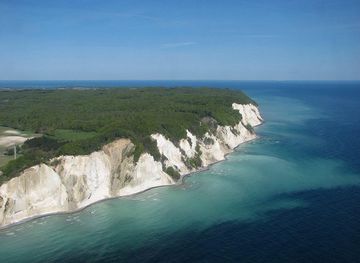
Den Blå Sø lies in the middle of Faxe Kalkbrud, Denmark’s largest limestone quarry, a man‑made basin covering around 150 hectares and dropping up to about 45 meters deep. Here, steep white chalk walls enclose pockets of intensely blue water, giving the small lake its name and lending the entire landscape an almost surreal character. The contrast between the blindingly pale rock and the saturated turquoise surface is what draws most visitors to this spot.The lake is fed by clean groundwater that seeps into the quarry floor. Because the water is extremely clear and holds very few algae or plant remains, sunlight penetrates deeply and is scattered by the fine chalk particles, producing the extraordinary blue color. On bright days, the reflections can be dazzling, and the lake shifts from milky turquoise near the edges to deep, inky blue where the quarry is at its deepest.
From Ancient Sea to Modern Quarry
Long before Den Blå Sø appeared, this entire area lay under a warm, tropical sea. Around 60–65 million years ago, coral reefs, bryozoans and other marine life settled on the seabed here, slowly forming thick layers of limestone. Over geological time, the sea retreated and the deposits were uplifted, leaving the rich chalk strata that would later be quarried at Faxe.Industrial extraction shaped the dramatic amphitheatre you see today. As the quarry expanded and deepened, abandoned pits filled with groundwater, creating a series of small lakes, including Den Blå Sø. The quarry is still an active workplace in parts, but designated areas are open for visitors to explore and to see the exposed rock faces, where fossils from the prehistoric seabed can still be found.
Visiting Den Blå Sø Safely
The lake’s clear water looks inviting, but bathing here is strongly discouraged. The quarry lake is very deep and the water is extremely cold just below the surface, which can lead to cramps or cold shock. In addition, the high pH value, caused by dissolved limestone, may irritate skin and eyes. For these reasons, Den Blå Sø is best enjoyed from the shore and surrounding viewpoints.Paths lead along parts of the quarry edge and down into selected sections, though the terrain can be uneven, dusty and slippery in wet weather. Solid footwear is essential, and in sunny conditions the bright chalk can make the light almost glaring, so sunglasses, a hat and drinking water are highly recommended. Visitors should pay attention to signs and respect any restricted zones linked to ongoing quarry operations.
Walking Routes and Fossil Adventures
A marked walking route managed by the Danish nature authorities explores the publicly accessible side of Faxe Kalkbrud, passing viewpoints where you can look across Den Blå Sø and the surrounding chalk landscape. The walk is not long in distance, but the constant visual drama of high walls, blue pools and exposed rock layers makes it memorable.For a deeper dive into the site’s story, many combine a visit to Den Blå Sø with time at Geomuseum Faxe, located by the quarry. The museum offers fossil hunting tours down into the pit, where you can borrow or rent tools and learn to recognize corals, sea urchins and other remains from the ancient sea. Even on a self‑guided visit, it is common to spot fossil fragments in the rubble around the lake.
Atmosphere Through the Seasons
Den Blå Sø has a different mood in each season. On bright summer days, the chalk reflects heat and light, and the lake glows almost tropical in color, even though the water stays cold. In spring and autumn, the air is cooler, and the sharp outlines of the quarry walls stand out under clear Scandinavian skies, ideal conditions for photography. In winter, thin layers of frost or snow on the chalk can make the slopes appear even more otherworldly.Despite its industrial origins, the area around the lake is gradually being reclaimed by nature. Grasses, wildflowers and hardy shrubs colonize ledges and plateaus, while birds use the quarry walls and quiet water as resting and feeding spots. This slow softening of the landscape adds an extra layer to a visit: it is a place where geology, industry and natural regeneration all meet in one compact, dramatic scene.
Evendo Review Centre
 Google
Guest reviews
Best time to go
Quietest: Jan, Feb & Dec · before 7am or from 8pm
Busy times are Evendo estimates for a typical year, to help you plan. Actual crowds vary with events, school holidays and the weather.
Explore Den blå sø on the map
A handpicked selection of must-see spots near Den blå sø, mapped for you.
Get your free copy of our complete guide to Den blå sø, delivered straight to you.
Everything on this page, from opening hours and how to get there to Eve’s tips and the best time to go, in one PDF you can read offline, print or share.
Already have an account? Sign in
Your Den blå sø guide is ready.
We'll send it to · Not you? Sign out

Getting your guide ready…
We are putting together a fresh copy of the Den blå sø guide. This can take up to a minute.
This can take a few moments. If your browser asks, choose Allow so the download can start. You'll find the guide in your Downloads folder.
Nothing happened? Download it again
Sorry, the guide is taking longer than usual. Please try again in a minute, or get it by email instead.
Other nearby places you may find interesting
The closest places of the same kind, if this one is not quite what you had in mind.
-
-
-
-
-


Swipe for more places
More to explore near Den blå sø

 Best experiences near Den blå sø
 Best hotels near Den blå sø
 Best landmarks near Den blå sø
 Best attractions near Den blå sø
 Best shops near Den blå sø
 Best restaurants near Den blå sø
 Best bars near Den blå sø
Do you manage this location?
Take control to get all the benefits, like improved information, better appearance, and stronger visibility across AI-powered discovery.
Explore more
Explore more of South Zealand
Discover South Zealand, where dramatic cliffs, historic castles, and charming coastal towns create the perfect Danish escape.
Explore South Zealand
Explore more of Denmark
Discover Denmark: A perfect blend of history, modern design, and the cozy concept of hygge. Explore vibrant cities, serene landscapes, and world-class cuisine.
Explore Denmark
