

New Town (Edinburgh) Travel Guide - Free
Explore New Town in Edinburgh with Evendo's free guide. Find the best shops, historic streets, restaurants, and gems on web or mobile.


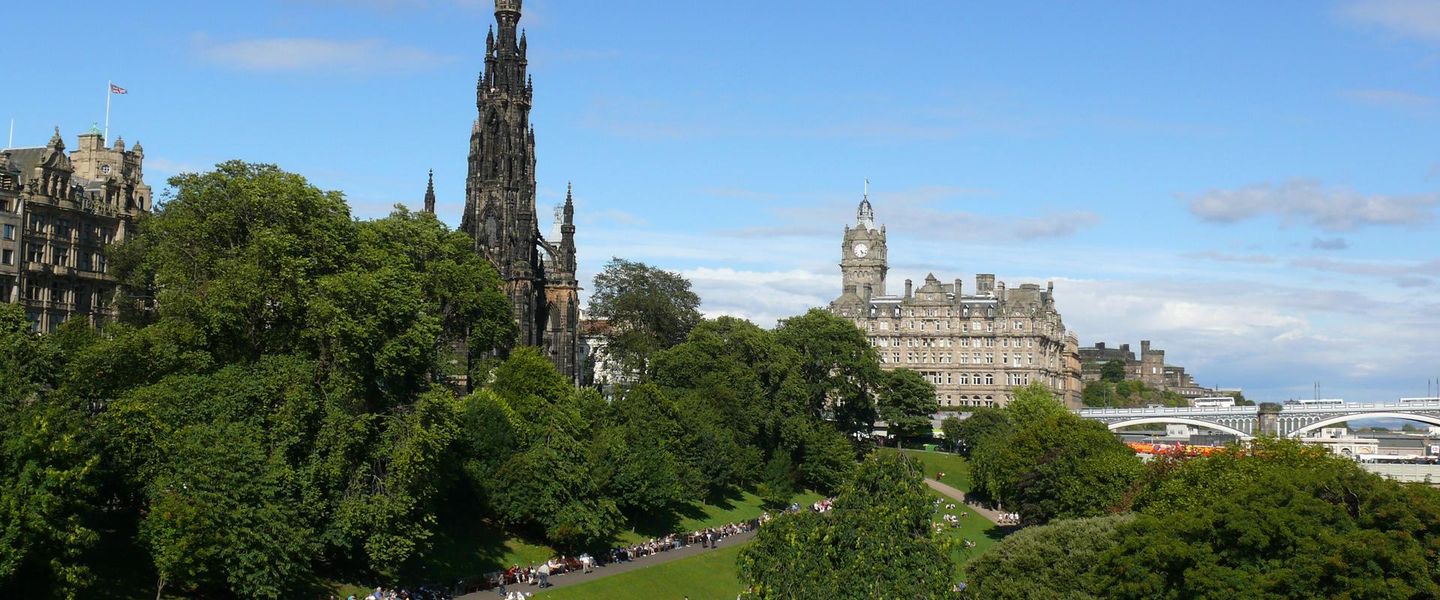


New Town Edinburgh pairs Georgian streets, grand squares, galleries, gardens, independent shops and elegant restaurants in Scotland’s historic capital.
Georgian Order and Urban Ambition
Edinburgh’s New Town is a carefully composed district of broad streets, formal squares and pale Georgian terraces extending north from the medieval Old Town. Planned from the 1760s as the city’s answer to overcrowding and poor sanitation, it remains one of Britain’s most coherent examples of Georgian urban design. Princes Street forms its dramatic southern edge, with views towards Edinburgh Castle and the Old Town, while George Street, Queen Street and Thistle Street reveal a more measured rhythm of elegant façades, boutiques, restaurants and offices.Read more about New Town
Squares, Galleries and Everyday Life
Shopping, Dining and Open Air
Explore New Town on the map
A handpicked selection of must-see spots in New Town, mapped for you.
Best hotels in New Town
New Town essentials
Getting There
Getting Around
Safety
Emergency Situations
Do's and Don'ts
Local Tips

From Eve
Local phrases worth knowing
You don't need to get them perfect. A few words go a long way, and locals appreciate the effort.
Basics
| English | Local | Say it |
|---|---|---|
| Hello | Alright | [al-rite] |
| Goodbye | Ta-ra | [ta-ra] |
| Yes | Aye | [aye] |
| No | Nah | [nah] |
| Please/You're welcome | Please/Ta | [please/ta] |
| Thank you | Cheers | [cheers] |
| Excuse me/Sorry | Sorry | [sorry] |
| How are you? | How do? | [how do?] |
| Fine. And you? | Sound. You? | [sound. you?] |
| Do you speak English? | Speak English? | [speak english?] |
| I don't understand | I'm lost | [I'm lost] |
Eating & Drinking
| English | Local | Say it |
|---|---|---|
| I'd like to see the menu, please | Can I see the menu, please | [can I see the menu, please] |
| I don't eat meat | I don't do meat | [I don't do meat] |
| Cheers! | Cheers! | [cheers!] |
| I would like to pay, please | Can I pay, please | [can I pay, please] |
Emergencies
| English | Local | Say it |
|---|---|---|
| Help! | Help! | [help!] |
| Go away! | Clear off! | [clear off!] |
| Call the Police! | Ring the Old Bill! | [ring the old bill!] |
| Call a doctor! | Get a doc! | [get a doc!] |
| I'm lost | I'm lost | [I'm lost] |
| I'm ill | I'm poorly | [I'm poorly] |
Shopping
| English | Local | Say it |
|---|---|---|
| I'd like to buy... | I wanna buy... | [I wanna buy...] |
| I'm just looking | Just looking | [just looking] |
| How much is it? | How much? | [how much?] |
| That's too expensive | That's steep | [that's steep] |
| Can you lower the price? | Can you do it cheaper? | [can you do it cheaper?] |
Time & Numbers
| English | Local | Say it |
|---|---|---|
| What time is it? | What's the time? | [what's the time?] |
| It's one o'clock | It's one | [it's one] |
| Half past (10) | Half ten | [half ten] |
| Morning | Morning | [morning] |
| Afternoon | Afternoon | [afternoon] |
| Evening | Evening | [evening] |
| Yesterday | Yesterday | [yesterday] |
| Today | Today | [today] |
| Tomorrow | Tomorrow | [tomorrow] |
| 1 | One | [one] |
| 2 | Two | [two] |
| 3 | Three | [three] |
| 4 | Four | [four] |
| 5 | Five | [five] |
| 6 | Six | [six] |
| 7 | Seven | [seven] |
| 8 | Eight | [eight] |
| 9 | Nine | [nine] |
| 10 | Ten | [ten] |
Transport & Directions
| English | Local | Say it |
|---|---|---|
| Where's a/the...? | Where's the...? | [where's the...?] |
| What's the address? | What's the address? | [what's the address?] |
| Can you show me (on the map)? | Can you show me (on the map)? | [can you show me (on the map)?] |
| When's the next (bus)? | When's the next (bus)? | [when's the next (bus)?] |
| A ticket (to ....) | A ticket (to ....) | [a ticket (to ....)] |
History of New Town
The First New Town Takes Shape
Edinburgh’s first New Town was planned after James Craig won a competition in 1767, reflecting civic ambitions to relieve pressure on the crowded Old Town and attract wealthier residents north of the Nor Loch. Construction began in the 1760s and continued through the late eighteenth century, following a disciplined grid centred on George Street and linked by Hanover Street, Frederick Street and Castle Street. The architecture drew on the classical ideals of the Enlightenment: regular façades, restrained decoration and carefully proportioned streets. The area was not simply a housing project; it represented a deliberate attempt to recast Edinburgh as a modern, orderly European capital.
Squares and Civic Grandeur
The New Town developed through a sequence of planned spaces rather than a single uniform building campaign. Charlotte Square marked the western termination of the original layout, while St Andrew Square established a ceremonial eastern counterpart. Queen Street and the northern terraces provided larger houses and gardens, and public buildings gradually joined the private residences. The Assembly Rooms opened on George Street in 1787, strengthening the district’s role in civic and social life. By the early nineteenth century, the New Town had become associated with Edinburgh’s professional classes, banks, institutions and fashionable domestic culture, while the Old Town retained a denser and more mixed urban character.
Expansion Beyond the Original Grid
As central Edinburgh grew, development spread beyond the first New Town towards Stockbridge, Canonmills and the Second New Town. Streets north of Queen Street were extended and rebuilt during the nineteenth century, adding terraces, villas and institutional buildings without abandoning the area’s preference for ordered façades. Transport and commercial improvements strengthened the district’s role as a link between the city centre and northern suburbs. Princes Street became a major retail and hotel address, while railway construction and the arrival of the station at Waverley, just south of the New Town, increased movement through the central area. These changes made the neighbourhood less exclusively residential and more commercially connected.
Victorian Layers and Heritage Protection
The nineteenth century introduced architectural contrasts to the New Town’s Georgian core. Gothic Revival buildings, including the Scottish National Portrait Gallery on Queen Street, reflected changing ideas about national culture and public institutions, while commercial structures brought larger shopfronts and more intensive uses to the main streets. In the twentieth century, parts of the district faced pressure from traffic, commercial redevelopment and changing patterns of residence. Conservation gradually became central to the area’s future, and the Old and New Towns of Edinburgh were inscribed together as a UNESCO World Heritage Site in 1995. Protection has helped preserve the overall townscape while allowing offices, cultural venues, hospitality and contemporary retail to occupy historic buildings.
A Mixed Central Neighbourhood Today
New Town now combines offices, homes, hotels, galleries, restaurants, shops and public institutions within the historic street plan. Its grandest addresses remain associated with finance, civic events and prestigious retail, but smaller streets contain independent businesses and everyday services. Conservation and adaptation have shaped the contemporary district: Georgian houses may contain apartments, professional premises or cultural attractions, while former commercial spaces support new food and drink venues. The area’s identity therefore rests not only on preserved architecture but also on continued use, with residents, workers, visitors and students sharing streets designed more than two centuries ago.
New Town in Photos
Browse through our photo collection highlighting the charm and character of the destination.
Neighbourhoods near New Town
The closest neighbourhoods to New Town, if you have time for more than one stop.
-

-


Swipe for more neighbourhoods
Explore more

Explore more of Edinburgh
Edinburgh blends medieval lanes, castle history, Georgian architecture, literary culture and lively festivals with hills, gardens and coastal escapes.
Explore Edinburgh