

Dodekalitten Travel Guide
Free Guide: Twelve granite sentinels and electronic music create a meditative monument where ancient legend meets contemporary art.


A brief summary of Dodekalitten
Twelve granite sentinels and electronic music create a meditative monument where ancient legend meets contemporary art.
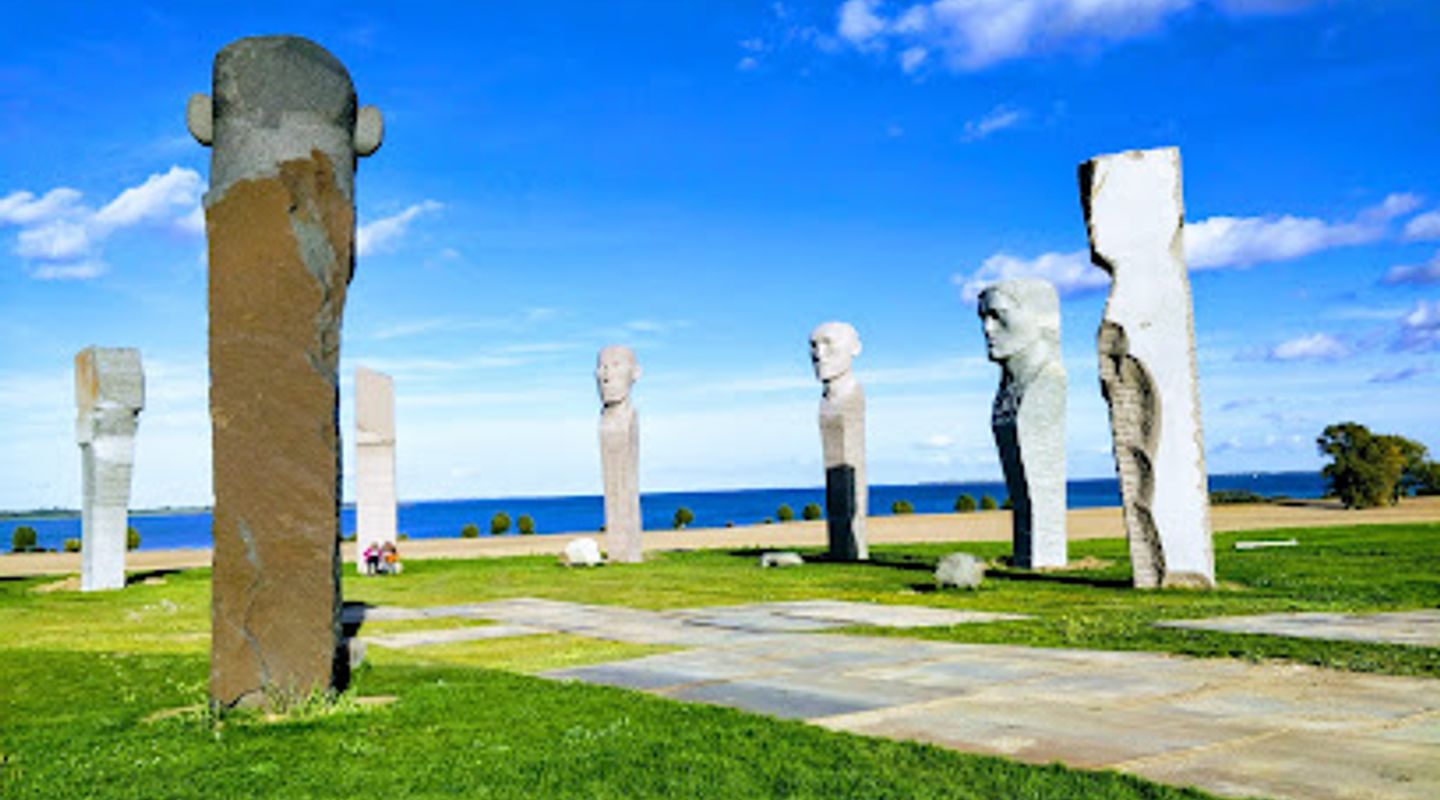
Dodekalitten is a monumental open-air art installation on Lolland featuring twelve colossal granite sculptures arranged in a 40-meter circle, each 7–9 meters tall and weighing 25–45 tons. Created by sculptor Thomas Kadziola and composer Wayne Siegel, the site combines carved stone heads gazing inward with seasonally-responsive electronic music emanating from hidden speakers, set against panoramic views of the Smålandsfarvandet strait. Free to visit year-round, it stands near Bronze Age burial mounds in a protected landscape, offering a meditative and immersive sensory experience.
On-site amenities
 Seating areas
 Picnic areas
 Information boards
Opening hours
- Every dayOpen 24 hours
Opening hours as listed on the venue’s Google Business Profile. Hours can change for services and special events, so check with the venue before you go.
- Address
- Kragenæsvej 62, 4943 Lolland
- Phone
- Website
Getting there
Walking from Kragenæs Harbor
Cycling from Nakskov or Maribo
Bus from Nakskov or Maribo
Driving and Parking
Discover more about Dodekalitten
A Monument Born from Ancient Legend
Dodekalitten—a name derived from the Greek words for "twelve stones"—is an extraordinary contemporary art installation located on the northern coast of Lolland, near the small fishing village of Kragenæs. The project began with a compelling narrative: composer Gunner Møller Pedersen conceived the legend of a fictional people who migrated to Lolland 7,500 years ago, fleeing the catastrophic Bosporus Breakthrough that flooded the Black Sea. This mythological foundation infuses the artwork with layers of historical imagination, connecting visitors to both ancient and imagined pasts.
Twelve Granite Sentinels in Dialogue
The physical centerpiece consists of twelve monumental granite sculptures arranged in a perfect circle 40 meters in diameter. Each figure stands 7 to 9 meters tall and weighs between 25 and 45 tons—a testament to the extraordinary skill of sculptor Thomas Kadziola, who has spent over a decade carving these forms from raw stone. The upper two meters of each sculpture are meticulously crafted as human heads, all facing inward toward the circle's center. This arrangement creates an intimate, introspective geometry: visitors standing in the middle find themselves surrounded by silent stone gazes, as if participating in an eternal council.The first chisel strike occurred in November 2010, and the work continues toward completion in 2025. Each figure possesses its own distinct character and expression, inviting visitors to perceive personality and emotion in the carved granite.
Soundscape and Seasonal Transformation
What elevates Dodekalitten beyond static sculpture is its integration of custom-composed electronic music. Composer Wayne Siegel, who joined the project in 2017, created an adaptive soundscape that responds to environmental conditions—season, light, weather, and even tidal patterns—ensuring the acoustic experience transforms throughout the year and across daylight hours. The music emanates from hidden speakers embedded in stone seating areas within the circle, creating an immersive sonic environment that shifts from meditative to ethereal to unsettling, depending on atmospheric conditions and time of day. Visitors frequently describe the combined effect as both deeply calming and mysteriously unsettling, a duality that defines the site's emotional power.
Landscape, History, and Horizon
The Dodekalitten occupy a prominent hilltop within the "Lollandske Alper" (Lolland Alps)—modest elevations that nonetheless command sweeping vistas across the Smålandsfarvandet, a strait separating Lolland from smaller islands. The location is archaeologically significant: the site sits near the Glentehøj passage grave and several Bronze Age burial mounds, placing contemporary art within a continuum of human ritual and monument-building spanning millennia. This juxtaposition of modern sculpture with prehistoric graves creates a profound temporal dialogue, suggesting that the human impulse to create meaningful places transcends epochs.Approximately 300 meters from the coast, the installation benefits from open landscape views and the presence of nearby forest, making the approach itself part of the experience. The walk from Kragenæs harbor through woodland and open fields builds anticipation before the massive stone heads suddenly emerge on the horizon.
A Living, Evolving Artwork
Unlike completed monuments, Dodekalitten remains a work in progress, with Kadziola continuing to refine and develop the sculptures. This ongoing evolution means the installation is never static; visitors may encounter new elements, modifications, or artistic developments on successive visits. The site regularly hosts cultural events, concerts, and art exhibitions, transforming the stone circle into a venue for contemporary performance and creative dialogue. This living quality distinguishes Dodekalitten from traditional sculpture parks: it is simultaneously a finished artwork and an active creative process.
Visitor Experience and Atmosphere
The site invites contemplation, play, and sensory immersion. Families discover it as an open-air playground where children's imaginations flourish among the monumental forms. Couples and solo visitors find it a space for meditation and introspection. The combination of visual grandeur, acoustic atmosphere, historical resonance, and natural landscape creates what many describe as a transformative experience—a place where the boundary between art, nature, history, and personal consciousness becomes permeable. The best visits often occur during quieter hours, when fewer visitors allow the full sensory and emotional impact to unfold.
Evendo Review Centre
 Google
Guest reviews
Best time to go
Quietest: Jan, Feb & Dec · before 7am or from 9pm
Busy times are Evendo estimates for a typical year, to help you plan. Actual crowds vary with events, school holidays and the weather.
Explore Dodekalitten on the map
A handpicked selection of must-see spots near Dodekalitten, mapped for you.
Get your free copy of our complete guide to Dodekalitten, delivered straight to you.
Everything on this page, from opening hours and how to get there to Eve’s tips and the best time to go, in one PDF you can read offline, print or share.
Already have an account? Sign in
Your Dodekalitten guide is ready.
We'll send it to · Not you? Sign out

Getting your guide ready…
We are putting together a fresh copy of the Dodekalitten guide. This can take up to a minute.
This can take a few moments. If your browser asks, choose Allow so the download can start. You'll find the guide in your Downloads folder.
Nothing happened? Download it again
Sorry, the guide is taking longer than usual. Please try again in a minute, or get it by email instead.
Other nearby places you may find interesting
The closest places of the same kind, if this one is not quite what you had in mind.
-
-
-
-
-


Swipe for more places
More to explore near Dodekalitten

 Best experiences near Dodekalitten
 Best hotels near Dodekalitten
 Best landmarks near Dodekalitten
 Best attractions near Dodekalitten
 Best shops near Dodekalitten
 Best restaurants near Dodekalitten
 Best bars near Dodekalitten
Do you manage this location?
Take control to get all the benefits, like improved information, better appearance, and stronger visibility across AI-powered discovery.
Explore more

Explore more of Lolland-Falster
Discover Lolland-Falster: Denmark's serene southern islands with stunning beaches, historic castles, and charming coastal towns offering a perfect blend of nature and culture.
Explore Lolland-Falster
Explore more of Denmark
Discover Denmark: A perfect blend of history, modern design, and the cozy concept of hygge. Explore vibrant cities, serene landscapes, and world-class cuisine.
Explore Denmark
