Marsk Tower - Marsk tårnet, Romo Travel Guide
A rust-red spiral rising from the Wadden Sea marsh, Marsk Tower pairs bold Danish design with sweeping horizons over one of Europe’s great coastal landscapes.
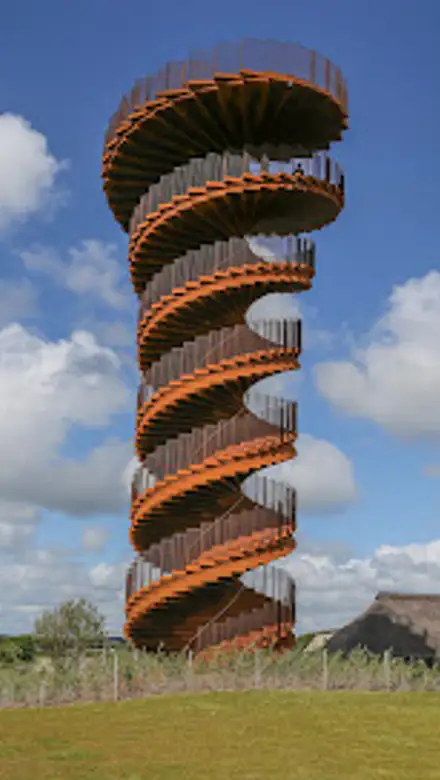
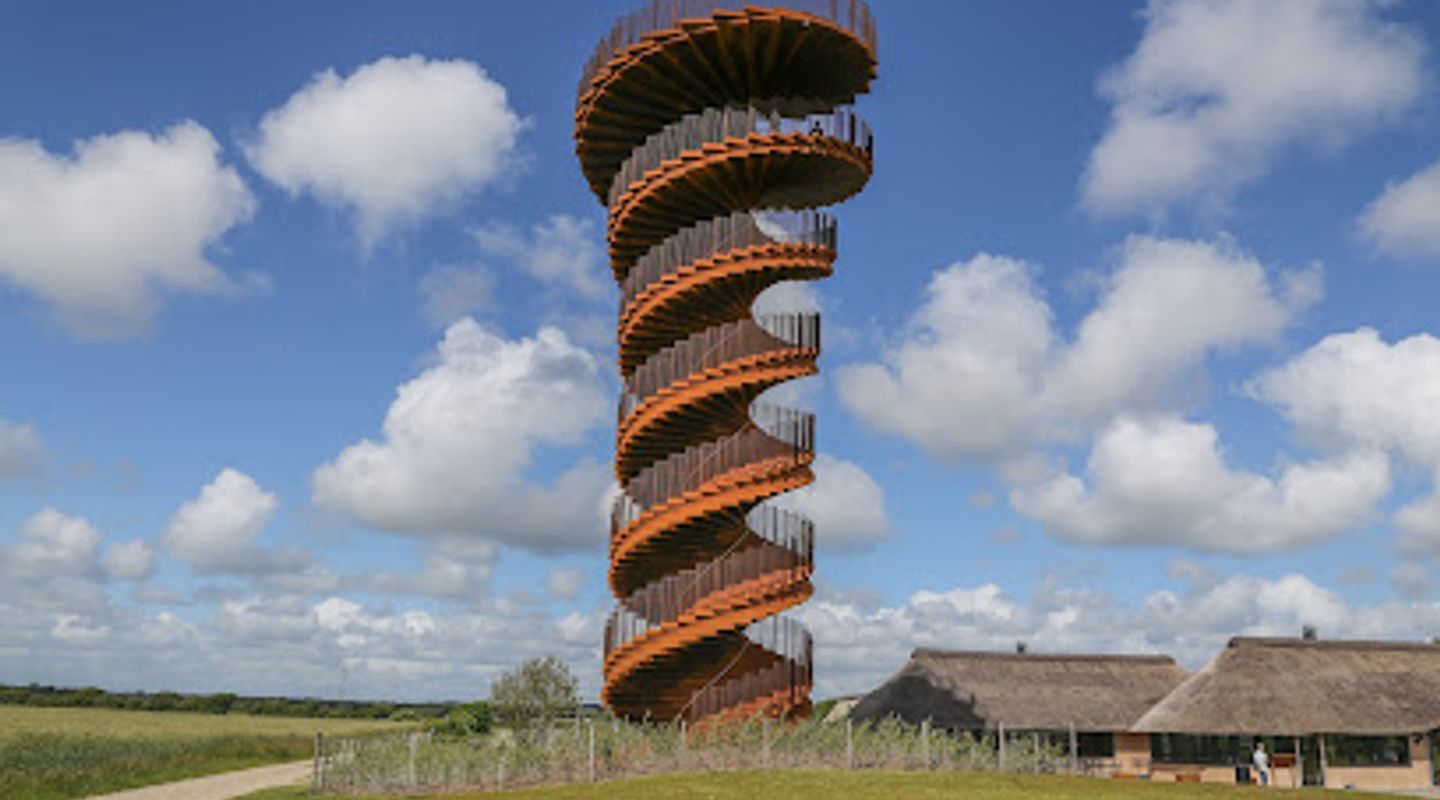
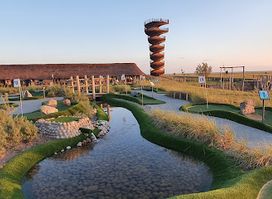
Marsk Tower is a striking 25 m corten-steel observation tower rising from the flat marshlands of Wadden Sea National Park at Marsk Camp near Skærbæk. Designed by Bjarke Ingels Group as a double-helix spiral of 272 steps, it delivers wide-open 360° views over UNESCO-listed wetlands, the North Sea horizon and the causeway towards Rømø. The tower anchors a broader leisure complex, blending bold contemporary design with one of Denmark’s most evocative landscapes.
A brief summary to Marsk Tower - Marsk tårnet
- Hjemstedvej 60, Skærbæk, 6780, DK
- Click to display
- Click to display
- Duration: 1 to 3 hours
- Mid ranged
-
 Outdoor
- Mobile reception: 4 out of 5
- Monday 9 am-7 pm
- Tuesday 9 am-7 pm
- Wednesday 9 am-7 pm
- Thursday 9 am-7 pm
- Friday 9 am-7 pm
- Saturday 9 am-7 pm
- Sunday 9 am-7 pm

Know before you go
Hi, I'm Eve. Here are a few practical things to know before exploring Marsk Tower - Marsk tårnet.
- Bring a windproof layer, even in summer; the exposed top platform catches strong North Sea breezes and can feel much cooler than ground level.
- Time your visit for late afternoon on a clear day to see the marshlands transform in low golden light and, if you linger, a vivid sunset over the Wadden Sea.
- If you prefer to avoid climbing 272 steps, use the elevator; it is integrated into the tower so you still enjoy the dramatic reveal of the views at the top.
- Combine your tower visit with a walk along nearby dikes to experience the marsh at eye level before or after viewing it from above.
- Check seasonal opening hours in advance, especially outside peak summer, as operating times for the tower and camp facilities can vary.
Do you manage this location?
Take control to get all the benefits, like improved information, better appearance, and stronger visibility across AI-powered discovery. Learn more about listing your business on Evendo
Activate your presenceOther nearby places you may find interesting
The closest places of the same kind, if this one is not quite what you had in mind.

Explore Marsk Tower - Marsk tårnet on the Map
A handpicked selection of must-see spots near Marsk Tower - Marsk tårnet, mapped for you.
Getting There
-
Regional train and bus
From Esbjerg, take a regional train towards Tønder and get off at Skærbæk; the journey typically takes 40–50 minutes and standard adult tickets are usually around 80–110 DKK one way. From Skærbæk station, a local bus or seasonal shuttle toward Rømø runs past the Marsk Camp area in about 10–15 minutes; expect to pay roughly 20–30 DKK and note that services can be less frequent in the evening and outside summer.
-
Car from Esbjerg and West Jutland
Driving from Esbjerg to Marsk Tower generally takes 45–60 minutes, following main regional roads across the flat marshland. The route is straightforward, but traffic can slow near coastal gateways during holiday periods. Parking is available at Marsk Camp, usually free or for a modest day fee of around 20–40 DKK, and spaces can fill during peak summer weekends, so arriving earlier in the day helps.
-
Bicycle from Skærbæk area
Cycling from central Skærbæk to Marsk Tower takes about 20–30 minutes along relatively flat roads and local cycle-friendly routes through open farmland. The terrain is easy but the wind from the North Sea can be strong, making the ride feel more demanding at times. Bring lights and reflective gear if returning late, and be prepared for rapidly changing weather on this exposed stretch.
-
Car from the island of Rømø
From the island of Rømø, Marsk Tower lies just inland beyond the long causeway, and the drive usually takes 15–25 minutes depending on where you start. The road is paved and suitable for all standard vehicles, but in high season it can be busy with day-trippers heading to and from the beaches. Allow extra time on sunny weekends and note that coastal fog or high winds may reduce visibility along the exposed sections.
For the on-the-go comforts that matter to you
-
 Restrooms
-
 Drink Options
-
 Drinking Water
-
 Food Options
-
 Seating Areas
-
 Sheltered Areas
-
 Picnic Areas
-
 Trash Bins
-
 Information Boards
-
 Visitor Center
Discover more about Marsk Tower - Marsk tårnet
A sculptural spiral in the marshland
Marsk Tower rises from the low, wind-brushed marsh of southern Jutland like a rust-red ribbon twisting into the sky. Standing around 25 metres tall on the grounds of Marsk Camp near Skærbæk, the tower was conceived as a contemporary landmark for the Wadden Sea National Park, one of Denmark’s most distinctive natural landscapes. Its corten-steel skin, weathered to deep ochre and brown tones, mirrors the earthy colours of the surrounding marsh and dikes.From a distance the structure reads as a slender, tapering sculpture, visible for kilometres across the flat terrain. As you draw closer, its form resolves into a double spiral: two intertwined staircases wrapping around a hollow core. The tower both stands apart from the landscape and feels rooted in it, using form and material to echo the sweeping curves of old sea defenses and the warm hues of the tidal flats.Architecture that turns a staircase into a journey
Designed by Danish studio Bjarke Ingels Group, Marsk Tower transforms a simple climb into a carefully choreographed experience. A pair of stairways coil together in a double helix, one dedicated to ascent, the other to descent, allowing a continuous one-way flow. In total, the spiral counts 272 steps, split between the way up and the way down, rising in seven tight turns from a compact 6‑plus metre base to a much wider viewing platform above.As the stairs climb, the tower subtly flares outward. Each loop of the helix grows slightly broader, so that the top widens into a generous, roughly 110 m² deck. The openness of this final platform contrasts with the enveloping feel of the lower coils, where the steel plates frame glimpses of sky and marsh like shifting picture windows. An integrated lift ensures that those who cannot manage the stairs can still reach the summit, making the views accessible to a wide range of visitors.Panoramic horizons over the Wadden Sea
Marsk Tower’s height is modest by urban standards, but in this perfectly flat landscape it feels dramatically elevated. At ground level, your view stretches a few kilometres across the fields and dikes. From the top platform, on a clear day, the horizon pushes out to around 18 kilometres, taking in the Wadden Sea, the North Sea and the island silhouettes beyond.Looking one way, you can trace the line of the causeway towards Rømø, a ribbon of infrastructure arrowing across the tidal flats. In other directions, your gaze runs over intricate patchworks of drainage channels, reed beds and meadows that form part of the UNESCO-listed Wadden Sea system. To the north, you may pick out the distant contour of Esbjerg; to the west, the sky often dominates, a vast dome that shifts by the minute with North Sea weather.Gateway to a UNESCO-listed landscape
The tower stands within Wadden Sea National Park, Denmark’s largest national park and part of a wider cross-border protected area shared with Germany and the Netherlands. These shallow coastal wetlands are a vital habitat for migratory birds, seals and countless invertebrates that thrive in the nutrient-rich tidal mud. Twice a day, the sea advances and retreats, reshaping sandbanks and mudflats in a slow, perpetual choreography.From the platform, it is easy to grasp the scale and fragility of this environment. You can see how dikes hold back the sea, how drainage ditches carve straight lines through the fields, and how wide the tidal zone becomes as it fans out towards the horizon. The tower’s role here is not only to entertain but also to introduce the geography of the marsh, helping visitors understand how human settlement and natural processes are interwoven.Marsk Camp: more than just a viewpoint
Marsk Tower forms the centerpiece of Marsk Camp, a low-rise complex set on the former Hjemsted open‑air museum site. Around the tower you will find a reception and visitor hub, dining options, an icehouse, mini‑golf, glamping tents and pitches for more than a hundred motorhomes. The setting feels deliberately open and informal, with wide lawns and gravel paths giving way to the marsh.This clustering of facilities turns the tower into a full‑day stop rather than a quick photo point. Some guests treat it as a base for exploring the national park and nearby islands; others come primarily for the architecture, pairing the climb with a leisurely meal or a stroll along the dikes. After the windy exposure of the viewing platform, the ground‑level spaces provide shelter, warmth and a chance to linger over the views you have just taken in from above.Light, weather and the changing mood of the tower
Because the marsh and sky are so exposed, the character of Marsk Tower shifts constantly with the elements. On bright days, the corten cladding glows almost orange against sharp blue skies, and the horizon reads crisp and far away. In mist or low cloud, the upper coils can disappear into a grey veil, and the landscape softens to muted greens and browns.Wind is a constant companion, especially on the upper platform, where gusts from the North Sea can be bracing even in summer. Sunsets can be spectacular, with the sun dropping into a band of cloud over the sea and the tower’s steel darkening to near-black silhouettes. At different hours you notice new alignments—shadows spiraling on the steps, reflections in puddles on the marsh, and birds wheeling at roughly eye level as they traverse the wetlands. Each ascent offers a slightly different reading of both tower and landscape.More to explore near Marsk Tower - Marsk tårnet













Your all‑in‑one travel companion app
Explore expert travel guides, compare and book tours, experiences, hotels, and more—all from the palm of your hand. Download now for seamless trip planning wherever your wanderlust takes you.


Explore More of Romo
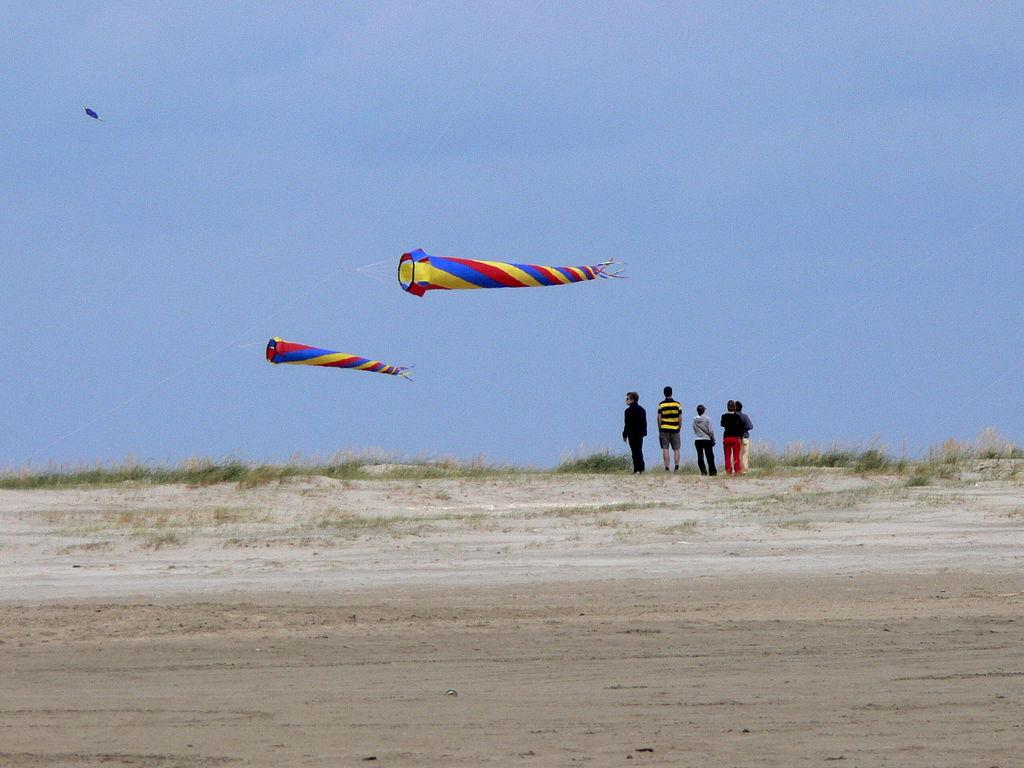
Looking beyond Marsk Tower - Marsk tårnet? Discover Romo for broader travel guides, local hot-spots, and regional highlights.
Explore Romo
A vast off-limits tidal landscape at Rømø’s northern tip, where bird-filled Wadden Sea flats double as a Danish military training ground watched from a safe dyke-top perch.
Architect-designed marshland camp with Marsk Tower views, glamping comfort, family-friendly fun and easy access to the dramatic Wadden Sea landscape.