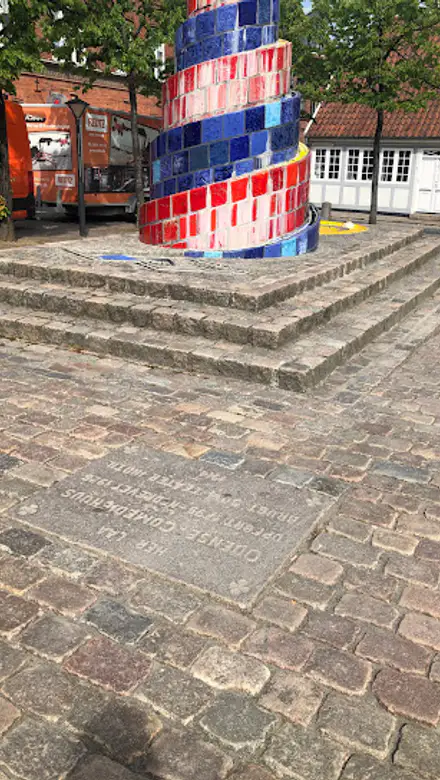
Odense Comediehuus, Odense Travel Guide
Free Guide: On Sortebrødre Torv, the lost Odense Comediehuus lives on in stories of young H.C. Andersen, vanished footlights and a square that still hums with everyday drama.


A brief summary of Odense Comediehuus
On Sortebrødre Torv, the lost Odense Comediehuus lives on in stories of young H.C. Andersen, vanished footlights and a square that still hums with everyday drama.
Odense Comediehuus once stood on Sortebrødre Torv as the city’s early theatre, closely linked to the childhood of Hans Christian Andersen and Odense’s rising urban culture. Although the original 18th–19th century building was demolished in the 20th century after later uses as auction hall and emergency housing, its footprint and surrounding square still mark an important chapter in Danish theatre history. Today the spot invites you to imagine bustling vaudevilles, local crowds and the young Andersen dreaming of the stage.
On-site amenities
 Restrooms
 Drink options
 Drinking water
 Food options
 Seating areas
 Trash bins
 Information boards
- Address
- Sortebrødre Torv 1, 5000 Odense
Getting there
City bus within Odense
Walking from Odense Banegård
Bicycle in central Odense
Discover more about Odense Comediehuus
A vanished theatre in the heart of Odense
Odense Comediehuus stood on Sortebrødre Torv, just off the medieval core of Odense, at a time when theatre was becoming a key form of urban entertainment. The building rose in the 18th century as a modest but ambitious playhouse, bringing spoken drama, music and light-hearted comedy to a growing provincial town. Its stage, lit by candles and simple lanterns, offered locals a rare window onto wider European culture.From the cobbled square where it once stood, it is easy to picture the original façade: a solid, slightly austere exterior facing the market, with people gathering at the entrance on performance evenings. Carriages would arrive and depart, and those with cheaper tickets would walk from nearby streets, queuing beneath flickering lamps before filing into the auditorium.
Hans Christian Andersen’s formative theatre world
The Comediehuus is especially remembered because it was one of the first theatres that captured the imagination of a young Hans Christian Andersen. As a boy in Odense, he was drawn repeatedly to performances here, utterly fascinated by actors, scenery and the magic of storytelling brought to life. For him, this was not just a diversion but an early gateway to the artistic world he would later inhabit.Within these walls he observed the craft of performance up close: how a simple change of costume, a line delivered with feeling or a bit of painted canvas could transform reality. Those impressions fed into his sense of drama and character, visible later in his tales where everyday figures are charged with theatrical emotion. Standing on the site today connects you indirectly to those early creative sparks.
From playhouse to auction hall and emergency shelter
Like many urban theatres, Odense Comediehuus went through several lives. As newer venues emerged and performance practices changed, this older building gradually lost its central theatrical role. In the late 19th and early 20th centuries it served more practical purposes, including use as an auction hall, where furniture, tools and everyday objects were sold under its high roof.In the aftermath of housing shortages, the structure was even converted into emergency accommodation, sheltering dozens of adults and children under crowded conditions. This phase added a very different, more somber layer to the building’s story, turning a former cultural hub into a place of necessity and survival before it was finally demolished in the 1920s.
The square that remembers what the walls forgot
Although the physical theatre has disappeared, the setting of Sortebrødre Torv still carries echoes of its presence. The square is framed by historic buildings and traditional Danish town architecture, and on certain days market stalls fill the space with fruit, flowers and local produce. The hum of traders and customers offers a modern parallel to the bustle that once surrounded performance nights.If you pause near the approximate footprint of the Comediehuus, you can imagine spectators spilling out into the cool night air, discussing the play they have just seen. The rhythm of the city continues, but layered beneath it is a quieter story about how entertainment, trade and daily life have always intertwined in this corner of Odense.
Tracing theatre history in modern Odense
Today, visitors come here less for a specific attraction and more for a sense of place. The site forms an informal stop on walks that trace Hans Christian Andersen’s Odense and the development of Danish theatre. It invites a reflective kind of sightseeing, where you rely on fragments of history, plaques and your own imagination rather than grand remains.Seen in that light, Odense Comediehuus becomes a reminder that cultural heritage is not only preserved in intact monuments. It also survives in absence: in the outline of a square, in stories about a boy captivated by the stage, and in the evolving uses of a building that once brought comedy, song and drama to a small but aspiring city.
Evendo Review Centre
 Google
Guest reviews
Best time to go
Quietest: Jan, Feb & Nov · before 7am or from 11pm
Busy times are Evendo estimates for a typical year, to help you plan. Actual crowds vary with events, school holidays and the weather.
Explore Odense Comediehuus on the map
A handpicked selection of must-see spots near Odense Comediehuus, mapped for you.
Get your free copy of our complete guide to Odense Comediehuus, delivered straight to you.
Everything on this page, from opening hours and how to get there to Eve’s tips and the best time to go, in one PDF you can read offline, print or share.
Already have an account? Sign in
Your Odense Comediehuus guide is ready.
We'll send it to · Not you? Sign out

Getting your guide ready…
We are putting together a fresh copy of the Odense Comediehuus guide. This can take up to a minute.
This can take a few moments. If your browser asks, choose Allow so the download can start. You'll find the guide in your Downloads folder.
Nothing happened? Download it again
Sorry, the guide is taking longer than usual. Please try again in a minute, or get it by email instead.
Other nearby places you may find interesting
The closest places of the same kind, if this one is not quite what you had in mind.
-
-
-
-
-


Swipe for more places
More to explore near Odense Comediehuus

 Best experiences near Odense Comediehuus
 Best hotels near Odense Comediehuus
 Best landmarks near Odense Comediehuus
 Best attractions near Odense Comediehuus
 Best shops near Odense Comediehuus
 Best restaurants near Odense Comediehuus
 Best bars near Odense Comediehuus
Do you manage this location?
Take control to get all the benefits, like improved information, better appearance, and stronger visibility across AI-powered discovery.
Explore more

Explore more of Odense
Discover Odense, Denmark's enchanting city where fairy tales come to life amidst historic streets, vibrant culture, and scenic beauty.
Explore Odense
Explore more of Denmark
Discover Denmark: A perfect blend of history, modern design, and the cozy concept of hygge. Explore vibrant cities, serene landscapes, and world-class cuisine.
Explore Denmark