
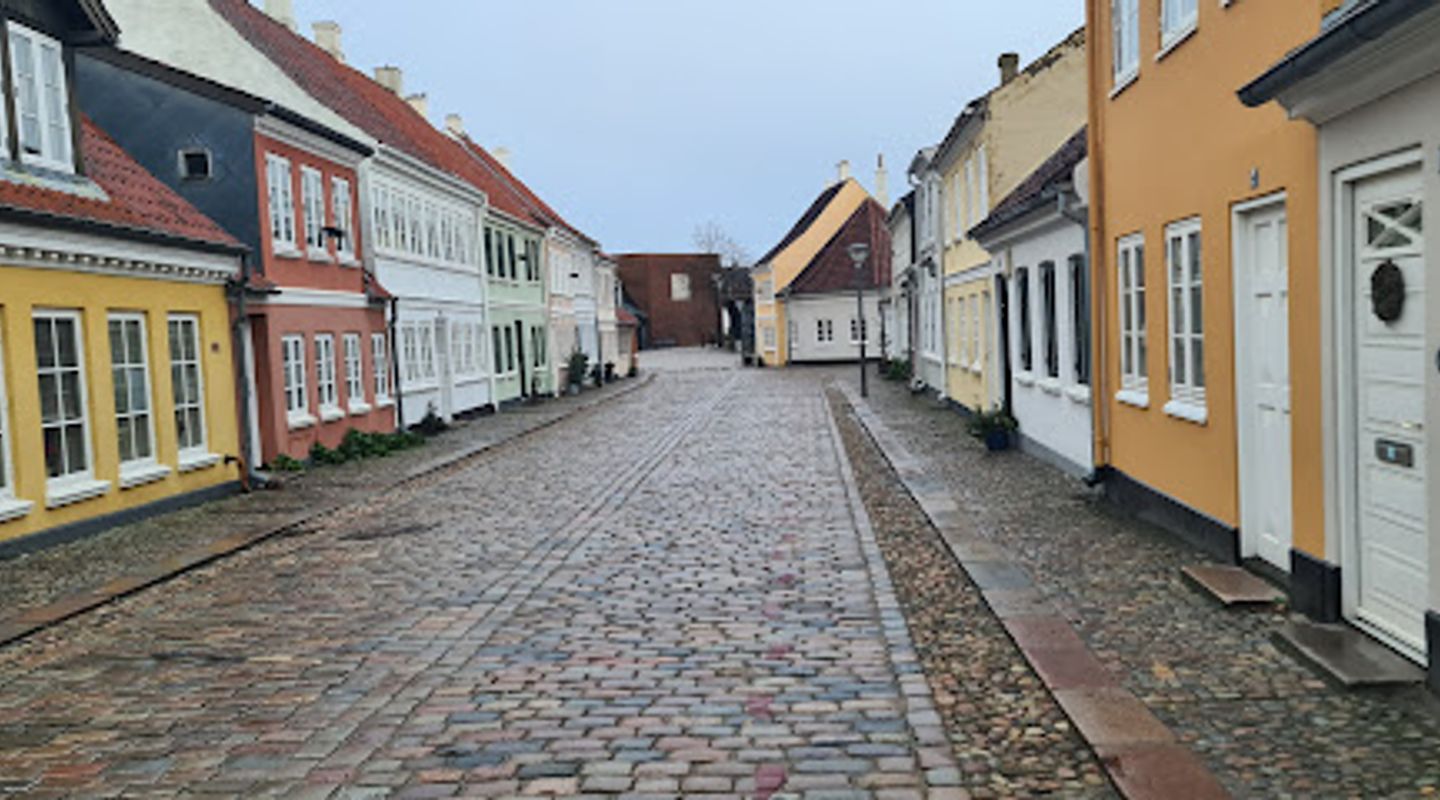
Andersen on the bench, Funen Travel Guide
Share a bronze bench with Hans Christian Andersen himself in the heart of Odense’s fairy-tale district, where the city’s stories slip quietly into everyday life.
Tucked beside the modern hotels and concert hall in central Odense, the bronze sculpture "Hans Christian Andersen on a Bench" invites you to sit shoulder to shoulder with Denmark’s beloved fairy-tale writer. Created by sculptor Jens Galschiøt, the life-sized Andersen gazes out with a thoughtful expression, offering a playful, intimate counterpoint to the city’s grander statues and museums. It is an easy, free stop on any Hans Christian Andersen walk, ideal for a quick photo, a quiet pause, or a moment of make-believe conversation with the author himself.
A brief summary to Andersen on the bench
- Claus Bergs Gade 7, Odense Municipality, Odense C, 5000, DK
- Duration: 0.25 to 0.75 hours
- Free
-
 Outdoor
- Mobile reception: 5 out of 5

Know before you go
Hi, I'm Eve. Here are a few practical things to know before exploring Andersen on the bench.
- Bring a camera or phone with a wide-angle setting so you can frame both yourself and the seated Andersen without cutting off the surrounding architecture.
- Combine the bench with a short self-guided walk to nearby Andersen-related spots such as the cathedral area and the main Hans Christian Andersen museum.
- Visit early morning or around sunset if you prefer a quieter moment on the bench without needing to wait for other people to finish taking photos.
- Use the stop as a short rest point; there are plenty of cafés within a few minutes’ walk if you want to extend the break with a coffee afterwards.
Do you manage this location?
Take control to get all the benefits, like improved information, better appearance, and stronger visibility across AI-powered discovery. Learn more about listing your business on Evendo
Activate your presenceOther nearby places you may find interesting
The closest places of the same kind, if this one is not quite what you had in mind.

Explore Andersen on the bench on the Map
A handpicked selection of must-see spots near Andersen on the bench, mapped for you.
Getting There
-
Train and short walk from Odense Station
From Odense Station, most regional and intercity trains on the main east–west line across Funen stop frequently throughout the day, with services from Copenhagen typically taking about 1 hour 15 minutes to 1 hour 40 minutes and from Aarhus around 1 hour 45 minutes to 2 hours 15 minutes. Standard adult fares on these routes usually range from about 120 to 300 DKK depending on time and flexibility. Once in Odense, the bench is roughly a 15–20 minute walk through the compact city centre on largely level, paved streets that are suitable for most visitors who are comfortable walking that long.
-
Local city bus within Odense
Odense’s city buses connect the railway station and residential districts with the central area around Claus Bergs Gade, with journey times generally between 5 and 15 minutes depending on the line and traffic. A single adult ticket bought on board or via local ticketing options typically costs in the range of 20 to 30 DKK for a short inner-city trip. Buses run frequently during the day but less often in the evening and on Sundays. Most stops have low platforms, but boarding can involve a step up, so travellers with limited mobility may wish to check accessibility details in advance.
-
Bicycle within Odense
Odense is one of Denmark’s more cycle-friendly cities, with a network of bike lanes leading towards the cathedral, concert hall and hotel district close to the bench. From many central neighbourhoods, cycling time is around 5 to 15 minutes. Visitors can use bike-share schemes or rental shops, where a standard city bike commonly costs about 100 to 150 DKK per day. Surfaces are mostly flat and paved, but riders should be comfortable navigating urban traffic, especially at busy junctions and during peak commuting hours.
For the on-the-go comforts that matter to you
-
 Restrooms
-
 Drink Options
-
 Food Options
-
 Seating Areas
-
 Trash Bins
-
 Information Boards
Discover more about Andersen on the bench
A quiet encounter with a famous storyteller
Hans Christian Andersen on a Bench is one of Odense’s most disarming tributes to its most famous son. Rather than towering on a pedestal, the author sits at street level on a simple bench, coat buttoned, hat on, caught mid-thought as if he has just stepped out of one of his own stories. The sculpture stands by the entrance of a central hotel complex on Claus Bergs Gade, in the heart of the city’s Andersen district.Here, the celebrated writer is rendered approachable and human. You can slide into the empty space beside him, rest your hand on the cool bronze, and imagine the clatter of quill on paper or the murmur of a tale being born. The bench turns the monument into a meeting place rather than a distant object, encouraging you to share a moment of stillness with a figure who shaped the world’s imagination.Jens Galschiøt’s lifelike bronze portrait
The bench figure was created by Danish sculptor Jens Galschiøt, known for expressive bronzes that feel both grounded and slightly theatrical. In this work, he captures Andersen with natural folds in his coat, finely modelled hands and a face that mixes curiosity with a hint of melancholy. Up close, the surface reveals subtle textures that catch the changing light of the Danish sky.Galschiøt’s Andersen is not frozen in stiff heroism. His posture is relaxed, almost conversational, one leg slightly forward, as if he might turn at any moment to address you. This informality makes the sculpture particularly engaging for children, who often clamber up beside him, and for adults who want a more intimate portrait than the grand statues in the nearby parks.Part of Odense’s fairy-tale sculpture trail
The bench is one of several Andersen-inspired works scattered through Odense’s streets, gardens and riverbanks. Around the hotel complex, four other pieces pick up themes from his tales, forming a small cluster of bronze figures that you can explore in a few unhurried minutes. Further afield, you will find statues of the author in Eventyrhaven, imaginative takes on stories like The Steadfast Tin Soldier and The Emperor’s New Clothes, and sculptural references to paper boats, swans and toads.Seen within this larger network, Hans Christian Andersen on a Bench becomes a gentle starting point or mid-way pause on a city-wide treasure hunt. It connects the literary heritage preserved in the museums with the lived city of cafés, shops and concert venues, keeping Andersen’s presence alive in everyday public space.A simple stop woven into a city stroll
Most visitors spend only a short time at the bench, but it lingers in memory because of its simplicity. There is no ticket office, no barrier, no prescribed route: you can encounter it on your way between the cathedral, the concert hall and the museum. The setting is urban but calm, with passing bicycles, the hum of traffic at a distance and the occasional tolling of nearby church bells.The spot works well at almost any time of day. In the morning, soft light picks out the folds of Andersen’s coat; later, the bronze warms in the sun and the surrounding façades throw changing reflections onto the metal. After dark, street lighting gives the figure a more introspective mood, as if he has retreated into his own thoughts while the city settles around him.Photographs, daydreams and a place to pause
For many, the greatest pleasure of this sculpture is how naturally it fits into ordinary moments. You might perch for a quick photograph, share the bench with a friend while you compare notes on Andersen’s tales, or simply sit in silence and watch the city flow past. The work invites a little play-acting: a whispered wish into the author’s ear, a child telling him their favourite story, or a traveller quietly planning the next steps of their journey.In a city rich with formal exhibitions, Hans Christian Andersen on a Bench offers something smaller but no less meaningful: an invitation to slow down, take a seat and imagine what stories might begin from this very spot.












Your all‑in‑one travel companion app
Explore expert travel guides, compare and book tours, experiences, hotels, and more—all from the palm of your hand. Download now for seamless trip planning wherever your wanderlust takes you.


Explore More of Funen
Looking beyond Andersen on the bench? Discover Funen for broader travel guides, local hot-spots, and regional highlights.
Explore Funen
Compact yet richly layered museum in Odense’s musical quarter, tracing Carl Nielsen’s life, music and partnership with sculptor Anne Marie Carl-Nielsen.

Cobblestoned Blackfriars Square blends medieval streets, colourful timber houses and a bustling twice‑weekly market in the historic heart of Hans Christian Andersen’s Odense.
