Rokkestenen Travel Guide
Free Guide: Bornholm’s most famous rocking stone: a 35‑ton Ice Age boulder you can set in motion, hidden in the rugged forested hills of Paradisbakkerne near Svaneke.


A brief summary of Rokkestenen
Bornholm’s most famous rocking stone: a 35‑ton Ice Age boulder you can set in motion, hidden in the rugged forested hills of Paradisbakkerne near Svaneke.
Hidden deep in the forested hills of Paradisbakkerne on Bornholm, Rokkestenen is a 35‑ton glacial boulder delicately balanced on a narrow base. With the right push, this giant stone rocks gently, turning geology into a hands‑on puzzle for all ages. Reached via a signed woodland trail near Svaneke and Nexø, the stone is surrounded by rugged rift valleys, mossy rocks and tranquil lakes, making it a classic stop on Bornholm’s most atmospheric hikes.
On-site amenities
 Restrooms
 Seating areas
 Trash bins
 Information boards
Opening hours
- Every dayOpen 24 hours
Opening hours as listed on the venue’s Google Business Profile. Hours can change for services and special events, so check with the venue before you go.
- Address
- 3740 Svaneke
- Website
Getting there
Car from Nexø
Car from Svaneke
Bus plus walk from Nexø or Svaneke
Discover more about Rokkestenen
A giant boulder with a delicate balance
Rokkestenen is Bornholm’s most famous rocking stone, a glacial erratic of around 35 tons perched so precisely on a pedestal of rock that it can be nudged into motion by human hands. Standing beside it, you see how the boulder seems to hover, its weight focused on a narrow contact point hidden beneath its rounded belly. With a series of short, rhythmic pushes at the right spot, the mass of granite begins to sway almost imperceptibly at first, then with a satisfying, gentle rocking motion.This natural balancing act is the legacy of the last Ice Age. As glaciers advanced and retreated across the Baltic, they plucked, transported and finally abandoned huge blocks of stone. Rokkestenen was left here in what is now the forested heart of Paradisbakkerne, where erosion has slowly exposed the contours that allow it to move. Today it is both a geological curiosity and an irresistible invitation to test your strength and technique.
Paradisbakkerne’s wild, folded landscape
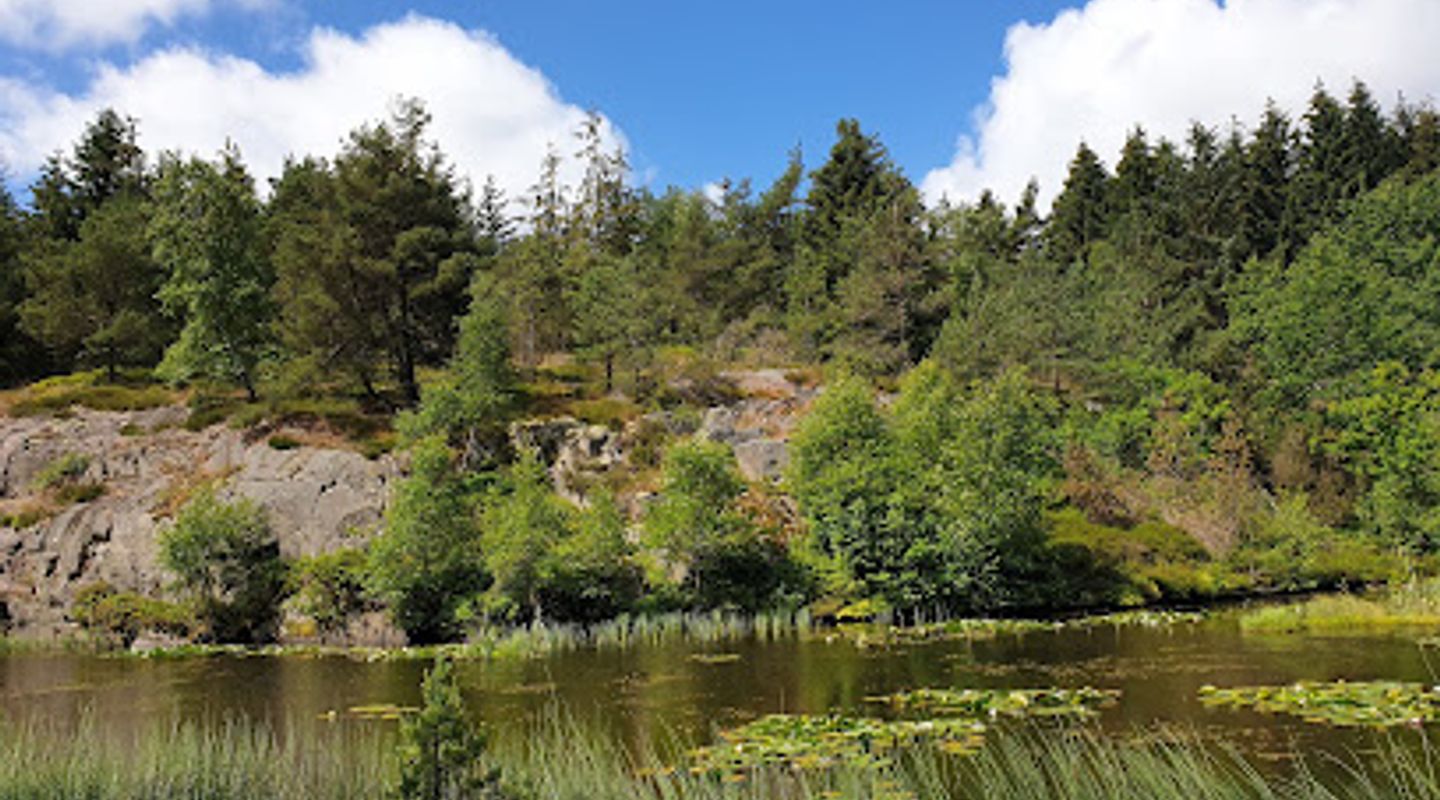
The rocking stone sits within Paradisbakkerne, a hilly, fissured landscape on eastern Bornholm shaped by ancient fault lines and glacial forces. Narrow gorges slice through the forest, while crevice valleys rise in steep walls up to several dozen metres high. The terrain alternates between rocky ridges, peat bogs, wet meadows and small, dark forest lakes where trees lean over the water.Despite its relatively modest elevation, the area feels surprisingly dramatic by Danish standards. The forest is dense and often damp, with carpets of moss and heather threading between exposed bedrock. This mosaic of habitats shelters rare beetles, bats and birds such as owls and raptors, adding a quiet sense of wilderness to the walk. The contrast between the peaceful greenery and the raw rock gives the approach to Rokkestenen a distinctive atmosphere.
Walking the forest trails to the stone
Reaching Rokkestenen is part of the experience. A waymarked path leads from the nearest parking area into the woods, heading gently up and down over roots and stone slabs. The route is short enough for most walkers, but the ground is uneven, with occasional muddier patches after rain, so sturdy footwear is useful. Waymarkers help keep you oriented as the track winds between rock outcrops and tall trees.Rokkestenen is also a waypoint on longer circular hikes through Paradisbakkerne, marked with coloured symbols. These loops link the stone with viewpoints, lakes and other rock formations, turning a quick visit into a half‑day exploration. Even when you follow the shortest route, you spend enough time under the canopy to feel immersed in the forest rather than just stopping at a roadside sight.
Legends, stories and the urge to make it move
Like many unusual stones on Bornholm, Rokkestenen has gathered its share of folklore. Local tales cast rocking stones as places of hidden power, sometimes connected with trolls, sometimes with tests of truth or strength. Standing beside the boulder, it is easy to imagine earlier generations returning again and again to see who could make the giant sway.For today’s visitors the ritual is part science experiment, part game. Children and adults search for the exact patch of rock where their effort counts, discovering that timing and technique matter more than brute force. The tiny movement of such a massive object is a memorable reminder of how natural forces placed it here in the first place. After a few shared attempts and laughter, most people step back to simply look and appreciate the improbable balance.
A protected corner of Bornholm’s nature
Paradisbakkerne has been under protection for more than a century, and Rokkestenen itself is specifically safeguarded as a geological feature. Much of the surrounding land is privately owned, but access is granted via marked paths during daylight hours to balance conservation and recreation. The absence of cars inside the forest keeps the area quiet; at most you hear wind in the treetops, birds calling and boots on the path.Simple facilities at the edge of the forest, such as an information board and seasonal restrooms, support visits without disturbing the landscape around the stone. Within the woods, you are largely on nature’s terms. That sense of being in a slightly wilder pocket of Denmark is part of Rokkestenen’s appeal: it is not just a quirky rock, but a focal point in one of Bornholm’s most characterful natural areas, where geology, stories and a peaceful forest setting come together.
Evendo Review Centre
 Google
Guest reviews
Best time to go
Quietest: Jan, Feb & Dec · before 8am or from 9pm
Busy times are Evendo estimates for a typical year, to help you plan. Actual crowds vary with events, school holidays and the weather.
Explore Rokkestenen on the map
A handpicked selection of must-see spots near Rokkestenen, mapped for you.
Get your free copy of our complete guide to Rokkestenen, delivered straight to you.
Everything on this page, from opening hours and how to get there to Eve’s tips and the best time to go, in one PDF you can read offline, print or share.
Already have an account? Sign in
Your Rokkestenen guide is ready.
We'll send it to · Not you? Sign out

Getting your guide ready…
We are putting together a fresh copy of the Rokkestenen guide. This can take up to a minute.
This can take a few moments. If your browser asks, choose Allow so the download can start. You'll find the guide in your Downloads folder.
Nothing happened? Download it again
Sorry, the guide is taking longer than usual. Please try again in a minute, or get it by email instead.
Other nearby places you may find interesting
The closest places of the same kind, if this one is not quite what you had in mind.
-
Hammershus Castle Ruins Bornholm’s great clifftop fortress, where vast medieval ruins, Baltic Sea panoramas and a striking modern visitor centre bring 800 years of history to life.
-
Opal Lake A flooded granite quarry turned emerald lake, Opal Lake on Bornholm blends raw cliffs, deep clear water and coastal views with swimming, cliff jumps and rugged trails.
-
Bornholms Rovfugleshow Immersive birds-of-prey shows and evolution-themed encounters on Bornholm, where owls, falcons, reptiles and farm animals turn science into a full, family-friendly day out.
-
Bornholmertarnet Former top-secret NATO listening post turned Cold War museum, crowned by a 70 m viewing tower with sweeping panoramas over Dueodde and eastern Bornholm.
-
Hammeren Lighthouse Compact granite lighthouse on Bornholm’s highest headland, offering free summer access, sweeping Baltic views and heather-clad coastal walking trails.
Swipe for more places
More to explore near Rokkestenen

 Best experiences near Rokkestenen
 Best hotels near Rokkestenen
 Best landmarks near Rokkestenen
 Best attractions near Rokkestenen
 Best shops near Rokkestenen
 Best restaurants near Rokkestenen
 Best bars near Rokkestenen
Do you manage this location?
Take control to get all the benefits, like improved information, better appearance, and stronger visibility across AI-powered discovery.
Explore more

Explore more of Bornholm
Explore Bornholm: Denmark's Baltic gem, offering stunning nature, rich history, and vibrant local culture. Perfect for nature lovers, history buffs, and food enthusiasts.
Explore Bornholm
Explore more of Denmark
Discover Denmark: A perfect blend of history, modern design, and the cozy concept of hygge. Explore vibrant cities, serene landscapes, and world-class cuisine.
Explore Denmark