
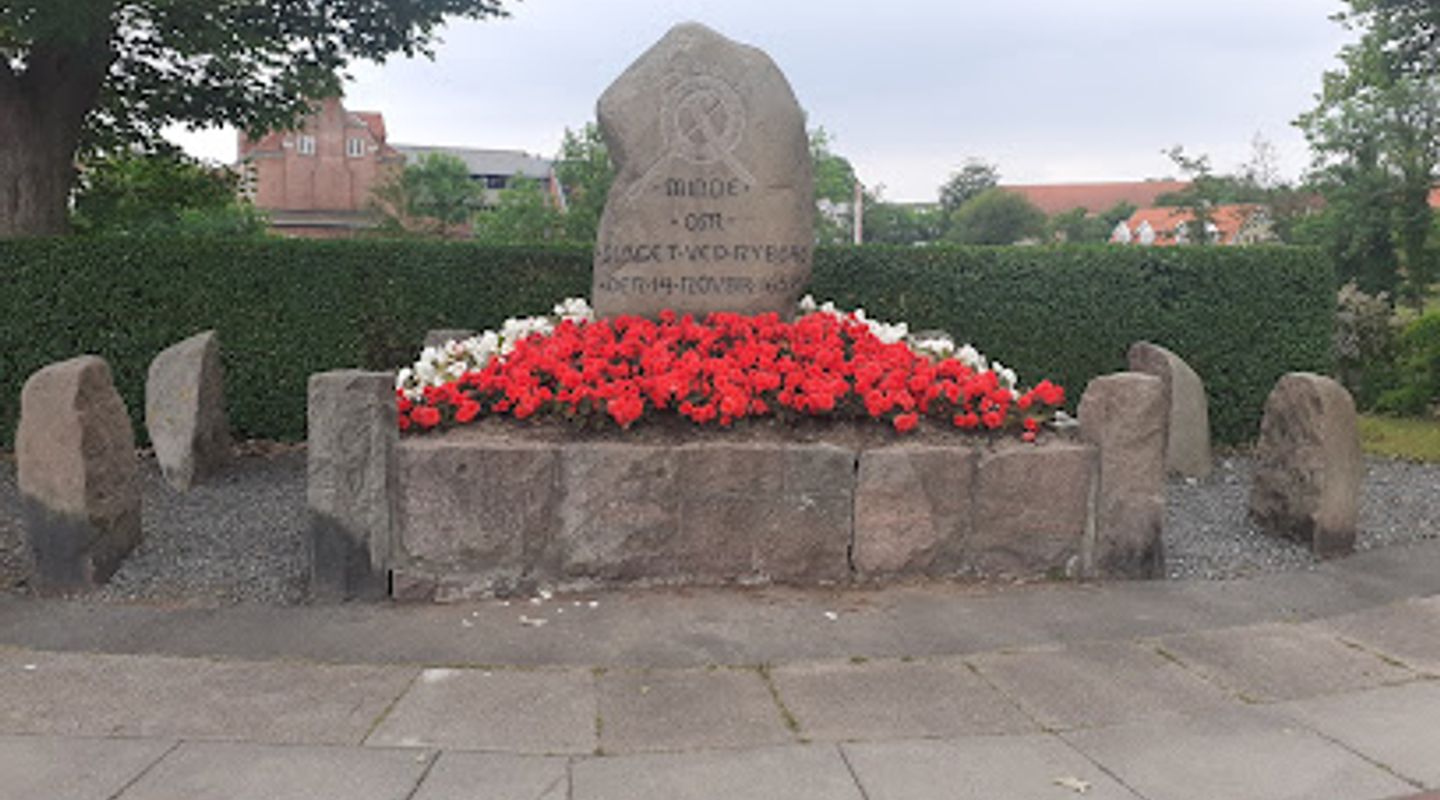
Mindesten for Slaget ved Nyborg 1659, Funen Travel Guide
A modest stone in a small green corner of Nyborg that quietly commemorates the brutal 1659 battle which helped secure Denmark’s survival as an independent kingdom.
Set back from the street in a small green space on Lindealleen, the modest stone monument to the Battle of Nyborg 1659 marks one of Denmark’s most decisive clashes with Sweden during the Dano-Swedish Wars. Here you step from quiet residential Nyborg into a fragment of 17th‑century history, commemorating the brutal battle that helped secure Denmark’s survival as an independent kingdom. A simple boulder, inscription and surrounding lawn invite quiet reflection rather than spectacle.
A brief summary to Mindesten for Slaget ved Nyborg 1659
- Lindealleen 10, Nyborg, 5800, DK
- Duration: 0.25 to 0.5 hours
- Free
-
 Outdoor
- Mobile reception: 4 out of 5

Know before you go
Hi, I'm Eve. Here are a few practical things to know before exploring Mindesten for Slaget ved Nyborg 1659.
- Pair a short stop at the monument with a visit to Nyborg’s historic center and castle to better understand the strategic role the town played in the 1659 battle.
- Visit in daylight to easily read the inscription on the stone and to appreciate the small park-like surroundings; there is no dedicated lighting at night.
- Use a map or local museum material about the Battle of Nyborg to visualize where the actual fighting took place in relation to this commemorative stone.
Do you manage this location?
Take control to get all the benefits, like improved information, better appearance, and stronger visibility across AI-powered discovery. Learn more about listing your business on Evendo
Activate your presenceOther nearby places you may find interesting
The closest places of the same kind, if this one is not quite what you had in mind.

Explore Mindesten for Slaget ved Nyborg 1659 on the Map
A handpicked selection of must-see spots near Mindesten for Slaget ved Nyborg 1659, mapped for you.
Getting There
-
Train and walk from Nyborg Station
From elsewhere on Funen or from Odense, take a regional train to Nyborg Station; trains typically run at least twice an hour during the day, and the journey from Odense takes about 20–25 minutes at a cost of roughly 40–70 DKK each way in standard class. From the station, it is an easy, mostly level urban walk of about 15–20 minutes through town streets to reach Lindealleen and the monument, suitable for most visitors and pushchairs in normal weather.
-
Local bus within Nyborg
Several local bus routes serve residential areas around Lindealleen from Nyborg Station and the town center, with typical journey times of 10–20 minutes depending on the line and time of day. A single adult ticket on local buses generally costs around 24–30 DKK and can usually be bought from the driver or via travel apps. Check current timetables, as evening and weekend services may run less frequently, and expect a short walk of 5–10 minutes from the nearest stop to the monument.
-
Car or taxi within Nyborg and East Funen
If you are staying on East Funen, driving to Nyborg and then following main roads toward the residential districts near Lindealleen is straightforward, with typical travel times of 10–25 minutes from nearby coastal villages and around 30–35 minutes from Odense. Street parking in Nyborg’s residential areas is often free or low cost, but always check local signs. A taxi from Nyborg Station to the monument area usually takes under 10 minutes and can cost in the region of 80–140 DKK depending on time of day and company.
For the on-the-go comforts that matter to you
-
 Trash Bins
-
 Seating Areas
Discover more about Mindesten for Slaget ved Nyborg 1659
A quiet stone where a violent day is remembered
The monument to the Battle of Nyborg 1659 sits in a small grassy plot off Lindealleen, almost hidden among trees and neighboring houses. At first glance it is just a rough-hewn boulder with a carved inscription, but it marks the final major battle of the Dano‑Swedish War of 1658–1660, fought just outside Nyborg on 14 November 1659. Here you are only a short distance from the fields where Danish and allied troops clashed with the Swedish army in a struggle that shaped the future borders of the kingdom.The stone was donated to Nyborg by a local historical society and set here as a permanent reminder of the war years 1657–1660. Its simplicity is deliberate: the focus is on remembrance rather than heroics. The surrounding grass, a few trees and a low hedge give the place the feel of a small memorial garden, open at all hours and freely accessible to anyone who passes.The battle that safeguarded a kingdom
In the late 1650s, Denmark was under immense pressure. Sweden had overrun large parts of the country, and the war threatened to dismantle the Danish realm completely. At Nyborg, Swedish forces had entrenched themselves outside the town, while a combined Danish and allied army – with support from a Dutch fleet – moved in for a decisive confrontation. On 14 November 1659, between Hjulby Lake and the Juelsberg estate, thousands of soldiers met in one of the bloodiest battles fought on Danish soil.After hours of fighting, a daring cavalry maneuver through marshy ground turned the tide. The Swedish troops were driven back toward Nyborg’s fortifications, suffering heavy losses. The following day, with a Dutch landing force closing in from the sea, the remaining Swedish soldiers were forced to surrender. The victory opened the way to peace in 1660 and helped ensure that Denmark remained an independent state with its core territories intact.A small memorial in a wider historic landscape
Standing at the stone, it takes some imagination to picture the smoke, shouting and confusion that once filled the nearby fields. The actual battlefield lay just outside town, but this unobtrusive monument draws a line between modern Nyborg and its 17th‑century war landscape. The inscription references the Swedish Wars and the crucial year 1659, anchoring this quiet corner of Lindealleen in the broader story of the Dano‑Swedish conflicts.The site itself is modest: no large sculptures, no extensive interpretive displays, just the stone, its inscription, and a small, park‑like setting. That understatement invites you to supply your own reflection. Many visitors combine a brief stop here with exploration of Nyborg’s other historic sites, such as the town’s fortifications and castle, creating a fuller picture of how strategic this area was during the wars.Experiencing the memorial today
Today the monument is part of everyday life in Nyborg. Nearby traffic hums softly, cyclists pass, and local residents walk dogs or push prams along Lindealleen. There are no gates or ticket offices; the memorial is simply there, open at all hours, ready for a short detour on a stroll through town. The grass and trees offer a touch of green, and on a clear day you may find dappled light playing across the stone’s weathered surface.A visit rarely takes long – often just a few minutes to read the inscription and take in the setting – but it can add depth to your understanding of East Funen. If you have more time, you can use the monument as a starting point to delve deeper into the Battle of Nyborg through local museums, battlefield walks and historical exhibitions elsewhere in town, connecting this quiet boulder to a much larger narrative.Reflections on war, memory and identity
Spending a moment at the memorial is also a reminder of how places remember conflict. Instead of a triumphant statue, Nyborg’s tribute to 1659 is a simple stone, suggesting a sober view of war’s costs. The battle brought victory, but it also meant thousands of casualties on both sides. Here, away from the former battlefield, the focus is on commemoration rather than reenactment.For travelers interested in history, the monument offers a compact, tangible link to a turning point in Scandinavian politics. For others, it may simply be a tranquil pause on a walk through Nyborg. Either way, this small memorial park quietly keeps alive the memory of a day when events around this town helped determine the map of Northern Europe.More to explore near Mindesten for Slaget ved Nyborg 1659
-

Best experiences near Mindesten for Slaget ved Nyborg 1659
-

Best hotels near Mindesten for Slaget ved Nyborg 1659
-

Best landmarks near Mindesten for Slaget ved Nyborg 1659
-

Best shops near Mindesten for Slaget ved Nyborg 1659
-

Best restaurants near Mindesten for Slaget ved Nyborg 1659
-

Best bars near Mindesten for Slaget ved Nyborg 1659







Your all‑in‑one travel companion app
Explore expert travel guides, compare and book tours, experiences, hotels, and more—all from the palm of your hand. Download now for seamless trip planning wherever your wanderlust takes you.


Explore More of Funen
Looking beyond Mindesten for Slaget ved Nyborg 1659? Discover Funen for broader travel guides, local hot-spots, and regional highlights.
Explore Funen
A century-old red-brick state prison on Funen, where imposing walls, watchtowers and hidden courtyards reveal Denmark’s evolving approach to confinement and rehabilitation.
Grassy fortress ramparts circling Nyborg’s old royal heart, now a leafy park of historic earthworks, castle views and relaxed walks above the town.
