Beau Brummell Statue, London Travel Guide
Free Guide: The dandy who revolutionised menswear and defined Regency elegance in bronze.


A brief summary of Beau Brummell Statue
The dandy who revolutionised menswear and defined Regency elegance in bronze.
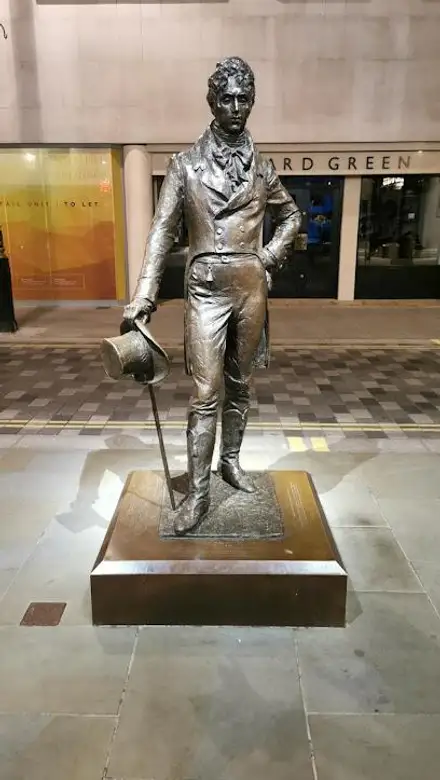
A bronze statue honouring George Bryan 'Beau' Brummell, the legendary 19th-century dandy and arbiter of men's fashion in Regency England. Located at the entrance to Piccadilly Arcade on Jermyn Street in Mayfair, this modest yet elegant sculpture captures Brummell in his characteristic pose—one hand on hip, the other holding a top hat and cane. Unveiled in 2002 by sculptor Irena Sedlecka, the statue commemorates a figure who revolutionised menswear by championing understated elegance and precise tailoring over the ostentatious styles of the 18th century.
On-site amenities
 Restrooms
 Drink options
 Food options
 Seating areas
 Information boards
- Address
- 53 Jermyn St, London SW1Y 6LX
Getting there
London Underground
Bus
Taxi or Ride-Share
Walking
Discover more about Beau Brummell Statue
The Man Behind the Legend
George Bryan Brummell, born in 1778 to a middle-class family, transformed himself into one of history's most influential style icons. From his schooldays at Eton, he cultivated friendships with the aristocracy and developed an obsession with fashion that would define his era. After a brief military career in the 10th Light Dragoons—the regiment of the Prince of Wales—he resigned rather than accept a posting to Manchester, which he deemed culturally inferior. With the patronage of the Prince Regent, Brummell moved to Chesterfield Street in Mayfair and embarked on his true vocation: the art of being impeccably dressed.
Revolutionary Fashion Philosophy
Brummell's genius lay in his rejection of the elaborate, ornate clothing that had dominated the previous century. Instead, he championed meticulously tailored garments, understated elegance, and the perfectly knotted cravat—a scarf-like necktie that became his signature accessory. His philosophy was encapsulated in his famous maxim, engraved on the statue's plaque: "To be truly elegant one should not be noticed." Within a single season of his arrival in Mayfair, Brummell earned the epithet 'Beau' and became the undisputed arbiter of men's fashion. He made trousers fashionable, introduced a military bearing to civilian dress, and influenced how the upper echelons of society dressed for generations to come. His influence extended far beyond clothing—he established standards of behaviour, conversation, and deportment that defined Regency gentility.
The Fall from Grace
Brummell's downfall was as dramatic as his rise. Surrounded by wealthy aristocratic friends, he adopted their lavish lifestyle without possessing their endless riches. He gambled recklessly and accumulated debts he could not repay. The turning point came in July 1813 when, at a masquerade ball hosted by Brummell and his friends at the Argyle Rooms, he made a cutting remark to the Prince Regent. Though Brummell's social standing initially remained intact, he had lost his royal patron—a loss that would prove catastrophic. As his debts mounted and creditors refused further credit, Brummell faced the prospect of debtor's prison. In 1816, he fled to France, never to return to England.
Exile and Decline
Brummell's exile lasted the remainder of his life. Rather than reform his ways, he continued gambling and accumulating debts in France. Twenty years after his flight from England, his French creditors finally caught up with him. He was arrested and imprisoned, and his health deteriorated dramatically. Ravaged by syphilis, he spent his final years in La Bon Sauveur Asylum in Caen, where he died in 1840 at the age of 62—a penniless pauper, dirty and unkempt, a tragic inversion of the fastidious dandy he had once been. To the end, he harboured hopes of reconciliation with the Prince, who had become King George IV, but that reconciliation never came.
The Statue and Its Significance
The bronze statue, unveiled on 5 November 2002 by HRH Princess Michael of Kent, was sculpted by Czech artist Irena Sedlecka and is based on an 1805 watercolour. The sculpture is deliberately modest in scale and mounted on a short plinth, reflecting Brummell's own philosophy that true elegance should not announce itself loudly. The statue depicts him in characteristic pose: one hand resting on his hip, the other holding a top hat and cane, his gaze directed toward Piccadilly Arcade. The placement on Jermyn Street is particularly apt, as this street has long been synonymous with bespoke tailoring and gentlemen's fashion—a legacy Brummell helped establish. The statue stands as a permanent tribute to a man whose influence on menswear and social culture remains undiminished nearly two centuries after his death.
Cultural Legacy
Brummell's legend has endured far beyond the statue itself. He has been the subject of numerous books, plays, films, an operetta, and even an erotic novella. His story—of a man who rose from the middle class to become the arbiter of taste for an entire society, only to fall into poverty and obscurity—continues to captivate audiences. His innovations in tailoring and his philosophy of understated elegance remain foundational to modern menswear. The statue serves not merely as a memorial to a historical figure, but as a symbol of the transformative power of style, taste, and the enduring influence of those who dare to redefine convention.
Evendo Review Centre
 Google
Guest reviews
Best time to go
Quietest: Jan, Feb & Mar · before 6am or from 11pm
Busy times are Evendo estimates for a typical year, to help you plan. Actual crowds vary with events, school holidays and the weather.
Explore Beau Brummell Statue on the map
A handpicked selection of must-see spots near Beau Brummell Statue, mapped for you.
Get your free copy of our complete guide to Beau Brummell Statue, delivered straight to you.
Everything on this page, from opening hours and how to get there to Eve’s tips and the best time to go, in one PDF you can read offline, print or share.
Already have an account? Sign in
Your Beau Brummell Statue guide is ready.
We'll send it to · Not you? Sign out

Getting your guide ready…
We are putting together a fresh copy of the Beau Brummell Statue guide. This can take up to a minute.
This can take a few moments. If your browser asks, choose Allow so the download can start. You'll find the guide in your Downloads folder.
Nothing happened? Download it again
Sorry, the guide is taking longer than usual. Please try again in a minute, or get it by email instead.
Unlock the best of Beau Brummell Statue
Skip-the-line tickets, guided tours with entry, and walking tours of the area, booked in a few clicks.


Other nearby places you may find interesting
The closest places of the same kind, if this one is not quite what you had in mind.
-

-
-
-
-


Swipe for more places
More to explore near Beau Brummell Statue

 Best experiences near Beau Brummell Statue
 Best hotels near Beau Brummell Statue
 Best landmarks near Beau Brummell Statue
 Best attractions near Beau Brummell Statue
 Best shops near Beau Brummell Statue
 Best restaurants near Beau Brummell Statue
 Best bars near Beau Brummell Statue
Do you manage this location?
Take control to get all the benefits, like improved information, better appearance, and stronger visibility across AI-powered discovery.
Explore more

Explore more of London
Explore London: A city of iconic landmarks, rich history, vibrant culture, and endless attractions that cater to every taste, making it a must-visit destination.
Explore London
Explore more of United Kingdom
Discover the United Kingdom: A blend of rich history, stunning landscapes, and vibrant cities, offering a unique travel experience for every visitor.
Explore United Kingdom