

Spruce Knob Travel Guide - Free Web & App
Your ultimate guide to Spruce Knob. Discover top landmarks, proposed trips, and local tips. Free on the web or via the Evendo companion app.


Spruce Knob in West Virginia rises above Monongahela National Forest, offering highland views, spruce trails, dark skies, camping and close access to Seneca Rocks.
High Country Landscape
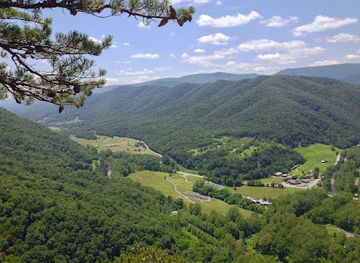
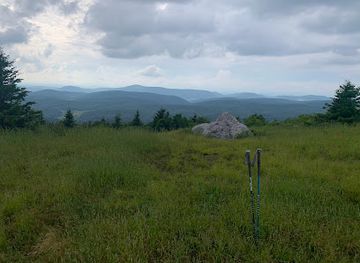
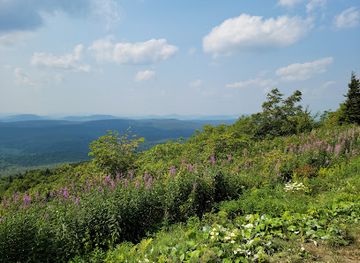
Spruce Knob is the highest point in West Virginia, rising to 4,863 feet within the Monongahela National Forest in the state’s eastern highlands. The summit lies in a cool, windswept landscape shaped by elevation, exposed slopes and dense stands of red spruce. Rather than a developed mountain resort, Spruce Knob is a forest destination reached by winding roads, with a stone observation tower, short summit walks, picnic areas and a nearby campground providing the main visitor facilities. The tower offers broad views across the Allegheny Mountains, although cloud, haze and changing weather can limit visibility.Read more about Spruce Knob
Forest, Trails and Nearby Gateways
Weather and Mountain Character
When is the best time to visit Spruce Knob?
Best: June, August–September · 23–27°C| Month | High (°C) | Rainfall (mm) |
|---|---|---|
| January | 3 | 90 |
| February | 5 | 80 |
| March | 10 | 90 |
| April | 16 | 100 |
| May | 21 | 110 |
| June (best) | 25 | 100 |
| July | 28 | 100 |
| August (best) | 27 | 90 |
| September (best) | 23 | 90 |
| October | 16 | 80 |
| November | 10 | 90 |
| December | 4 | 90 |
Getting to and around Spruce Knob
How to get there
Transportation
Best attractions in Spruce Knob
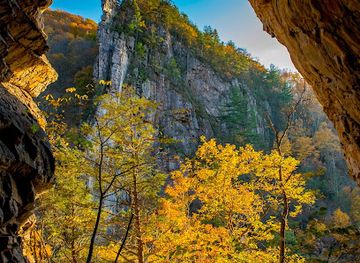
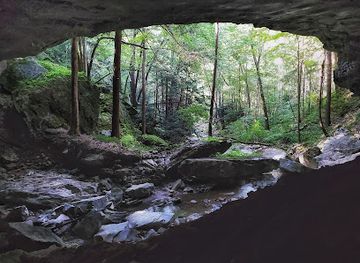
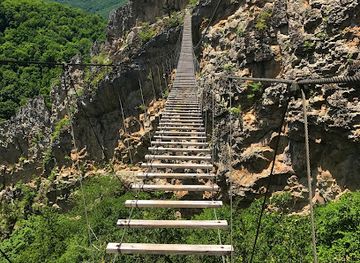
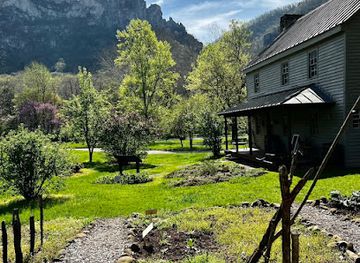
The principal attraction is the Spruce Knob summit, where a stone observation tower and surrounding clearings provide elevated views across the Allegheny Mountains when weather permits. Short trails near the summit lead through red spruce forest and open highland vegetation, offering a close look at the cool, moist environment that distinguishes the area from West Virginia’s lower valleys. Spruce Knob Lake, below the summit in the wider recreation area, provides a forest setting for fishing and quiet outdoor recreation subject to applicable regulations. The broader Spruce Knob–Seneca Rocks National Recreation Area adds considerable variety, including long forest roads, hiking routes, streams and the prominent climbing cliffs of Seneca Rocks, which are a separate destination within the same recreation area. Gateway communities such as Seneca Rocks and Franklin provide access to supplies, local history and additional outdoor opportunities, but are not part of the summit itself.
-
Hiking area
Seneca Rocks Trailhead
Explore the stunning vistas and diverse trails at Seneca Rocks Trailhead, a premier hiking destination in West Virginia's Monongahela National Forest.
-
Tourist attraction
Seneca Caverns
Discover the enchanting world of Seneca Caverns, a geological wonder in West Virginia with stunning formations and rich history.
-
Tourist information center
Seneca Rocks Discovery Center
Explore the Seneca Rocks Discovery Center for insights into the natural beauty and adventure opportunities in West Virginia's Monongahela National Forest.
-
Rock climbing
NROCKS Outdoor Adventures
Discover the thrill of rock climbing and the serenity of camping at NROCKS Outdoor Adventures in beautiful West Virginia.

Best landmarks in Spruce Knob
Spruce Knob itself is the defining natural landmark, standing at 4,863 feet as West Virginia’s highest point and forming a prominent highland within the Allegheny Mountains. The summit observation tower is the area’s principal built landmark, designed to give visitors a raised outlook over the surrounding forested ridges. The red spruce woodland around the summit is also significant, representing the cool, elevated environment that gives the destination its distinctive character. Elsewhere in the same Spruce Knob–Seneca Rocks National Recreation Area, Seneca Rocks rises as a dramatic line of exposed Tuscarora quartzite cliffs and is one of the region’s best-known geological features, though it is not at Spruce Knob. Spruce Knob Lake adds a contrasting water landmark below the summit, surrounded by forest and used for regulated recreation.
-
Park
Spruce Knob-Seneca Rocks National Recreation Area
Explore the breathtaking beauty of Spruce Knob-Seneca Rocks National Recreation Area, where adventure meets stunning natural landscapes in West Virginia.
-
Non-profit organization
Spruce Knob Mountain Center
Discover the beauty of West Virginia at Spruce Knob Mountain Center—your gateway to outdoor adventures and ecological learning.
-
Historical landmark
Sites Homestead
Experience the captivating history and stunning landscapes at Sites Homestead in Seneca Rocks, West Virginia, where the past meets natural beauty.
Explore Spruce Knob on the map
Plan your trip on one map. See where the top attractions, landmarks, restaurants and hotels are, and book hotels and experiences in a few clicks.
Best hotels in Spruce Knob
Best bars in Spruce Knob
Spruce Knob has no nightlife district, bars or nightclubs, and evenings are generally quiet once visitors leave the summit roads and forest trails. Traditional pubs, small restaurants and informal drinking places may be found in nearby communities such as Seneca Rocks or Franklin, but opening patterns and entertainment options reflect a rural area rather than a resort. Evening activity is more likely to centre on conversation, local hospitality, stargazing, campfires where authorised and the darkness of the Monongahela highlands. Visitors should not assume that remote campsites provide organised entertainment or that every gateway business remains open late. Seasonal community events and occasional local music may occur in the wider region, but schedules should be checked locally rather than taken for granted.
-
Scenic spot
Spruce Knob
Discover the breathtaking heights of Spruce Knob, West Virginia's highest peak, with stunning views, hiking trails, and serene nature escapes.
Best shops in Spruce Knob
Shopping at Spruce Knob is limited to the practical needs of visitors, with no concentrated retail centre at the summit. Food, fuel, camping supplies and basic provisions are more reliably obtained in gateway communities such as Franklin, Riverton and Seneca Rocks before entering the mountain roads. Independent shops and small businesses in the wider region may offer locally made crafts, artwork, Appalachian-themed goods, books, outdoor equipment and regional food products, although selection and opening patterns vary. Farm stands and producers can be found along some rural routes, but they are not a substitute for a planned supply stop. Visitors interested in genuine regional purchases should look for locally produced food, handmade work and community businesses rather than expecting designer retail or a permanent market associated with the summit.
-
 Gift shop
Seneca Caverns
Discover the stunning geological formations at Seneca Caverns, a unique blend of adventure, education, and local charm in West Virginia.
-
Mountain peak
Spruce Knob
Discover breathtaking views and serene nature at Spruce Knob, West Virginia's highest peak and a hiker's paradise.
-
Grocery store
T&K Markets
Explore the charm of T&K Markets, a local grocery store in Franklin, WV, offering fresh produce, local snacks, and friendly service.
-
Grocery store
Yokum's Store and Grill
Discover the perfect blend of shopping and dining at Yokum's Store and Grill in the stunning Seneca Rocks, West Virginia.
Get your free copy of our complete guide to Spruce Knob, delivered straight to you.
Everything on this page, from attractions and restaurants to essentials and local phrases, in one PDF you can read offline, print or share.
Already have an account? Sign in
Your Spruce Knob guide is ready.
We'll send it to · Not you? Sign out

Getting your guide ready…
We are putting together a fresh copy of the Spruce Knob guide. This can take up to a minute.
This can take a few moments. If your browser asks, choose Allow so the download can start. You'll find the guide in your Downloads folder.
Nothing happened? Download it again
Sorry, the guide is taking longer than usual. Please try again in a minute, or get it by email instead.
Spruce Knob essentials
Currency and Payment
Safety
Emergency Situations
Do's and Don'ts
Local Tips
From Eve
Local phrases worth knowing
You don't need to get them perfect. A few words go a long way, and locals appreciate the effort.
Basics
| English | Local | Say it |
|---|---|---|
| Hello | Howdy | [hah-dee] |
| Goodbye | See ya later | [see yuh lay-tur] |
| Yes | Yup | [yuhp] |
| No | Nah | [nah] |
| Please/You're welcome | Please/No problem | [pleez/no prob-lem] |
| Thank you | Thanks a bunch | [thanks uh bunch] |
| Excuse me/Sorry | Pardon me/My bad | [par-dun me/my bad] |
| How are you? | How y'all doin'? | [how y'all doin'] |
| Fine. And you? | Just fine. How 'bout you? | [just fine. how 'bout yuh] |
| Do you speak English? | Y'all speak English? | [y'all speak ing-glish] |
| I don't understand | I ain't catchin' on | [I ain't catch-in' on] |
Eating & Drinking
| English | Local | Say it |
|---|---|---|
| I'd like to see the menu, please | Can I take a gander at the menu? | [can I take a gan-der at the menu] |
| I don't eat meat | I don't eat critters | [I don't eat crit-ters] |
| Cheers! | Bottoms up! | [bot-tums up] |
| I would like to pay, please | I reckon it's time to settle up | [I reckon it's time to set-tle up] |
Emergencies
| English | Local | Say it |
|---|---|---|
| Help! | SOS! | [S-O-S] |
| Go away! | Git! | [git] |
| Call the Police! | Ring up the Sheriff! | [ring up the sher-riff] |
| Call a doctor! | Get the doc on the horn! | [get the doc on the horn] |
| I'm lost | I'm turned around | [I'm turned around] |
| I'm ill | I'm feelin' poorly | [I'm feelin' poor-ly] |
Shopping
| English | Local | Say it |
|---|---|---|
| I'd like to buy... | I'm fixin' to purchase... | [I'm fix-in' to pur-chase] |
| I'm just looking | Just browsin' | [just brow-sin'] |
| How much is it? | What's the damage? | [what's the dam-age] |
| That's too expensive | That's mighty steep | [that's mighty steep] |
| Can you lower the price? | Can ya do better on the price? | [can yuh do bet-ter on the price] |
Time & Numbers
| English | Local | Say it |
|---|---|---|
| What time is it? | What's the hour? | [what's the hour] |
| It's one o'clock | It's one of the clock | [it's one of the clock] |
| Half past (10) | Half past ten | [half past ten] |
| Morning | Mornin' | [mornin'] |
| Afternoon | Afternoon | [after-noon] |
| Evening | Evenin' | [evenin'] |
| Yesterday | Yest'day | [yest'day] |
| Today | Today | [to-day] |
| Tomorrow | Mornin' | [mornin'] |
| 1 | One | [wun] |
| 2 | Two | [too] |
| 3 | Three | [three] |
| 4 | Four | [four] |
| 5 | Five | [five] |
| 6 | Six | [six] |
| 7 | Seven | [seven] |
| 8 | Eight | [eight] |
| 9 | Nine | [nine] |
| 10 | Ten | [ten] |
Transport & Directions
| English | Local | Say it |
|---|---|---|
| Where's a/the...? | Where's the... | [where's the...] |
| What's the address? | What's the street? | [what's the street] |
| Can you show me (on the map)? | Can you point it out (on the map)? | [can you point it out (on the map)] |
| When's the next (bus)? | When's the next bus comin'? | [when's the next bus comin'] |
| A ticket (to ....) | A pass (to ....) | [a pass (to ....)] |
History of Spruce Knob
Allegheny Mountain Formation
Spruce Knob forms part of the Allegheny Mountains, a long Appalachian highland system shaped by ancient sedimentary rocks, uplift and prolonged erosion. The summit is not a volcanic peak; its elevated profile reflects the resistant upland terrain and deeply dissected valleys characteristic of eastern West Virginia. Cool, moist conditions at this height helped support red spruce and other northern forest communities that are less common in the lower surrounding landscape.
Indigenous Homelands and Mountain Routes
The mountains and valleys around Spruce Knob were used and travelled by Indigenous peoples long before the arrival of European settlers. The wider region lies within the historic cultural geography of peoples including the Shawnee and Seneca, although modern place names and later county boundaries do not represent the full complexity of earlier territories. Streams, ridgelines and passes provided routes through a difficult landscape, while the high summit itself remained a forested upland rather than a permanent urban settlement.
Settlement, Farming and Timber
European-American settlement expanded through the surrounding mountain valleys from the eighteenth and nineteenth centuries, with communities developing along streams, roads and more workable lowland areas. Small farms, hunting, milling and timber extraction became important elements of local life. During the late nineteenth and early twentieth centuries, extensive logging altered many parts of the Allegheny highlands, including forests in the wider region around Spruce Knob. The effects of timber use, fires and regeneration remain part of the landscape’s environmental history.
The Monongahela National Forest
The Monongahela National Forest was established in 1920, bringing much of the surrounding highland landscape into a system of managed public forest. Federal ownership supported reforestation, watershed protection, recreation and more structured stewardship after the intensive timber era. Roads, trails and visitor facilities gradually made remote mountain areas more accessible, while forest management continued to balance timber production, habitat protection, scenic character and public enjoyment.
Recreation and Conservation
Spruce Knob became increasingly recognised as a destination for high-elevation recreation because of its summit views, cool spruce woodland and distinctive mountain climate. The Spruce Knob–Seneca Rocks National Recreation Area was established in 1965, linking the summit landscape with the dramatic cliffs and forests around Seneca Rocks under a shared recreation identity. Today, the area’s character is shaped by public-land conservation, outdoor recreation and the protection of forest, water and wildlife habitats rather than by intensive development.
Spruce Knob in Photos
Browse through our photo collection highlighting the charm and character of the destination.
Neighbouring destination travel guides
The closest destinations to Spruce Knob, if you have time for more than one.
-

-

-

-

-


Swipe for more destinations
Explore more

Explore more of Allegheny Highlands
Explore West Virginia's Allegheny Highlands for cool mountain valleys, ancient forests, historic railways, outdoor recreation and Appalachian culture.
Explore Allegheny Highlands
Explore more of West Virginia
Discover West Virginia's natural beauty, historic charm, and outdoor adventures in the heart of the Appalachian Mountains.
Explore West Virginia