

Free Harper's Ferry Travel Guide & Mobile App
Plan your Harper's Ferry trip with Evendo. Get free guides to top attractions, restaurants, hotels, and bars. Web access or download the mobile app.


Harper's Ferry, West Virginia, blends Civil War history, riverside trails, Appalachian scenery and historic streets in a compact National Historical Park.
At the Confluence
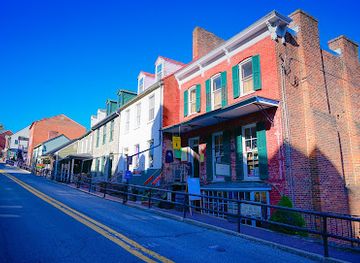
Harpers Ferry occupies a dramatic point at the meeting of the Potomac and Shenandoah rivers in the eastern panhandle of West Virginia. Steep, wooded ridges rise around a compact historic settlement, giving the town an unusual sense of enclosure and making even a short walk feel connected to the surrounding landscape. The Lower Town, preserved within Harpers Ferry National Historical Park, is lined with stone buildings, narrow lanes and restored structures associated with the federal armoury, the Civil War and the town's changing fortunes.Read more about Harper's Ferry
History in the Landscape
A Small Town for Slow Exploration
When is the best time to visit Harper's Ferry?
Best: May–June, September · 24–28°C| Month | High (°C) | Rainfall (mm) |
|---|---|---|
| January | 3 | 67 |
| February | 5 | 61 |
| March | 11 | 79 |
| April | 18 | 82 |
| May (best) | 24 | 91 |
| June (best) | 28 | 94 |
| July | 31 | 101 |
| August | 29 | 96 |
| September (best) | 25 | 91 |
| October | 18 | 77 |
| November | 11 | 80 |
| December | 4 | 78 |
Getting to and around Harper's Ferry
How to get there
Transportation
Best attractions in Harper's Ferry
Harpers Ferry National Historical Park is the town's principal visitor attraction, combining preserved streets, museum exhibits and historic buildings with a wooded river landscape. In Lower Town, the John Brown Museum explains the 1859 raid, while the fort-like remains of the federal armoury reveal the industrial importance of the site. The small collection of historic lanes and reconstructed workshops is rewarding to explore slowly, with interpreters and park exhibits adding context to the buildings. Beyond the settlement, the Appalachian Trail passes through Harpers Ferry and provides access to the Appalachian Trail Conservancy's headquarters and long-distance walking culture. Maryland Heights offers a demanding climb with celebrated views across the Potomac, Shenandoah and rooftops below; Loudoun Heights provides another perspective from the opposite side of the river. Riverbanks, bridges and wooded paths create quieter opportunities for photography and walking, while seasonal water-based recreation is available in the surrounding Potomac Valley.
-
Tourist attraction
John Brown's Fort
Explore the rich history of John Brown's Fort in Harpers Ferry, a significant historical landmark that showcases America's journey through the Civil War.
13 min walk · 1.1 km from city centre
-
Hiking area
Maryland Heights Trailhead
Experience breathtaking views and rich history at Maryland Heights Trailhead, a premier hiking area in the Appalachian Mountains.
12 min walk · 1.0 km from city centre
-
Tourist attraction
Ghost Tour of Harpers Ferry
Explore the haunted streets of Harpers Ferry on a chilling ghost tour, uncovering the town's rich history and spooky legends under the moonlight.
12 min walk · 0.9 km from city centre
-
Tourist attraction
Ruins of St. John's Episcopal Church
Discover the haunting beauty of St. John's Episcopal Church ruins, a historical gem in Harpers Ferry, West Virginia, steeped in rich heritage and natural splendor.
11 min walk · 0.8 km from city centre


Best landmarks in Harper's Ferry
The John Brown Fort is Harpers Ferry's most recognisable historic structure, a small armoured fire-engine house associated with the abolitionist's 1859 raid and later moved and reconstructed as the building became a national symbol. The ruins and surviving features of the United States Armory and Arsenal mark the town's earlier role in federal arms manufacture, while the Engine House area connects industrial history with the national debate over slavery. Storer College buildings and grounds represent the post-Civil War expansion of African American education, adding an important Reconstruction-era layer to the town's story. The confluence of the Potomac and Shenandoah rivers is itself a defining geographical landmark, framed by Maryland Heights and Loudoun Heights. Historic Lower Town, with its steep lanes, stone structures and preserved façades, forms a coherent architectural landscape rather than a single monumental building.
-
Historical landmark
John Brown's Fort
Explore John Brown's Fort, a historical landmark in Harpers Ferry that encapsulates the spirit of American history and stunning natural beauty.
13 min walk · 1.1 km from city centre
-
Historical landmark
Jefferson Rock
Experience the breathtaking views and rich history at Jefferson Rock, a cherished landmark in Harpers Ferry, West Virginia.
10 min walk · 0.8 km from city centre
-
Ghost town
Ghost Tour of Harpers Ferry
Discover Harpers Ferry's ghostly past through spine-tingling tales and haunting legends on a captivating night tour.
12 min walk · 0.9 km from city centre
-
Wax museum
John Brown Wax Museum
Explore the John Brown Wax Museum in Harpers Ferry, where history comes to life through lifelike exhibits depicting America's past.
11 min walk · 0.9 km from city centre


Explore Harper's Ferry on the map
Plan your Harper's Ferry trip on one map. See where the top attractions, landmarks, restaurants, bars and hotels are, find what's near where you're staying, and book hotels and experiences in a few clicks.
Best hotels in Harper's Ferry
Best restaurants in Harper's Ferry
Harpers Ferry's dining scene is small and closely tied to the historic Lower Town, where cafés, casual restaurants, taverns and sweet shops serve visitors between museum visits and trail walks. Menus commonly draw on familiar American and Appalachian influences, with hearty breakfasts, sandwiches, soups, burgers, baked goods and regional comfort food more prominent than elaborate fine dining. West Virginia specialities such as pepperoni rolls may appear in local or nearby eateries, although availability varies. Independent establishments occupy historic buildings, giving meals an atmosphere shaped as much by the setting as by the food. The surrounding eastern panhandle also supports farm markets and locally produced goods, while nearby towns broaden the choice of restaurants. Visitors staying overnight should expect relaxed, limited-town dining rather than a late-night culinary district, and should check individual businesses for current schedules.
-
Restaurant
The Rabbit Hole
Discover delightful flavors at The Rabbit Hole in Harpers Ferry - where local ingredients meet culinary artistry in a cozy atmosphere.
11 min walk · 0.9 km from city centre
-
Vegan
Kelley Farm Kitchen
Discover Kelley Farm Kitchen in Bolivar: A delightful vegan restaurant offering mouthwatering burgers, desserts, and ice cream made from fresh local ingredients.
5 min walk · 0.4 km from city centre
-
American
Country Café
Discover the heart of American cuisine at Country Café in Harpers Ferry – where delicious meals meet warm hospitality.
16 min walk · 1.3 km from city centre
-
Grill
Coach House Bar & Grill
Experience delightful American cuisine in the heart of Harpers Ferry at Coach House Bar & Grill, where flavor meets history.
11 min walk · 0.9 km from city centre


Best bars in Harper's Ferry
Harpers Ferry has a quiet evening scene rather than a concentrated nightclub culture. Historic Lower Town includes taverns, pub-style restaurants and places for a drink after a day of walking, with the atmosphere generally more suited to conversation than late-night dancing. Some accommodation properties and restaurants operate in restored buildings, creating atmospheric settings for an early evening meal or drink, while nearby Charles Town and Shepherdstown provide additional bars, live music and cultural programming in the wider region. Night-time activity is also shaped by the landscape: river views, dark wooded hills and quiet historic streets become part of the experience once daytime visitors leave. Opening days and evening service can vary, particularly outside peak seasons, so nightlife is best approached as a modest extension of the town's heritage and outdoor character rather than as a major entertainment district.
-
Restaurant
The Rabbit Hole
Experience a unique culinary journey at The Rabbit Hole, a charming restaurant in Harpers Ferry, where local flavors meet innovative cuisine.
11 min walk · 0.9 km from city centre
-
American
Country Café
Experience the charm of American dining at Country Café in Harpers Ferry, a cozy spot for delicious meals and local hospitality.
16 min walk · 1.3 km from city centre
-
Cafe
Battle Grounds Bakery & Coffee
Discover the perfect blend of comfort and flavor at Battle Grounds Bakery & Coffee in Harpers Ferry, where every sip and bite tells a story.
11 min walk · 0.9 km from city centre
-
Inn
The Town's Inn
Experience the charm and history of Harpers Ferry at The Town's Inn, your cozy retreat in a historic town by the rivers.
11 min walk · 0.8 km from city centre


Best nightclubs in Harper's Ferry
Harpers Ferry has a quiet evening scene rather than a concentrated nightclub culture. Historic Lower Town includes taverns, pub-style restaurants and places for a drink after a day of walking, with the atmosphere generally more suited to conversation than late-night dancing. Some accommodation properties and restaurants operate in restored buildings, creating atmospheric settings for an early evening meal or drink, while nearby Charles Town and Shepherdstown provide additional bars, live music and cultural programming in the wider region. Night-time activity is also shaped by the landscape: river views, dark wooded hills and quiet historic streets become part of the experience once daytime visitors leave. Opening days and evening service can vary, particularly outside peak seasons, so nightlife is best approached as a modest extension of the town's heritage and outdoor character rather than as a major entertainment district.
-
Grill
Coach House Bar & Grill
Discover the flavors of Harpers Ferry at Coach House Bar & Grill, where classic American cuisine meets a charming atmosphere.
11 min walk · 0.9 km from city centre
-
Grill
Almost Heaven Pub and Grill
Experience the warm hospitality and delicious grilled delights at Almost Heaven Pub and Grill in Harpers Ferry, a must-visit for every traveler.
11 min walk · 0.9 km from city centre
-
Bar
The Barn of Harpers Ferry
Experience the charm of The Barn of Harpers Ferry, a vibrant event venue and bar celebrating community spirit in scenic West Virginia.
6 min walk · 0.4 km from city centre
-
Night club
Charmadoah
Immerse yourself in the vibrant nightlife at Charmadoah, an elegant night club in Harpers Ferry, West Virginia, offering music, dancing, and unforgettable experiences.
3 min walk · 0.3 km from city centre


Best shops in Harper's Ferry
Shopping in Harpers Ferry centres on the compact Lower Town, where independent shops occupy historic buildings and cater largely to visitors exploring the national park. Bookshops and specialist retailers reflect the town's Civil War, abolition and Appalachian associations, while galleries and craft shops offer locally made art, jewellery, pottery, textiles and small gifts. Antique-style goods, maps, prints and historical reproductions are more characteristic here than large-scale fashion retail. Food shops and bakeries provide regional treats and provisions for walkers, and nearby farm markets can add local produce when operating. The shopping area is deliberately small and walkable, with the historic setting forming part of the experience. Visitors looking for supermarkets, broader everyday retail or larger commercial centres will find more choice in nearby communities rather than in Harpers Ferry itself.
-
Candy store
True Treats Historic Candy
Explore True Treats Historic Candy in Harpers Ferry for a delightful journey through vintage sweets and artisanal confections.
12 min walk · 0.9 km from city centre
-
Gift shop
Tenfold Fair Trade Collection
Explore the essence of fair trade at Tenfold Fair Trade Collection, offering unique gifts that support global artisans and sustainable practices.
11 min walk · 0.9 km from city centre
-
Book store
Bookshop
Explore the Harpers Ferry Bookshop: A literary gem in a historic town, offering a unique blend of books, gifts, and local charm.
12 min walk · 0.9 km from city centre
-
Outdoor clothing and equipment shop
Harpers Ferry Outfitters Hike & Bike Supplies
Discover Harpers Ferry Outfitters for top-notch outdoor gear and expert advice, your perfect partner for exploring West Virginia's beautiful trails and landscapes.
11 min walk · 0.9 km from city centre


Get your free copy of our complete guide to Harper's Ferry, delivered straight to you.
Everything on this page, from attractions and restaurants to essentials and local phrases, in one PDF you can read offline, print or share.
Already have an account? Sign in
Your Harper's Ferry guide is ready.
We'll send it to · Not you? Sign out

Getting your guide ready…
We are putting together a fresh copy of the Harper's Ferry guide. This can take up to a minute.
This can take a few moments. If your browser asks, choose Allow so the download can start. You'll find the guide in your Downloads folder.
Nothing happened? Download it again
Sorry, the guide is taking longer than usual. Please try again in a minute, or get it by email instead.
Harper's Ferry essentials
Currency and Payment
Safety
Emergency Situations
Do's and Don'ts
Local Tips
From Eve
Local phrases worth knowing
You don't need to get them perfect. A few words go a long way, and locals appreciate the effort.
Basics
| English | Local | Say it |
|---|---|---|
| Hello | Howdy | [haw-dee] |
| Goodbye | So long | [soh lawng] |
| Yes | Yup | [yuhp] |
| No | Nah | [nah] |
| Please/You're welcome | Please/You're welcome | [pleez/yur wel-kuhm] |
| Thank you | Thank you | [thank yoo] |
| Excuse me/Sorry | Pardon me | [pahr-dn mee] |
| How are you? | How ya doin'? | [haw yuh doo-in] |
| Fine. And you? | Fine. And you? | [fahyn. and yoo?] |
| Do you speak English? | You speak English? | [yoo speek ing-glish?] |
| I don't understand | I don't get ya | [eye dohnt get yuh] |
Eating & Drinking
| English | Local | Say it |
|---|---|---|
| I'd like to see the menu, please | Can I see the menu, please | [kan eye see the men-yoo pleez] |
| I don't eat meat | I don't eat meat | [eye dohnt eet meet] |
| Cheers! | Cheers! | [cheers] |
| I would like to pay, please | Can I pay now, please | [kan eye pay now pleez] |
Emergencies
| English | Local | Say it |
|---|---|---|
| Help! | Help! | [help] |
| Go away! | Git outta here! | [git out-uh heer] |
| Call the Police! | Call the cops! | [call the cops] |
| Call a doctor! | Get a doc! | [get a doc] |
| I'm lost | I'm lost | [eye'm lost] |
| I'm ill | I'm sick | [eye'm sik] |
Shopping
| English | Local | Say it |
|---|---|---|
| I'd like to buy... | I wanna buy... | [eye wah-nuh buy] |
| I'm just looking | I'm just lookin' | [eye'm just look-in] |
| How much is it? | How much does it cost? | [haw much duhz it cost?] |
| That's too expensive | That's too pricey | [thats too prahy-see] |
| Can you lower the price? | Can ya bring the price down? | [kan yuh bring the prahys down] |
Time & Numbers
| English | Local | Say it |
|---|---|---|
| What time is it? | What time is it? | [what time iz it] |
| It's one o'clock | It's one o'clock | [its wun oh-klok] |
| Half past (10) | Half past ten | [haf past ten] |
| Morning | Morning | [morn-in] |
| Afternoon | Afternoon | [after-noon] |
| Evening | Evenin' | [even-in] |
| Yesterday | Yesterday | [yest-er-day] |
| Today | Today | [tuh-day] |
| Tomorrow | Tomorrow | [toh-mor-row] |
| 1 | One | [wun] |
| 2 | Two | [too] |
| 3 | Three | [three] |
| 4 | Four | [fawr] |
| 5 | Five | [fahyv] |
| 6 | Six | [siks] |
| 7 | Seven | [sev-en] |
| 8 | Eight | [ayt] |
| 9 | Nine | [nine] |
| 10 | Ten | [ten] |
Transport & Directions
| English | Local | Say it |
|---|---|---|
| Where's a/the...? | Where's the...? | [wheres the] |
| What's the address? | What's the address? | [whats the ad-dress] |
| Can you show me (on the map)? | Can you show me (on the map)? | [kan yuh show mee on the map] |
| When's the next (bus)? | When's the next (bus)? | [whens the next bus] |
| A ticket (to ....) | A ticket (to ....) | [uh tik-it to] |
History of Harper's Ferry
River Settlement and Robert Harper
The settlement grew around the riverside ferry established by Robert Harper in the eighteenth century. Harper acquired land in the area in the 1740s and operated a crossing where the Shenandoah meets the Potomac, a natural junction between the Shenandoah Valley and routes towards Maryland and Virginia. The waterways, steep ridges and nearby passes shaped the community's future, making it useful for movement, trade and industry. In 1763 the Virginia General Assembly chartered the town as Shenandoah Falls at Mr Harper's Ferry, although the shorter name Harpers Ferry became established. The landscape that attracted the ferry operator later drew government industry and military attention.
The Federal Armoury and Industrial Growth
The United States established a federal armoury and arsenal at Harpers Ferry in 1799, beginning a period of industrial expansion that transformed the riverside settlement. The armoury manufactured firearms, including rifles, and used the Potomac and Shenandoah to power machinery. In 1803 the United States Armory began production, and the site became an important centre of federal manufacturing. John H. Hall developed innovative methods of producing interchangeable gun parts there during the early nineteenth century, an important step in American industrial history. The armoury buildings and associated landscape later became central to the town's historical interpretation, even though much of the complex was destroyed during wartime.
John Brown's 1859 Raid
On the night of 16 October 1859, the abolitionist John Brown and a small group of followers seized the federal armoury at Harpers Ferry. Brown intended to secure weapons and encourage an uprising against slavery, but local militia and United States Marines led by Lieutenant Colonel Robert E. Lee surrounded the raiders. Brown was captured in the armoury's fire-engine house, now one of the town's best-known historic structures, and was later tried and executed in nearby Charles Town. The raid failed militarily, yet its national political impact was profound: it intensified conflict over slavery and became one of the crises preceding the American Civil War.
Civil War Occupation and Destruction
Harpers Ferry's position at the meeting of major waterways and transport routes made it strategically important during the Civil War. The town changed hands repeatedly, and soldiers used the surrounding heights, bridges and roads to control movement through the Potomac Valley. In September 1862, Confederate forces under Stonewall Jackson captured the Union garrison at Harpers Ferry, one of the largest United States surrenders of the war. Military activity damaged the industrial works and much of the town. The conflict also altered the population and economy, leaving a landscape of ruined structures, rebuilt streets and enduring associations with wartime memory.
Education, Preservation and the National Park
After the war, Harpers Ferry became an important centre of African American education through Storer College, founded in 1867 with support from the Freewill Baptist Church. The college educated students until it closed in 1955, and its history reflects the wider struggle for education and citizenship during Reconstruction and afterwards. Preservation efforts gathered pace in the twentieth century, and Harpers Ferry National Historical Park was established in 1944. The National Park Service has since restored and interpreted parts of Lower Town, the armoury area and associated historic sites. Today, the town's identity rests on the combined stories of industry, abolition, war, African American education and landscape.
Harper's Ferry in Photos
Browse through our photo collection highlighting the charm and character of the destination.
Cities near Harper's Ferry
The closest cities to Harper's Ferry, if you have time for more than one stop.
-
-

-

-

-


Swipe for more cities
Explore more

Explore more of West Virginia
Discover West Virginia's natural beauty, historic charm, and outdoor adventures in the heart of the Appalachian Mountains.
Explore West Virginia